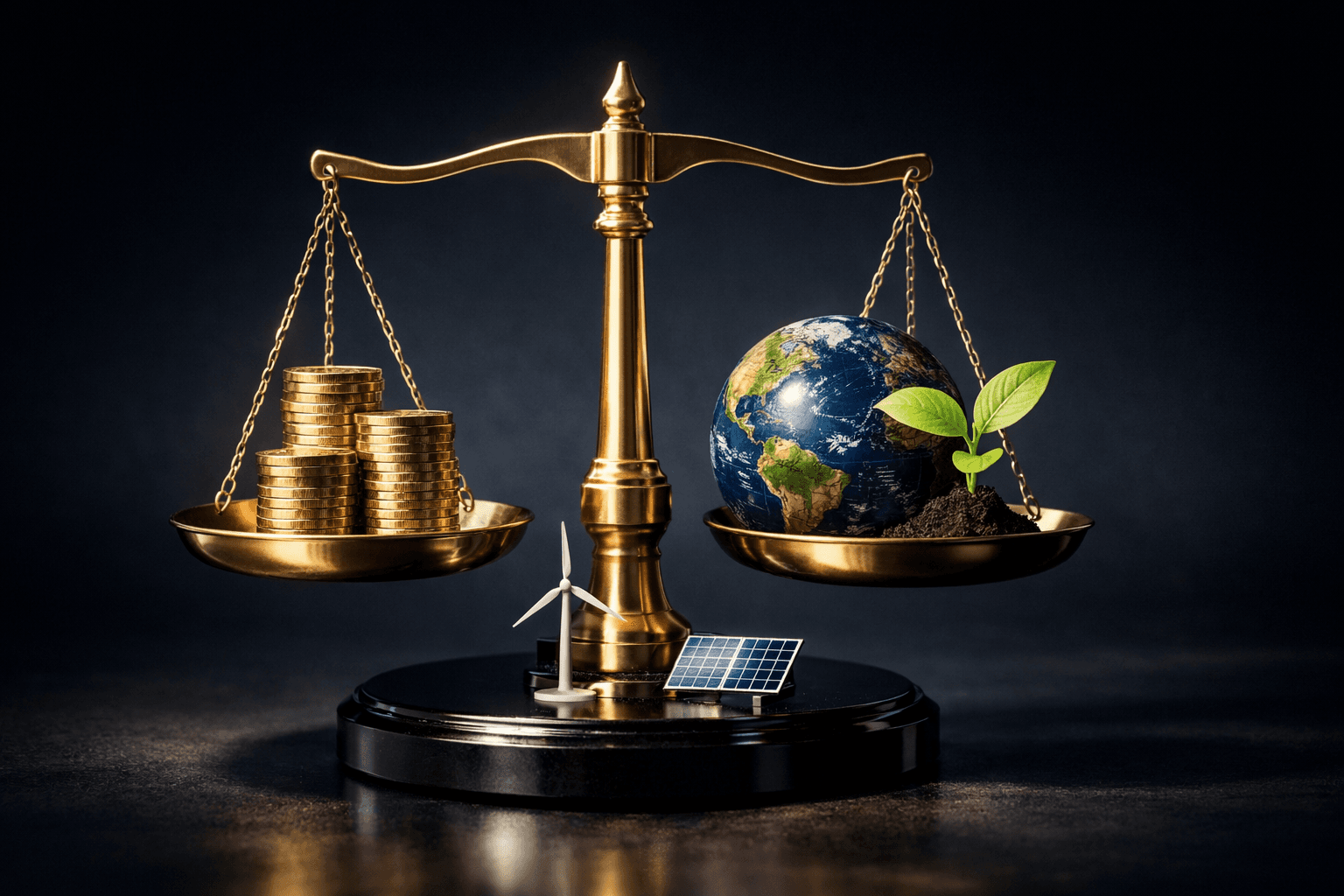
- ESG stands for Environmental, Social, and Governance, and it's a framework for evaluating a company's nonfinancial impacts and risks.
- You can invest with ESG goals using exclusion screens, positive screening, integration, thematic funds, or impact investing strategies.
- ESG ratings and fund labels vary, so check methodology, holdings, and fees to avoid greenwashing.
- ESG can affect long term risk and return, but it's not a guarantee of outperformance or lower risk in every case.
- Practical steps: decide your goals, choose an approach, compare ETFs or mutual funds by holdings and fees, and consider shareholder engagement.
Introduction
ESG investing uses Environmental, Social, and Governance criteria to evaluate companies beyond traditional financial metrics. It helps investors align their portfolios with personal values, such as climate action, labor standards, or strong corporate governance.
Why does this matter to you as an investor? ESG factors can influence long term business performance by creating risks or opportunities that conventional analysis may miss. Do you want your investments to reflect your values, or to reduce exposure to certain risks? Those are common reasons people explore ESG strategies.
In this guide you'll learn what ESG means, the main ways to build an ESG portfolio, how to read ESG funds and ratings, potential benefits and tradeoffs, and practical steps to get started. You can expect clear examples and simple checklists you can use right away.
What ESG Means: The Basics
ESG breaks into three areas. Environmental covers climate impact, carbon emissions, water use, and resource efficiency. Social includes labor practices, human rights, product safety, and community relations. Governance looks at board structure, executive pay, accounting practices, and shareholder rights.
ESG is a lens used by investors and fund managers. It is not a single measure. Different firms and rating providers use different metrics and weights. That means a company may score well with one provider and poorly with another.
Common ESG approaches
- Negative screening, which excludes industries such as fossil fuels, tobacco, or weapons.
- Positive screening, which selects companies with strong ESG performance within an industry.
- ESG integration, where ESG factors are folded into traditional financial analysis to manage risk and find opportunities.
- Thematic investing, which targets themes like clean energy or gender diversity.
- Impact investing, which aims for measurable social or environmental outcomes alongside financial returns.
How Investors Put ESG into Practice
There are many practical paths to building an ESG allocation. Your choice depends on how strict you want the ESG criteria to be and whether you're focused on returns, values, or measurable impact. You can use individual stocks, ETFs, or mutual funds.
Using ETFs and mutual funds
Exchange traded funds and mutual funds make ESG investing accessible for beginners. Funds bundle many companies and often follow a clear strategy, such as excluding coal or investing only in low-carbon companies. Examples include broad ESG ETFs and more focused clean energy funds.
Look at an ETF's holdings, methodology, and fees before you invest. For example, an ESG US stock ETF like $ESGV tracks companies screened for ESG considerations. Another ESG option is $SUSA which uses a different MSCI-based selection process. Comparing two ETFs can show how methodologies produce different portfolios.
Picking individual stocks
If you choose individual companies, start by checking ESG reports and third-party ratings. Companies like $AAPL publish sustainability reports that cover emissions and supply chain efforts. Some companies like $TSLA attract attention for environmental innovation but raise questions about governance or labor practices.
Buying single stocks requires more research. Make a checklist that includes ESG disclosures, recent controversies, and long term plans. Remember that diversification matters. Relying on a few stocks can increase risk.
Understanding ESG Ratings and Labels
ESG ratings are produced by firms such as MSCI, Sustainalytics, and Refinitiv. Each provider uses its own data sources and scoring rules. That leads to differences in scores and sometimes confusion for investors.
Key things to check
- Methodology: How does the provider weight environmental, social, and governance factors?
- Data sources: Are scores based on company disclosures, news, lawsuits, and supplier data?
- Coverage: Does the provider cover the companies and markets relevant to you?
- Fund transparency: Does the ETF or mutual fund publish its holdings and screening rules?
Ratings are useful as a starting point, but you should dig into the underlying criteria. A high ESG score does not always mean low risk, and a low score may reflect controversy that is being addressed.
Potential Benefits and Tradeoffs of ESG Investing
Many investors pursue ESG investing for both values and financial reasons. Studies show mixed results on performance. Some analyses find ESG strategies match or beat market returns over long periods, while others show no consistent outperformance.
ESG can reduce certain risks by excluding companies with high regulatory or reputational exposure. It can also unlock opportunities, such as investing early in companies transitioning to cleaner technologies. At the end of the day, ESG is another way to manage risk and express preferences, not a guarantee of higher returns.
Practical tradeoffs to consider
- Concentration risk, when ESG funds weight certain sectors differently than broad market indexes.
- Higher fees, since some ESG funds use active management or costly data to score companies.
- Greenwashing, where marketing overstates the sustainability of a fund or firm.
- Performance variability, as ESG screens can exclude high-performing companies or include companies that later underperform.
Real-World Examples and Scenarios
Here are practical examples that show how ESG choices play out with real numbers. These are simplified to make the concepts clear.
Example 1: Exclusion versus integration
Imagine you have $10,000 to invest. Option A is a conventional S&P 500 ETF. Option B is an ESG S&P 500 ETF that excludes oil and gas companies. Over a five year period the ESG ETF may avoid a sector downturn tied to oil prices, or it may miss gains if energy stocks rally. Your return will reflect both market moves and the sectors you exclude, so think about volatility and diversification.
Example 2: Thematic investment in clean energy
Suppose you choose a clean energy thematic ETF that holds 50 companies focused on wind and solar. If those technologies accelerate and revenues grow, the thematic ETF could outperform. If policy changes or technology setbacks occur, the ETF could be more volatile than a broad market fund. That means decide if you can tolerate higher ups and downs for a targeted theme.
Example 3: Shareholder engagement
Owning shares in a large company can allow you to support shareholder proposals. Institutional investors often file proposals about climate targets or board diversity. Even small individual investors can collaborate through stewardship groups to influence company policy over time.
Common Mistakes to Avoid
- Assuming all ESG funds are the same. Check holdings, methodology, and fees to see real differences.
- Relying solely on ESG ratings. Use ratings as a starting point and read fund disclosures and company sustainability reports.
- Ignoring diversification. Excluding whole sectors can create unintended concentration in others.
- Confusing values with impact. A fund that screens out certain companies may not achieve measurable social or environmental outcomes.
- Overlooking fees. Higher active management fees can erode long term returns, so compare expense ratios.
FAQ
Q: What is the difference between ESG and socially responsible investing?
A: ESG refers to Environmental, Social, and Governance criteria used to assess risks and opportunities. Socially responsible investing often includes ESG but typically emphasizes ethical exclusions such as no tobacco or weapons. The terms overlap but are not identical.
Q: Do ESG funds sacrifice returns for ethics?
A: Not necessarily. Studies show mixed results. ESG can reduce some risks and capture growth opportunities, but it can also exclude high-performing companies. Evaluate funds by performance, fees, and methodology rather than assuming returns will be lower.
Q: How do I avoid greenwashing when choosing an ESG fund?
A: Read the fund's prospectus and methodology, check actual holdings, compare ESG ratings across providers, and look for third-party verification. Funds that clearly publish screening rules and measurable goals are generally a safer bet.
Q: Can small investors influence company behavior through ESG?
A: Yes. Small investors can support shareholder proposals, vote proxy ballots, and participate in investor coalitions. While a single investor has limited power, collective action and long term ownership can influence company policies.
Bottom Line
ESG investing gives you tools to align your portfolio with values while considering nonfinancial risks that affect long term performance. You can choose from exclusionary screens, positive selection, ESG integration, thematic funds, or impact investing depending on your goals.
Start by defining what matters most to you, review fund methodologies and holdings, and watch out for greenwashing and fees. Whether you're focused on climate, social justice, or corporate governance, ESG strategies let you invest with intention while keeping diversification and costs in mind.
Next steps you can take today: list your top ESG priorities, compare two or three ESG funds by holdings and expense ratios, and consider a small allocation to test how ESG fits your overall plan. If you want to learn more, track ESG reports and join investor stewardship groups to engage with companies over time.