Introduction
Investing 101: Stock Market Basics for Beginners explains the core ideas new investors need to understand how the stock market works. You will learn what stocks and bonds are, why prices move, and how simple choices can shape long-term results.
This matters because investing helps your savings grow faster than a bank account over time, and it gives you options for reaching financial goals like retirement or buying a home. This guide uses plain language and real examples to make the concepts easy to grasp.
What you'll learn: basic market mechanics, the main investment types, simple strategies for beginners, how to manage risk, common mistakes to avoid, and practical examples using well-known tickers like $AAPL and $VTI.
Key Takeaways
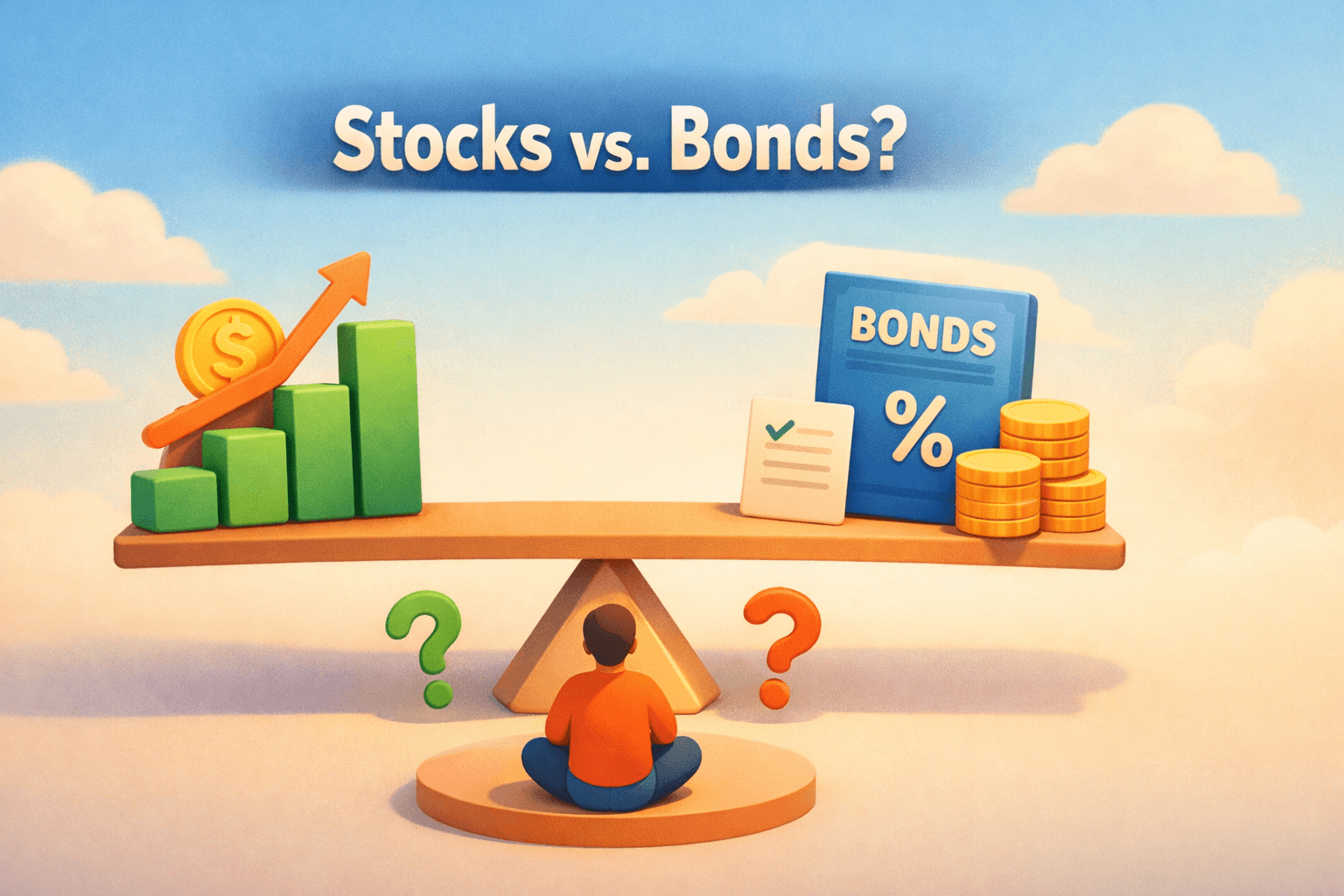
- Stocks represent ownership in a company; bonds are loans you make to issuers in exchange for interest.
- Diversification, spreading money across many investments, reduces risk without eliminating rewards.
- Low-cost index funds and ETFs like $VTI offer broad market exposure and are good starting points for beginners.
- Investing is long-term: compound returns and time in the market matter more than timing the market.
- A simple, consistent plan (regular contributions, diversified allocation, periodic rebalancing) outperforms frequent trading for most new investors.
How the Stock Market Works
The stock market is a place where investors buy and sell shares of publicly traded companies. When you buy a share, you buy a small piece of that company. Prices change based on supply and demand, which in turn reflect how investors feel about future profits and risks.
Markets are organized through exchanges (like the New York Stock Exchange) and electronic platforms. Orders flow through brokers, and prices update in real time. Public companies list shares through an initial public offering (IPO) so investors can buy them on an exchange.
Primary vs. Secondary Market
The primary market is where companies issue new shares to raise capital. The secondary market is where investors trade already-issued shares. Most retail investors participate in the secondary market when they buy or sell through a brokerage account.
Types of Investments: Stocks, Bonds, and Funds
There are three core categories beginners should know: individual stocks, bonds, and pooled funds (mutual funds and ETFs). Each has different risk, return, and cost characteristics.
Stocks
Stocks represent ownership. If you buy one share of $AAPL, you own a sliver of Apple. Stocks can pay dividends (cash payments) and can increase in value if the company grows.
Example: If you buy 10 shares of $AAPL at $150, your cost is $1,500. If the price rises to $180, the value is $1,800 and you have a $300 unrealized gain. If Apple pays a $0.25 dividend per share, you would also receive $2.50 in cash for those 10 shares when paid.
Bonds
Bonds are loans you make to governments or companies. In exchange, the issuer pays interest and returns the principal at maturity. Bonds are generally less volatile than stocks but also offer lower expected long-term returns.
Example: A 10-year U.S. Treasury bond might pay 3% interest annually. If you buy a $1,000 face-value bond at par, you’ll receive $30 per year and $1,000 back at maturity (assuming no default).
Mutual Funds and ETFs
Mutual funds and exchange-traded funds (ETFs) pool money from many investors to buy a diversified basket of assets. Index funds aim to track a market index like the S&P 500. They are an efficient way to own broad market exposure.
Example tickers: $VTI (Vanguard Total Stock Market ETF) gives exposure to the entire U.S. stock market. $VOO or $SPY track the S&P 500 index. These funds reduce single-stock risk and often have low fees compared with active funds.
Basic Investing Strategies for Beginners
Start simple. Choose a mix of stocks and bonds that matches your time horizon and risk comfort. Many beginners do well with a core-and-satellite approach: a low-cost index fund as the core, plus a few satellite holdings if desired.
Steps to Build a Simple Plan
- Set goals: Define why you are investing (retirement, short-term purchase, education).
- Determine time horizon: More time allows more stock exposure because you can ride out volatility.
- Choose allocation: A common rule is age-based (e.g., percent in bonds = your age), but adjust based on comfort.
- Select investments: Use broad index funds (e.g., $VTI or $VOO) for the stock portion and a bond fund or individual bonds for the fixed-income portion.
- Contribute regularly: Dollar-cost averaging, investing a fixed amount each month, reduces timing risk.
Example allocation: A 30-year-old with a long horizon might choose 80% stocks (via $VTI) and 20% bonds. A 60-year-old nearing retirement might choose 50% stocks and 50% bonds.
Understanding Risk and Return
Risk and return are linked: higher potential returns typically come with higher volatility. Volatility means price swings. Stocks usually offer higher long-term returns but can drop sharply in the short term.
Key concepts to understand: diversification, volatility, and risk tolerance. Diversification reduces the impact of any one investment performing poorly. Volatility is normal; your ability to stay invested during down periods defines long-term outcomes.
Measuring Risk
Common metrics include standard deviation (how widely returns vary) and beta (how much an asset moves relative to the market). For beginners, focus on practical questions: Can I wait out a market drop? Do I have an emergency fund so I won't need to sell in a downturn?
Real-World Examples
Example 1, Long-term growth with an index fund: Anna invests $200 per month in $VTI. After 30 years, assuming an average annual return of 7% (a historical approximation for U.S. stocks), her contributions and compounded returns could grow substantially. Regular contributions plus compounding are powerful.
Calculation snapshot: $200 per month for 30 years at 7% annual return results in a future value roughly $218,000. This illustrates how small, consistent amounts add up over time.
Example 2, Single-stock risk: Ben buys $TSLA before a major product announcement. If the announcement is well-received, the stock could spike, but if not, the stock could fall sharply. Holding many single stocks increases the chance of big wins and big losses compared with a diversified fund.
Example 3, Bonds for stability: Carla is 55 and shifts part of her portfolio to bonds to reduce volatility. If 30% of her portfolio is in a high-quality bond fund, she may see smaller swings during market downturns, though long-term returns may be lower than an all-stock portfolio.
Common Mistakes to Avoid
- Trying to time the market: Buying low and selling high sounds simple but consistently predicting short-term moves is extremely difficult. Instead, focus on time in the market and regular contributions.
- Overconcentrating in one stock: Putting a large portion of your net worth into your employer's stock or a single tech stock increases risk. Diversify across sectors and companies to reduce single-company risk.
- Ignoring fees: High expense ratios and trading costs eat returns over time. Prefer low-cost index funds or ETFs and use commission-free brokers when possible.
- Reacting emotionally to volatility: Large market declines trigger panic selling for many investors. Have a plan, maintain an emergency fund, and remember that downturns are part of investing.
- Neglecting basic financial foundations: Investing before building an emergency fund or paying down high-interest debt can create liquidity problems and higher overall costs.
FAQ Section
Q: How much money do I need to start investing?
A: You can start with small amounts. Many brokers allow fractional shares and have no minimum deposit. Focus on consistent contributions, $50 or $100 per month is enough to begin building a portfolio.
Q: What's the difference between an ETF and a mutual fund?
A: Both pool investor money to buy many securities. ETFs trade like stocks throughout the day; mutual funds trade once per day at net asset value. ETFs often have lower fees and more intraday flexibility.
Q: Should I pick individual stocks or use index funds?
A: Index funds are a good default because they offer instant diversification and low costs. If you enjoy researching companies, a small portion of your portfolio can be in individual stocks, but most beginners benefit from a fund-focused approach.
Q: How often should I check my investments?
A: Regularly review your investments quarterly or semiannually unless you have a reason to act sooner. Frequent checking can lead to emotional reactions; focus on your long-term plan instead.
Bottom Line
Investing doesn't require perfect timing or expert knowledge. Begin with clear goals, a basic allocation aligned to your time horizon, and low-cost diversified funds like $VTI or $VOO for broad exposure.
Take practical next steps: open a brokerage or retirement account, set up automatic contributions, build an emergency fund, and avoid common mistakes like chasing short-term gains. Over time, discipline and patience are the most reliable tools for growing wealth.
Continue learning: read trusted resources, track simple metrics like expense ratios and allocation, and update your plan as life changes. Investing is a long-term habit, not a one-time project.