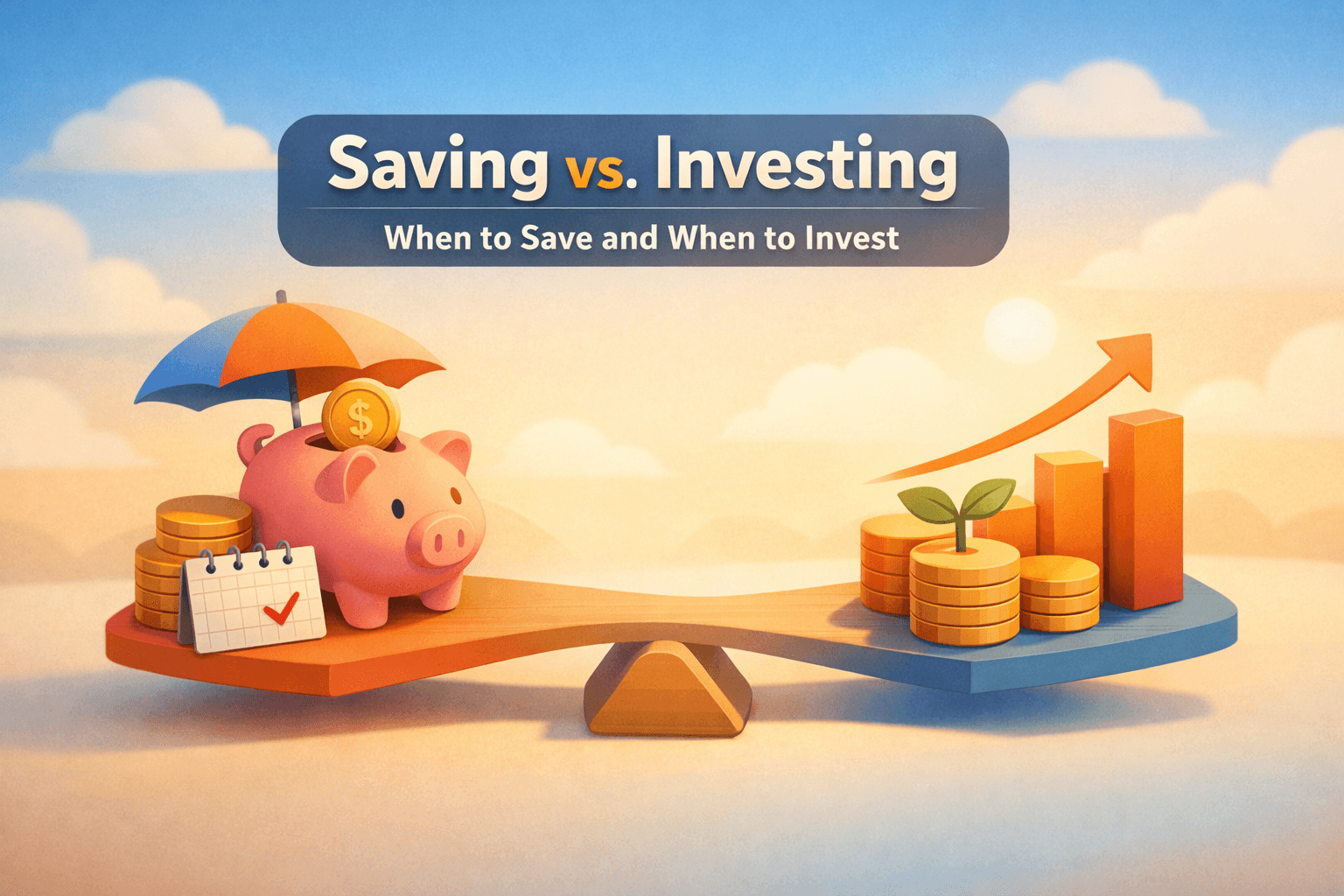
- Saving protects short-term needs and liquidity; investing aims for long-term growth but comes with risk.
- Prioritize an emergency fund (commonly 3, 6 months of expenses) before investing aggressively.
- Use savings tools (high-yield savings accounts, CDs) for short goals; use diversified investments (index funds like $VTI) for long goals.
- Match timeline and risk: short horizon → save; long horizon → invest. Intermediate goals may use a mix.
- Automatic contributions, clear goals, and rebalancing help you stay on track and avoid common mistakes.
Introduction
Saving vs investing describes two different ways to manage money: saving keeps funds safe and liquid for short-term needs, while investing puts money into assets expected to grow over time. Both are essential parts of a healthy financial plan.
This matters because choosing the wrong approach for a goal can cost you, either unnecessary risk that can lead to losses, or missed growth that erodes purchasing power due to inflation. This article explains when to prioritize an emergency fund, when to invest in stocks or bonds, and how to decide the appropriate mix for your goals.
You'll learn practical rules of thumb, real examples using common tools and tickers, and step-by-step actions to start or adjust your plan today.
Section 1: Core Differences, Safety vs Growth
At its core, saving is about safety and liquidity. Money in a savings account or short-term deposit is readily available and unlikely to lose nominal value. The trade-off is lower returns, often below historical stock returns and sometimes close to or below inflation.
Investing is about seeking growth by accepting risk. Stocks, bonds, real estate, and funds have the potential to increase purchasing power over years or decades. However, investments can fluctuate in value and may lose money in the short term.
Key features compared
- Liquidity: Savings are liquid; many investments are less liquid or may require selling at a loss to access cash quickly.
- Risk: Savings have low nominal risk; investments have market risk and volatility.
- Return: Savings earn modest interest (e.g., high-yield savings around 2, 5% as of recent periods); investments have historically returned higher averages (U.S. stock market ~7, 10% annualized nominal over decades).
- Purpose: Savings for short-term goals and emergencies; investing for long-term goals like retirement or wealth accumulation.
Section 2: When to Prioritize Saving (Emergency Funds & Short-Term Goals)
Saving should be the priority when you need money within the next 0, 3 years or when you lack financial cushioning. An emergency fund is the most common reason to save first.
Most advisors recommend an emergency fund of 3, 6 months of essential expenses for stable households, and 6, 12 months if income is variable or job security is low. This fund prevents forced selling of investments at bad times.
Where to keep short-term savings
- High-yield savings accounts: Offer liquidity and competitive interest without market exposure.
- Money market accounts or short-term CDs: Slightly higher yields but may limit access for fixed terms.
- Short-term Treasury bills: Very safe, often used by conservative savers seeking a bit more yield.
Section 3: When to Prioritize Investing (Long-Term Goals)
Investing should be prioritized when your goal is more than about 3, 5 years away and you can tolerate short-term price swings. Long horizons allow compound returns to work and recover from periodic downturns.
Typical long-term goals include retirement, funding a child's college years that start in a decade, or building wealth to buy a house far in the future. For these, investments in diversified equity and bond funds typically outperform cash over time.
Types of investments for beginners
- Broad-market stock index funds (e.g., $VTI or an S&P 500 fund) for growth and diversification across many companies.
- Bond funds or ETFs (e.g., $BND) for stability and income; bonds generally move differently from stocks.
- Target-date or balanced funds for automatic asset allocation based on time horizon.
- Tax-advantaged accounts (401(k), IRA) when available, they improve long-term outcomes through tax benefits.
Risk and diversification
Diversification spreads risk across many assets so a problem at one company or sector doesn't devastate your portfolio. A simple starter portfolio might combine a broad stock fund like $VTI and a bond fund like $BND in proportions matching your risk tolerance.
Section 4: How to Decide, A Simple Framework
Use three questions to decide whether to save or invest: timeline, liquidity needs, and risk tolerance. This framework makes the decision practical and repeatable.
- What is your time horizon? Short (<3 years) → save. Medium (3, 7 years) → mix. Long (>7 years) → invest more heavily.
- How likely are you to need the money unexpectedly? High → keep cash. Low → consider investing.
- Can you tolerate losses in the short term? If not, favor savings or conservative bonds; if yes, favor stocks for higher expected returns.
Example allocation rules
- Emergency fund complete: 3, 6 months in savings. After that, direct extra contributions to retirement or taxable investments.
- Short-term goal (e.g., down payment in 2 years): keep in savings or short-term bonds to avoid market risk.
- Long-term goal (retirement in 30 years): prioritize tax-advantaged retirement accounts and stock index funds for growth.
Real-World Examples
Example 1, New graduate, recent job: Alex has 3 months of expenses saved and wants to build wealth. First, Alex increases the emergency fund to 6 months. Then Alex contributes to employer 401(k) up to any match, and opens a Roth IRA to invest in a low-cost total-market fund like $VTI.
Example 2, Couple saving for a home in 18 months: Priya and Sam need a 20% down payment in 18 months. Because the timeline is short, they keep the down payment money in a high-yield savings account or short-term CDs to avoid market volatility.
Example 3, Mid-career earner with volatile income: Jordan earns irregular freelance income. Jordan keeps 6, 12 months of expenses in savings for stability, uses quarterly contributions into a diversified mix of stock and bond funds for long-term goals, and prioritizes a retirement account for tax benefits.
How Much to Allocate: Practical Steps
Step 1: Calculate your essential monthly expenses (housing, food, utilities, insurance, minimum debt payments). Multiply by 3, 6 to set an emergency fund target.
Step 2: Automate contributions. Direct a portion of each paycheck into savings until the emergency fund goal is reached. Automate retirement contributions and investment transfers after that.
Step 3: Reassess annually. Life changes, pay, family size, job stability, affect how much you should keep in savings versus investments.
Common Mistakes to Avoid
- Skipping an emergency fund: Without one, you may sell investments at a loss to cover unexpected costs. Avoid by building at least 3 months of expenses first.
- Keeping long-term money in low-yield savings: This reduces purchasing power over time due to inflation. Move long-term goals into diversified investments after the emergency fund is set.
- Investing short-term money in volatile assets: Market downturns can derail short-term goals. Use conservative vehicles for near-term needs.
- Trying to time the market: Waiting for a “perfect” time to invest often leads to missed gains. Use dollar-cost averaging and invest consistently.
- Not using employer matches: Failing to capture a 401(k) match is leaving free money on the table. Contribute enough to get the full match once basic savings are secure.
FAQ
Q: How much should I keep in an emergency fund?
A: Aim for 3, 6 months of essential expenses if you have stable income. If your income is variable or job risk is higher, consider 6, 12 months.
Q: Should I invest while paying off high-interest debt?
A: Prioritize paying down high-interest debt (credit cards, payday loans) because the interest cost often exceeds expected investment returns. Maintain a small emergency fund while reducing debt, then ramp up investing.
Q: Can I split money between savings and investing for the same goal?
A: Yes. For medium-term goals (3, 7 years), a blended approach, part in savings or short-term bonds and part in conservative equities, can balance safety and growth. Match the split to your comfort with risk.
Q: What about inflation, does it mean I should invest everything?
A: Inflation reduces the real value of cash over time, so long-term money should be invested to seek returns above inflation. However, you still need liquid cash for emergencies and short-term needs, so keep a dedicated emergency fund.
Bottom Line
Saving and investing serve different but complementary roles. Savings provide safety, liquidity, and peace of mind for short-term needs and emergencies. Investing offers the potential for higher returns to meet long-term goals but comes with risk and volatility.
Use a simple framework: secure an emergency fund first, match the savings or investments to your time horizon, and automate contributions. Start small and be consistent; over time, compounding and disciplined habits matter more than timing the market.
Next steps: calculate your monthly expenses, set an emergency fund target, automate a savings plan, and open a low-cost diversified investment account for long-term goals when you’re ready. Continue learning about asset allocation, tax-advantaged accounts, and basic portfolio rebalancing to refine your plan.