Introduction
How to start investing is one of the most important questions for anyone building long-term wealth. Investing means using money today to buy assets that you expect will grow in value or produce income over time.
This matters because investing lets your money work for you, potentially outpacing inflation and building financial security. This guide explains, in simple steps, how to make your first investments safely and sensibly.
You'll learn how to set goals, prepare your finances, choose the right brokerage account, understand common fees, pick beginner-friendly investments (like index funds and ETFs), and place your first trade with real-world examples.
Key Takeaways
- Set clear financial goals and payout timelines before investing to choose suitable accounts and assets.
- Build a short-term cash buffer and reduce high-interest debt before committing money to the market.
- Choose a low-cost brokerage and compare fees, account types, and available investments.
- Begin with diversified, low-cost index funds or ETFs (examples: $VTI, $VOO, $SPY) rather than picking individual stocks.
- Keep costs low by watching expense ratios, avoiding frequent trading, and using tax-advantaged accounts when appropriate.
- Start small, automate contributions, and review your plan periodically rather than trying to time the market.
1. Set your financial goals and timeline
Before you open an account, decide what you are investing for and when you'll need the money. Common goals include a retirement fund, home down payment, or a long-term education fund. Each goal has a different timeline and risk tolerance.
Short-, medium-, and long-term goals
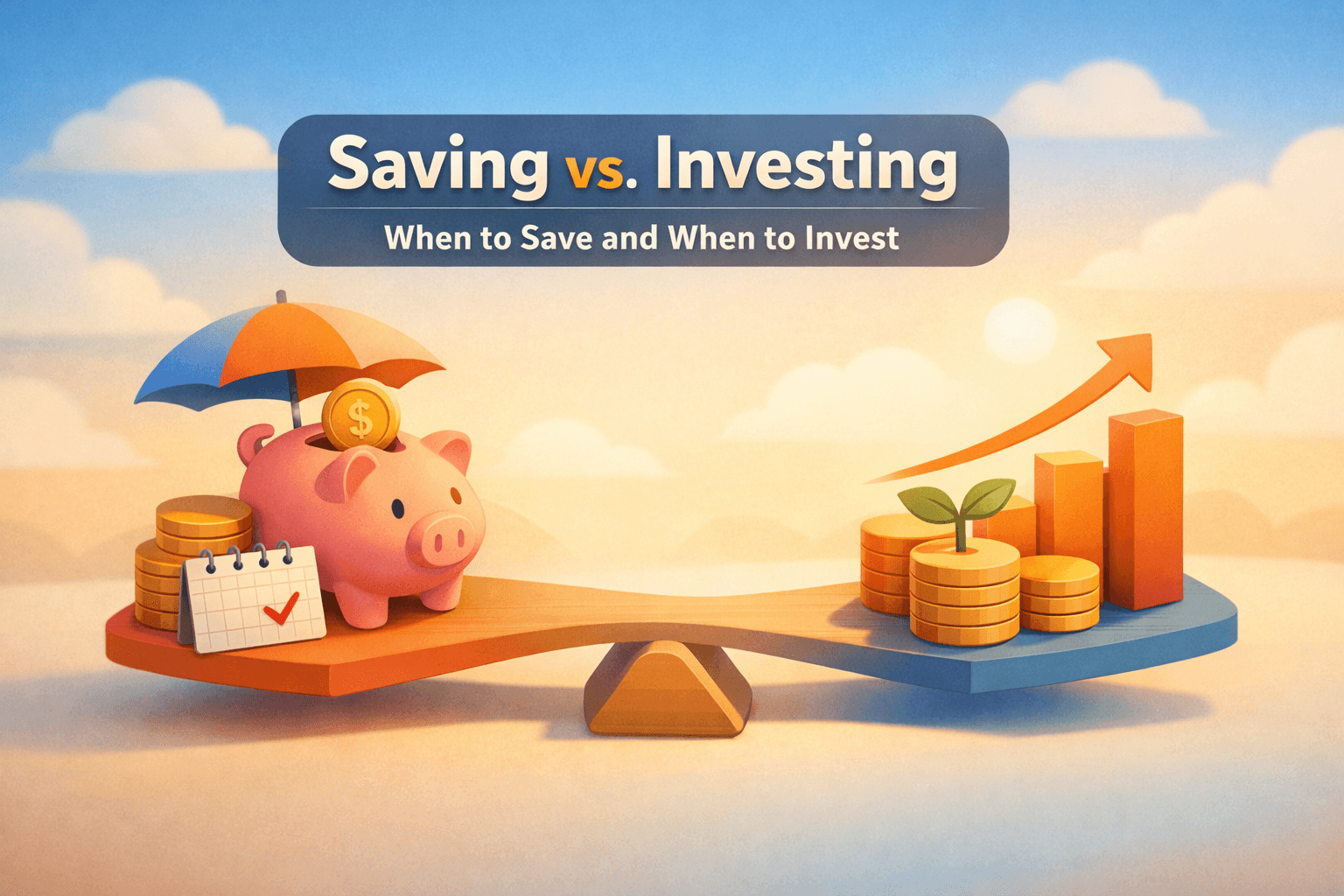
Short-term goals (under 3 years) should prioritize safety and liquidity. Medium-term goals (3, 10 years) can take moderate risk, balancing growth and preservation. Long-term goals (10+ years) can handle higher volatility for greater growth potential.
Example: If you want to save for retirement 30 years away, you can accept stock market volatility and focus on growth-oriented investments like broad U.S. stock ETFs. If you need money for a house in two years, use a high-yield savings account or short-term bonds instead.
2. Build a financial foundation
Good investing starts with a stable base: an emergency fund, a plan to manage debt, and an understanding of your cash flow. This reduces the chance you'll need to sell investments at the wrong time.
Emergency fund and debt
Aim for 3, 6 months of essential expenses in a liquid account (high-yield savings or money market) before investing significant sums. Prioritize paying down high-interest debt, like credit cards, because the interest cost often exceeds likely investment returns.
Example: If a credit card charges 20% interest, paying it off is usually a better use of cash than investing expected market returns of 7, 10%.
3. Choose the right brokerage account
A brokerage is where you buy and sell investments. Match the account type to your goal: taxable brokerage accounts are flexible, while retirement accounts (Traditional IRA, Roth IRA, or 401(k)) offer tax advantages.
Brokerage types and features to compare
Look for low-cost, reputable brokers that offer commission-free trades, robust mobile/web platforms, good customer service, and educational tools. Compare fees such as account maintenance fees, trade commissions (often $0 for stocks/ETFs today), and margin costs.
- Tax-advantaged accounts: Roth IRA (tax-free withdrawals in retirement if rules met), Traditional IRA (tax-deductible contributions depending on income), 401(k) plans (often employer match).
- Taxable brokerage accounts: No contribution limits, flexible withdrawals, and taxes on dividends, interest, and capital gains.
- Robo-advisors: Automated portfolios that pick and rebalance investments for you, helpful if you prefer a hands-off approach.
Example brokers include discount brokerages and robo-advisors; compare offerings and minimums. Many major brokers now have $0 minimums and commission-free ETFs.
4. Understand fees and taxes
Fees reduce your returns over time. The main costs to watch are expense ratios for funds, trading costs, and tax drag from taxable accounts.
Expense ratios and trading costs
Expense ratio is an annual fee charged by funds and ETFs, expressed as a percentage of assets. Low-cost index ETFs often have expense ratios near 0.03%, 0.10% (for example, $VTI or $VOO are around 0.03%). Avoid funds with high expense ratios unless they have a strong, justified track record.
Trading costs are often $0 for online equity and ETF trades, but watch for commissions on mutual funds, broker transfer fees, and spreads for thinly traded securities.
Taxes
Long-term capital gains (assets held longer than one year) typically receive lower tax rates than short-term gains. Holding investments long-term and using tax-advantaged accounts (IRAs, 401(k)s) reduces the tax hit. Consider tax-efficient funds in taxable accounts.
5. Pick beginner-friendly investments: index funds and ETFs
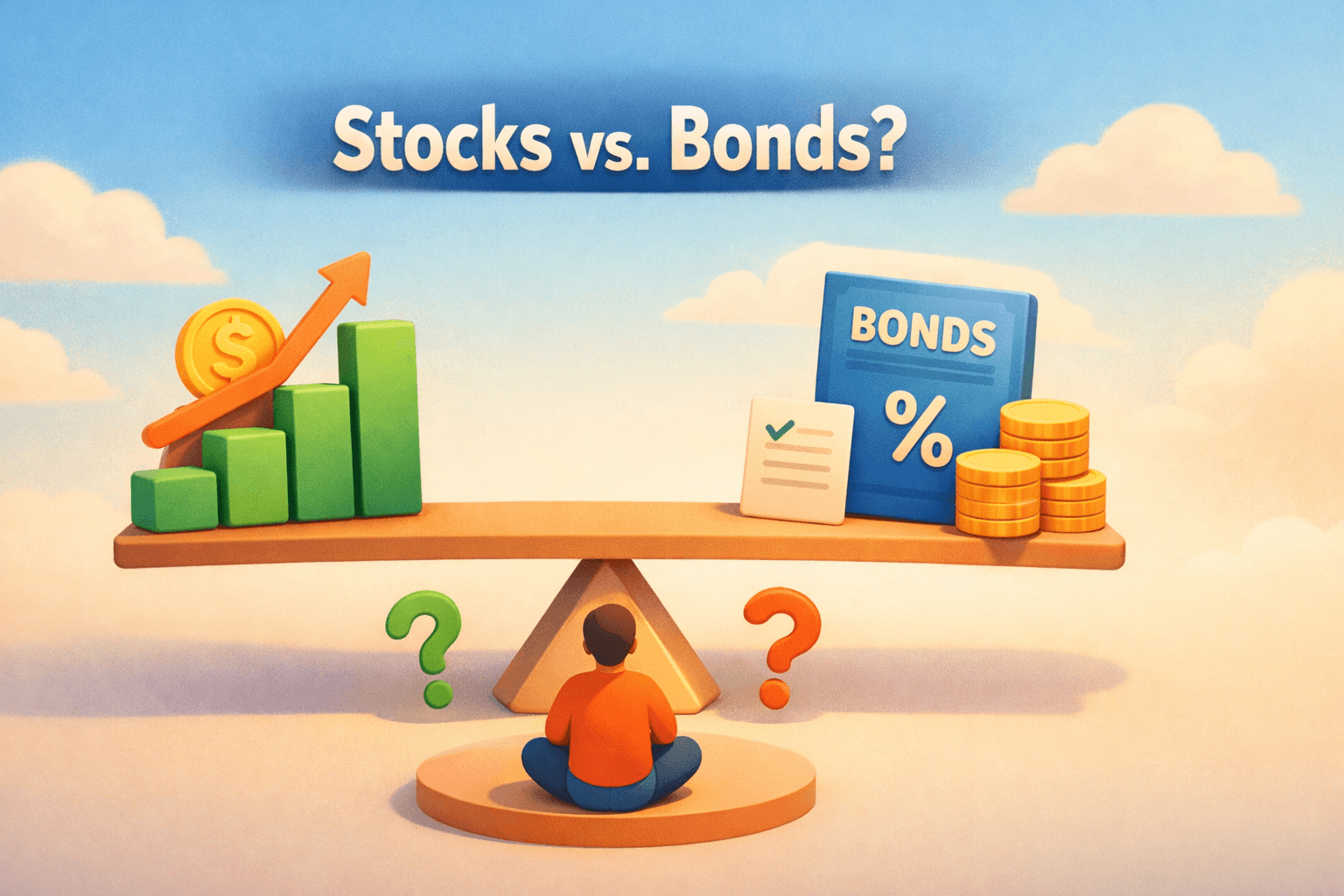
For beginners, broad market index funds or ETFs are the simplest way to get diversified exposure to stocks or bonds. These funds track an index rather than betting on individual companies.
Why index funds and ETFs are good for beginners
They offer instant diversification, low costs, and predictable strategies. You don't need to research individual companies heavily, which reduces decision paralysis and the temptation to trade frequently.
Examples: $VTI (Vanguard Total Stock Market ETF) covers the whole U.S. stock market. $VOO or $SPY track the S&P 500, which represents large U.S. companies. For bond exposure, consider broad bond ETFs like $AGG (iShares Core U.S. Aggregate Bond ETF).
6. How to place your first trade (step-by-step)
Once you have a brokerage account and a chosen investment, placing your first trade follows a few simple steps. Start small and use limit orders if you want precise price control.
- Fund your account: Transfer money from your bank to the brokerage. This can take 1, 3 business days.
- Search for the ticker: Enter the $TICKER (for example $VTI) in the broker’s trade screen.
- Choose order type: A market order executes immediately at the current price. A limit order sets the maximum price you’ll pay (useful in volatile markets).
- Enter quantity or dollar amount: For ETFs, you can buy whole shares or fractional shares if your broker supports them.
- Review and submit: Confirm fees (usually $0 for ETFs), the estimated cost, and place the order.
Example: You deposit $500, decide to buy $VTI, and place a market order for $500. Your broker fills the order, and you now own a stake in the total U.S. stock market with an expense ratio of around 0.03% per year.
Real-world example: A first-investment plan
Scenario: You are 25, want to retire comfortably, and can save $200 per month after building a $2,000 emergency fund. You choose a Roth IRA for tax-free retirement growth and decide on $VTI as your core holding.
If you start with a $500 deposit and automate $200 monthly into $VTI, assuming an average annual return of 7% compounded monthly, after 20 years your contributions and growth could be about $106,000. This example illustrates the power of regular contributions and compounding, it is not a guarantee of returns.
Common Mistakes to Avoid
- Waiting to start because you want a ‘perfect' moment, delay costs you time in the market. Start small and increase over time.
- High trading frequency or trying to time the market, frequent trading often lowers returns due to fees and poor timing. Use a buy-and-hold or dollar-cost averaging approach.
- Neglecting an emergency fund, selling investments during a market downturn locks in losses. Maintain liquid savings for short-term needs.
- Ignoring fees and tax consequences, high expense ratios and taxes can erode returns. Prefer low-cost funds and tax-advantaged accounts when possible.
- Lack of diversification, putting all money into one stock or sector increases risk. Use broad index funds or ETFs to spread risk.
FAQ
Q: How much money do I need to start investing?
A: You can start with very little, many brokerages allow you to buy fractional shares with $5, $50. More important than the initial amount is consistency: regular contributions build wealth over time.
Q: Should I pick individual stocks or funds for my first investments?
A: For beginners, diversified index funds or ETFs are usually a better starting point because they spread risk and require less research. Individual stocks add volatility and require ongoing attention.
Q: How often should I check my investments?
A: Avoid daily monitoring. Check quarterly or semiannually to ensure allocation matches your plan. Rebalance if your asset mix drifts significantly from your target.
Q: Can I lose all my money investing in index funds?
A: While index funds can decline in value during market downturns, losing all your money is unlikely if the fund holds a diversified set of assets. The primary risk is timing withdrawals during a market crash, which is why long-term planning and an emergency fund matter.
Bottom Line
Starting to invest is a process, not a single decision. Set clear goals, build an emergency fund, choose the appropriate account type, and use low-cost, diversified investments like index ETFs to begin. Small, consistent contributions matter more than perfect timing.
Actionable next steps: 1) Define your goal and timeline, 2) build a 3, 6 month emergency fund, 3) open a brokerage or retirement account, 4) pick a low-cost index ETF (examples: $VTI, $VOO), and 5) set up automatic contributions. Keep learning and review your plan periodically.
Starting early and keeping costs low are two of the most powerful advantages you can give your future self. Happy investing.