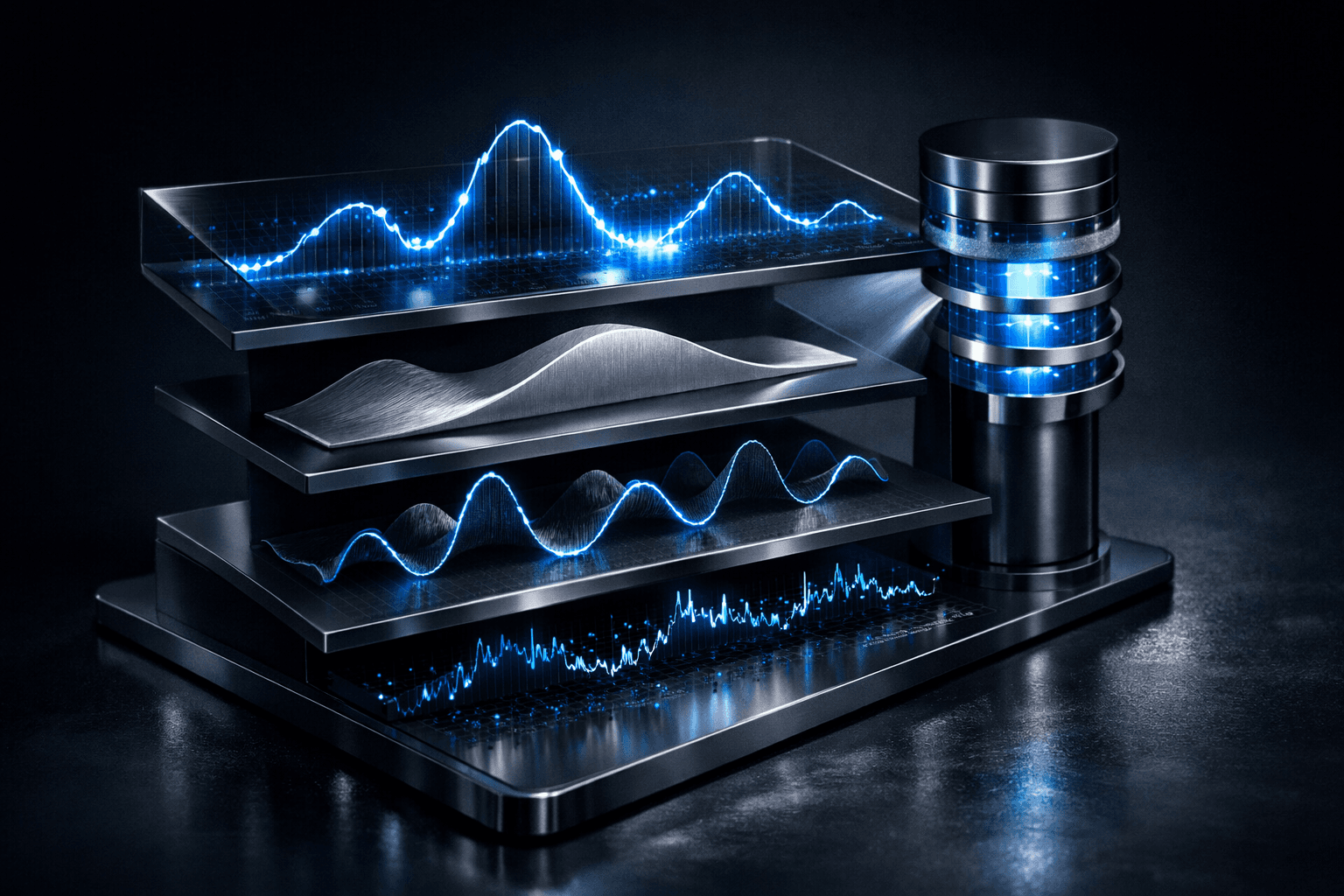
- Wavelet decomposition separates time series into scale-specific components so you can isolate intraday noise, cyclical swings, and long-run trend for horizon-aligned signals.
- Choose wavelet family, decomposition level, and boundary handling to map scales to calendar horizons, then reconstruct components with inverse transform for interpretation.
- Build horizon-consistent signals by constructing normalized component scores, applying scale-appropriate risk and turnover constraints, and combining with economic filters.
- Test stability across regimes with rolling decompositions, significance testing of coefficients, and cross-validation to avoid overfitting to noise.
- Avoid common mistakes such as mismatched sampling frequency, leaking trend into detail bands through inadequate levels, and lookahead in reconstruction.
Introduction
Wavelet signal decomposition is a time-frequency method that splits a price or return series into components associated with different horizons, from high-frequency noise to medium-term cycles and long-term trends. For investors, this means you can design signals that are horizon-consistent: intraday trading systems can ignore weekly cycles, and long-term allocators can filter out daily noise.
Why does this matter for you? Mixing information from incompatible horizons leads to signals that either overtrade or miss the structural moves that matter for your holding period. By explicitly separating scales you reduce noise, align risk and turnover with strategy goals, and improve interpretability.
This article covers the theory, practical mapping of wavelet scales to calendar horizons, step-by-step decomposition and reconstruction, building horizon-consistent signals, validation and common pitfalls. You will see concrete examples using common equities like $AAPL and $MSFT and learn what to test before putting a model into production. Ready to get hands-on with multiscale signals?
1. Why wavelets, and how they compare to other tools
Wavelets are localized in both time and frequency. Unlike Fourier methods which give global frequency content, wavelets let you examine transient features and assign them to specific times and scales. That makes them ideal for financial time series with nonstationary volatility and regime changes.
Compared with moving averages or Hodrick-Prescott filtering, wavelets provide an orthogonal decomposition when using discrete wavelet transforms, giving energy-preserving components you can reconstruct exactly. Compared with empirical mode decomposition, wavelets are more straightforward to regularize and to map to predefined horizons.
Key concepts
- Mother wavelet: the base waveform, for example Daubechies (db4) or Symlets. It determines time-frequency tradeoffs.
- Levels: decomposition levels correspond to dyadic scales. Level j captures fluctuations around period 2^j samples.
- Approximation and details: the approximation at the final level represents the low-frequency trend. Detail coefficients capture progressively higher-frequency content.
2. Mapping wavelet scales to calendar horizons
To use wavelets for horizon separation you need a clear mapping from decomposition level to calendar time. That mapping depends on sampling frequency and the wavelet transform type. For discrete wavelet transform with dyadic scales, level j corresponds roughly to fluctuations with period between 2^j and 2^{j+1} samples.
Example mappings for common sampling frequencies:
- If you use 1-minute bars, level 6 corresponds to periods of roughly 64-128 minutes, which captures intraday cycles. Level 10 corresponds to multi-day swings around 1024-2048 minutes, close to weekly patterns.
- For daily returns, level 3 covers 8-16 trading days, a short cycle. Level 6 covers 64-128 trading days, useful for medium-term trend identification.
Practical rule: pick a sampling frequency that aligns with your execution data, then select the maximum decomposition level L so that 2^L is comparable to your longest horizon of interest. If you want to separate intraday noise (minutes), daily cycles, weekly cycles, and long-run trend, choose L so that the approximation at level L spans months or years depending on your asset.
3. Implementation steps: from raw series to reconstructed components
Below is a stepwise, implementable workflow that you can translate to your environment in Python, R, or C++. Keep an eye on boundary choices to avoid artifacts at edges.
- Data preparation: use a regular sampling grid. For irregular ticks, resample with volume-weighted mid-price or last price per interval. Clean outliers and fill missing data with short-term interpolation.
- Select wavelet family and level: db4 or db6 are common for finance. Choose level L so 2^L approximates the longest horizon you need. Wavelets with longer filters have better frequency separation but worse time localization.
- Perform discrete wavelet transform (DWT): compute detail coefficients d1..dL and approximation aL. Use an orthogonal transform for energy preservation, or MODWT (maximum overlap DWT) to avoid downsampling effects and improve alignment with original time indexes.
- Reconstruct components: for each level j reconstruct the detail component by inverse transform using only dj. Reconstruct the trend using aL. If using MODWT, you can reconstruct time-aligned components at full sample rate.
- Map components to horizons: label details with corresponding horizon ranges using your mapping from section 2. Validate by spectral analysis of reconstructed components to confirm periods match expectations.
Practical example, daily data for $AAPL
Suppose you have 5 years of daily close prices for $AAPL. You resample to daily returns and choose db4 with L=7. Level 1 captures 2-4 day noise, level 3 captures 8-16 day cycles, level 5 captures 32-64 day cycles, and a7 is the multi-month trend. Reconstructing these gives separate series: Noise (sum of d1-d2), Cycle (d3-d5), and Trend (a7 + d6 if you want slow cycles included).
4. Building horizon-consistent signals
Once you have reconstructed components aligned with horizons, convert them into actionable signals while respecting turnover and risk constraints for each horizon.
- Normalize component scores: compute z-scores per component using rolling volatility estimates appropriate to each scale. For example, use a 21-day window for medium-term cycles and a 63-day window for trend.
- Apply scale-specific filters: for short-horizon components set higher thresholds and tighter stop rules. For trend components use lower thresholds but longer holding periods.
- Combine components hierarchically: use a weighted sum where weights reflect your holder's horizon and transaction cost budget. For a weekly trader, emphasize d3-d5; for a multi-month allocator, rely mostly on aL and low-frequency details.
Example signal construction for multi-horizon use
- Compute normalized scores s_j(t) for each component j, where s_j = component / rolling_std_j.
- Define horizon profile H: intraday trader H=[1,0,0], swing H=[0,1,0], trend investor H=[0,0,1], mapping to detail groups.
- Signal S(t)=sum_j w_j * clip(s_j, -k_j, k_j), with caps k_j, and w_j proportional to H and scaled by liquidity and turnover limits.
That approach keeps your trading behavior consistent with the horizon you target and reduces churn from short noise that does not affect long-term positions.
5. Validation, stability, and live considerations
Decompositions can be sensitive to regime shifts and boundary effects. You must test for stability and ensure no lookahead leakage.
- Rolling re-decomposition: perform the full decomposition on expanding or rolling windows and measure coefficient stability. Large changes in reconstruction energy suggest regime shifts requiring model adjustment.
- Significance testing: test detail coefficients against a noise model, for example by bootstrapping returns or using surrogate data, to avoid trading on coefficients that are statistically indistinguishable from noise.
- Latency and online updating: MODWT supports online updating better than decimated DWT. For real-time signals, implement streaming transforms or short-lag recomputation with warm-up buffers.
Common Mistakes to Avoid
- Using mismatched sampling frequency: Don’t decompose daily series if your execution is intraday. Match the sample grid to the execution horizon. Avoids false attribution of noise to cycles.
- Too few or too many levels: Choosing L incorrectly either mixes trend into detail bands or leaves relevant cycles in the approximation. Map 2^L to your max horizon beforehand to prevent leakage.
- Ignoring boundary effects: Default padding can inject spurious movement at edges. Use reflection or predictive padding and validate results near the endpoints.
- Overfitting components: Tuning wavelet family and thresholds on the full dataset creates lookahead. Use rolling cross-validation and out-of-sample testing to set hyperparameters.
- Neglecting transaction costs and slippage by combining high-frequency components with low-frequency ones without separate cost models for each scale.
FAQ
Q: How do I choose between DWT and MODWT?
A: Use DWT if you want an orthogonal, compact representation and don't mind downsampling. Use MODWT when you need time-aligned coefficients and better translation invariance, which is important for signaling and real-time applications.
Q: Can I use wavelets on log prices instead of returns?
A: You can, but most practitioners apply wavelet decomposition to returns or log-returns because stationarity and variance interpretation are cleaner. If you decompose prices, trend components will dominate and interpretation of detail bands as 'noise' is less clear.
Q: How do I handle non-dyadic sample lengths?
A: Wavelet packages handle non-dyadic lengths with padding. Prefer reflection padding or MODWT to reduce boundary artifacts. Alternatively truncate or extend series to the nearest power of two if using DWT with critical decimation.
Q: Will wavelet decomposition reduce drawdowns?
A: It can, indirectly. By isolating trend and filtering noise you avoid false signals that cause whipsaws. But you should combine wavelet-based signals with risk controls and position sizing. Wavelets are tools for signal construction, not a standalone risk management system.
Bottom Line
Wavelet decomposition gives you a principled way to split a financial time series into horizon-specific components. When you align sampling frequency, decomposition level, and reconstruction practices with your trading horizon, you create signals that are more stable, interpretable, and cost-aware.
Start by mapping 2^j to calendar periods for your data, choose a wavelet family that balances time and frequency resolution, and validate with rolling re-decompositions and statistical tests. Build signals with scale-specific normalization, caps, and cost models to ensure horizon consistency and practical deployability.
At the end of the day, wavelets are a powerful addition to a quant’s toolbox. Try them on a few tickers like $AAPL and $MSFT, compare DWT and MODWT reconstructions, and iterate with cross-validation before scaling any strategy live.