Introduction
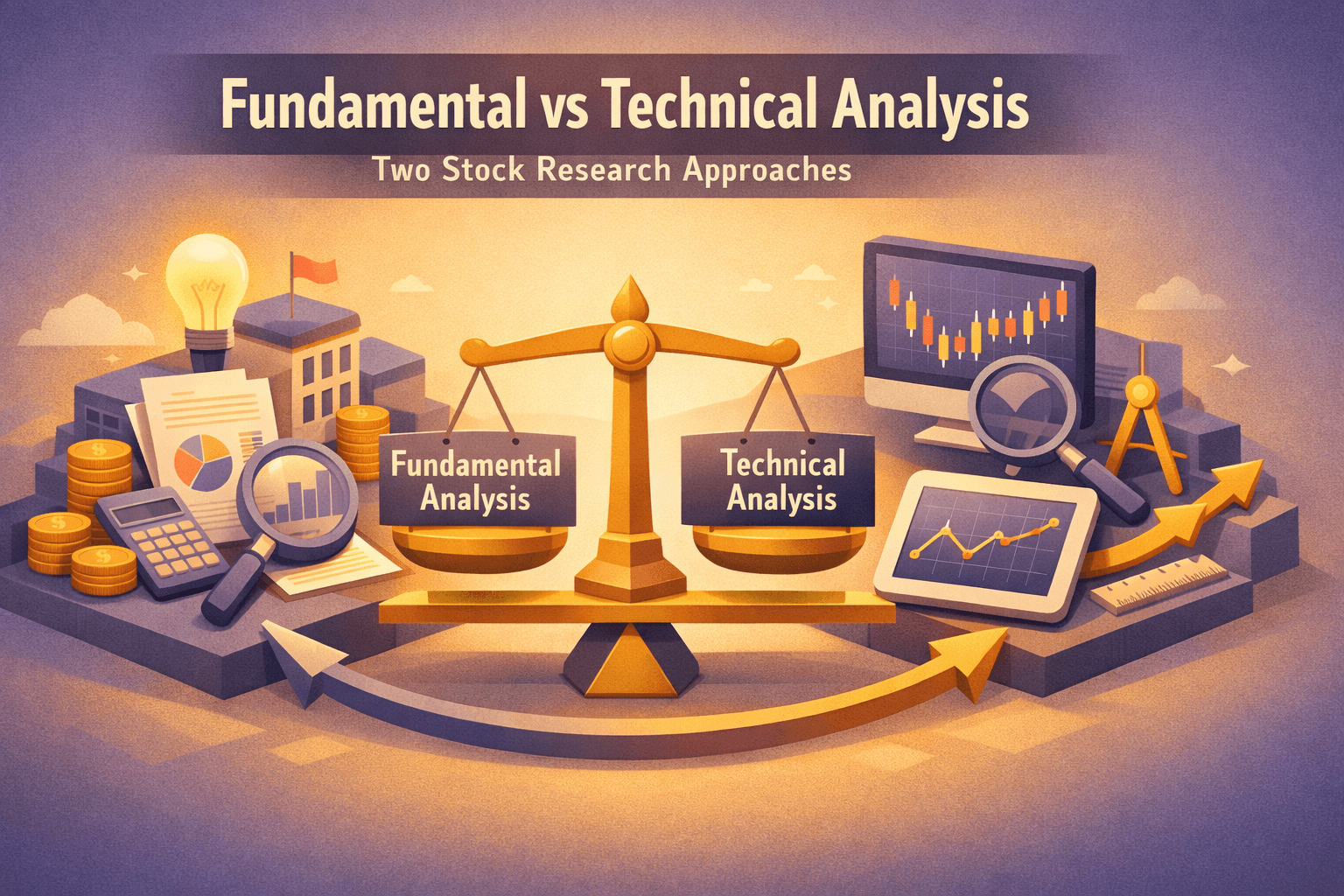
Fundamental vs technical analysis defines two complementary approaches to stock research: one evaluates the business and its financials, the other studies price, volume, and chart patterns. Both methods aim to help investors make better decisions, but they answer different questions and use different tools.
This matters because choosing the right approach, or combining both, affects where you focus research time, how you manage risk, and what signals trigger entries or exits. In this article you'll learn the core concepts behind each school, practical metrics and indicators, workflows for combining them, and concrete examples using $TICKER-style tickers.
Preview: we cover fundamentals (financial statements, valuation, qualitative factors), technicals (trend, momentum, support/resistance), how to integrate the two, tools and workflows, real-world scenarios, common mistakes, and a short FAQ.
- Fundamental analysis values the business using financial statements, ratios, and qualitative factors; it answers "What is this company worth?"
- Technical analysis reads price and volume to time entries, exits, and measure market sentiment; it answers "What is the market doing now?"
- Use fundamentals for long-term selection and technicals for timing and risk management, they can complement each other in a repeatable workflow.
- Key fundamental metrics: revenue growth, free cash flow, return on equity (ROE), and valuation multiples like P/E and EV/EBITDA.
- Key technical tools: moving averages, RSI, MACD, price patterns, volume analysis, and support/resistance levels across multiple timeframes.
- Common mistakes: overfitting indicators, ignoring macro context, relying on single metrics, and letting bias drive interpretation.
What is Fundamental Analysis?
Fundamental analysis evaluates a company's intrinsic value by studying its financial statements, competitive position, and growth prospects. Investors use fundamentals to determine whether a stock is under- or over-valued relative to estimated fair value.
Core inputs: financial statements
The three primary statements are the income statement, balance sheet, and cash flow statement. Key items include revenue trends, gross margin, operating margin, free cash flow (FCF), debt levels, and cash on the balance sheet.
Example: when analyzing $AAPL, an investor watches revenue growth and gross margins to gauge product mix, and free cash flow to estimate capital returns via buybacks or dividends.
Valuation metrics and what they tell you
Common multiples include price-to-earnings (P/E), enterprise value-to-EBITDA (EV/EBITDA), price-to-sales (P/S), and price-to-book (P/B). Use these vs historical ranges, peers, and industry norms to spot potential mispricings.
Example: if $MSFT trades at a P/E of 30 while its five-year average is 25, investigate whether faster growth or higher margins justify that premium before concluding it's expensive.
Qualitative factors
Not all value shows up in numbers. Competitive advantages (moats), management quality, regulatory risks, and product pipelines influence long-term outcomes. Qualitative analysis complements ratios and projections.
Example: a company like $TSLA may have strong brand and scale advantages in EVs, but also execution risk and capital intensity; a qualitative view helps contextualize valuation multiples.
What is Technical Analysis?
Technical analysis studies price action and volume to identify trends, momentum, and probable turning points. It assumes all known information is reflected in price and focuses on the market's behavior rather than the company's fundamentals.
Trend and momentum indicators
Moving averages (50-day, 200-day), MACD, and RSI are staples. Moving averages smooth price to reveal trend direction; crossovers can signal trend changes. RSI shows momentum extremes, useful for spotting overbought or oversold conditions.
Example: a trader watching $NVDA might use a 50/200-day moving average crossover to confirm a new bullish trend, and RSI to detect short-term exhaustion before adding to a position.
Support, resistance, and chart patterns
Support and resistance are price levels where buying or selling pressure historically appears. Chart patterns (triangles, head-and-shoulders, flags) and candlestick patterns provide structure for timing trades and placing stops.
Example: if $AAPL consistently finds buyers near $120, technical traders mark that as support and may use it for stop placement or scaled entries.
Volume and market structure
Volume confirms price moves: strong moves on low volume are less reliable than those on high volume. Market structure, higher highs/lows vs lower highs/lows, quantifies trend strength and helps with position sizing and risk controls.
Example: a breakout in $SPY with above-average volume is more likely to sustain than a breakout on weak volume; institutions tend to move price on higher volume.
Combining Fundamentals and Technicals: A Pragmatic Framework
Many investors find the most practical approach is to use fundamentals to select candidates and technicals to time entries and manage risk. This hybrid model leverages the strengths of both schools.
- Screen for fundamentals: start with quantitative filters such as revenue growth >10% or ROE >15%, low debt-to-equity, or positive FCF. This narrows the universe to financially sound businesses.
- Perform valuation checks: calculate P/E, EV/EBITDA, and discounted cash flow ranges. Look for names trading below justified ranges or at least offering a margin of safety for long-term investors.
- Apply technical filters: check trend strength (e.g., price above 50-day MA), look for pullbacks to key support, or confirm momentum via MACD/RSI. Prioritize names with favorable chart structure.
- Define trade plan: set entry, stop-loss, and target levels based on support/resistance and position sizing aligned to portfolio risk. Use fundamentals to set holding-period expectations.
- Monitor and adapt: re-evaluate fundamentals quarterly and update technicals daily/weekly. If fundamentals deteriorate materially, reassess even if technicals remain bullish.
Example workflow: you screen for consumer tech names with revenue growth >15% and ROE >20%. $AAPL passes the screen. Valuation looks reasonable vs peers. The chart shows a pullback to the 50-day moving average with RSI near 40. You plan a staggered entry with a stop below the recent swing low and size the position to risk 1% of portfolio.
Tools, Data, and Practical Workflows
Use a combination of data sources and platforms: financial statement access (SEC filings), screener tools for fundamentals, charting platforms for technicals, and portfolio trackers for risk monitoring. Automation and watchlists save time.
Screens and data
Start with a fundamental screener to filter by growth, profitability, and valuation. Export a shortlist for deeper analysis. Use financial models (DCF or multiples) to estimate fair value ranges and sensitivity to growth and margins.
Example sources: company 10-K/10-Q filings, financial data providers, and earnings transcripts for qualitative color.
Charting and alerts
Set multi-timeframe charts: daily for entries, weekly for trend confirmation, and monthly for secular bias. Add moving averages and RSI, and configure alerts for breakouts, MA crossovers, or volume spikes.
Example alert: notify when $NVDA price crosses above its 200-day MA on volume greater than the 50-day average.
Journaling and review
Keep a trade and idea journal documenting why you bought or sold, the fundamental thesis, technical triggers, and outcome. Review monthly to identify recurring strengths and weaknesses in your process.
Statistic to track: hit rate, average return per trade, and risk-adjusted return (e.g., Sharpe ratio) for your strategy over time.
Real-World Examples
Below are two practical scenarios showing how fundamentals and technicals interact.
Example 1, Long-term investor using fundamentals, timing with technicals
Scenario: You like $MSFT for durable revenue growth and high free cash flow. Fundamental checks: revenue growth ~10% year-over-year, FCF margin healthy, ROE above 25%, and manageable net debt. Valuation is modestly above history with justified premium for growth.
Technical timing: the weekly chart shows a long-term uptrend and the daily chart pulls back to the 50-day MA. RSI sits near neutral. You enter a graded position on the pullback with a stop slightly below the 50-day and plan to hold through earnings unless fundamentals deteriorate.
Example 2, Shorter-term trade focused on technical setup, informed by fundamentals
Scenario: $NVDA displays a clear ascending triangle on the daily chart, with a breakout level at $X. Fundamentals are strong (high revenue growth and improving margins), but you treat the trade as short-term speculative due to price volatility.
Execution: you wait for a confirmed breakout with volume above the 20-day average, enter a defined position size, set a stop below the breakout point, and lock partial profits at a measured target. You keep an eye on the next earnings date in case fundamentals introduce sudden volatility.
Common Mistakes to Avoid
- Overreliance on a single metric: Avoid making decisions based solely on one number (e.g., P/E). Combine value, growth, and cash flow analysis to form a rounded view.
- Ignoring timeframes: Using only long-term fundamentals for very short trades, or only short-term technicals for long-term positions, creates mismatched expectations and risk.
- Confirmation bias: Seeking only data that supports a prior view leads to bad decisions. Use checklists and counterfactual scenarios to challenge your thesis.
- Poor risk management: Neglecting stop placement or position sizing can turn small losses into catastrophic ones. Define risk per trade and stick to it.
- Chasing indicators: Jumping into trades because an indicator flashed a signal without assessing context and volume often results in false signals. Confirm with multiple signals and timeframes.
FAQ
Q: Should I pick one approach, fundamental or technical, or learn both?
A: Learning both is valuable. Fundamentals answer long-term value and quality; technicals help with timing, risk management, and market sentiment. Many investors use fundamentals for selection and technicals for execution.
Q: Can technical analysis work for long-term investors?
A: Yes. Long-term investors can use weekly and monthly charts to confirm secular trends and to find better entry points during pullbacks. Technicals are useful for determining when market risk is elevated.
Q: How often should I re-evaluate a fundamental thesis?
A: Re-evaluate at least quarterly around earnings and major filings, or sooner if there are material changes in revenue trends, margins, management, or regulatory environment.
Q: Which indicators are essential for beginners transitioning to intermediate level?
A: Start with moving averages (50/200), RSI, MACD, and simple volume analysis for technicals. For fundamentals, master revenue growth, gross/operating margins, free cash flow, debt metrics, and basic valuation multiples.
Bottom Line
Fundamental and technical analysis answer different but complementary questions: fundamentals assess intrinsic value and business quality, while technicals read market behavior to time actions and manage risk. Combining both produces a pragmatic, repeatable research and execution workflow.
Next steps: build a screening process to identify candidates, define technical criteria for timing, document trade plans with clear risk controls, and regularly review outcomes to refine your method. With disciplined application, you can turn theory into a practical edge without relying on a single school of thought.