Key Takeaways
- Financial statements (income statement, balance sheet, cash flow) together show profitability, financial position, and cash generation, read them as a system, not in isolation.
- Focus on recurring operating metrics (revenue growth, gross margin, operating margin) and cash flow trends rather than one-off accounting items.
- Use liquidity, solvency, efficiency, and profitability ratios to translate line items into actionable signals about risk and performance.
- Watch for cash flow conversion (net income vs. operating cash flow), changes in working capital, and capital expenditure trends to assess sustainability.
- Avoid common pitfalls: overreacting to single-quarter noise, misreading GAAP vs. non-GAAP numbers, and ignoring footnotes and accounting policies.
Introduction
How to read financial statements: that simple question is the foundation of company analysis. Financial statements, the income statement, balance sheet, and cash flow statement, are the primary tools investors use to evaluate a company's profitability, financial health, and cash dynamics.
Understanding these documents matters because they translate business activity into standardized numbers you can compare across companies and time. This guide teaches you what each statement reports, which line items matter most, how to convert numbers into ratios, and how to use the combined picture to form practical, data-driven views.
The Income Statement: Measuring Performance
The income statement (also called the profit and loss statement) summarizes revenue, costs, and profit over a period. It answers the question: did the company make money this period and at what margins?
Key line items and what they indicate
- Revenue (Sales): Top-line growth shows demand. Compare year-over-year (YoY) and sequential trends, and watch for one-time revenue items.
- Cost of Goods Sold (COGS): Direct costs of producing goods or services. Rising COGS as a percent of revenue indicates margin pressure.
- Gross Profit and Gross Margin: Gross margin = (Revenue - COGS) / Revenue. It reflects pricing power and production efficiency.
- Operating Expenses (R&D, SG&A): Costs to run the business. High R&D can signal investment for growth; high SG&A may indicate inefficient selling or admin costs.
- Operating Income (EBIT) and Operating Margin: Core profitability before financing and taxes. Useful for comparing operational efficiency across peers.
- Net Income and EPS: The bottom line after interest, taxes, and non-operating items. EPS trends matter for shareholder returns, but watch for one-time gains/losses and share count changes.
Practical signals to watch
Consistent revenue growth with stable or expanding gross and operating margins usually indicates a healthy business model. If revenue grows but margins shrink, dig into whether competition, rising input costs, or higher marketing spend is the cause.
Example: $AAPL reports strong revenue and expanding gross margin driven by services growth. For an intermediate investor, separate the revenue mix (products vs. services) because margins differ significantly and affect future profitability.
The Balance Sheet: Snapshot of Financial Position
The balance sheet captures assets, liabilities, and shareholders' equity at a point in time. It answers: what does the company own, what does it owe, and how much equity is backing the business?
Core sections and interpretation
- Assets: Current assets (cash, receivables, inventory) show short-term resources. Non-current assets (PP&E, intangibles) reflect long-term investments.
- Liabilities: Current liabilities (accounts payable, short-term debt) indicate near-term obligations. Long-term liabilities (long-term debt, deferred tax) show future claims on cash flow.
- Shareholders' Equity: Equity = Assets - Liabilities. Retained earnings reveal cumulative profits reinvested in the business.
Key ratios from the balance sheet include liquidity measures (current ratio, quick ratio) and leverage measures (debt-to-equity, net debt/EBITDA). These ratios help you assess short-term solvency and long-term financial risk.
Real-world cue: inventory and receivables
Rising inventory relative to sales may signal demand weakness or overproduction. Increasing days sales outstanding (DSO) suggests customers are taking longer to pay, which can strain cash flow. For example, a retailer with rising inventory days should prompt questions about discounting risk and margin pressure.
The Cash Flow Statement: Cash Is King
The cash flow statement reconciles net income to cash movements across operating, investing, and financing activities. It answers: how much cash did the company generate and where did it go?
Sections and why they matter
- Operating Cash Flow (CFO): Cash generated from core operations. Positive and growing CFO confirms that reported profits convert into real cash.
- Investing Cash Flow: Cash used for capital expenditures (CapEx), acquisitions, or asset sales. Heavy CapEx may signal growth investment but will reduce free cash flow in the short term.
- Financing Cash Flow: Cash flows from issuing/repurchasing shares, debt issuance/repayment, and dividends. This shows how the company finances its activities and returns capital to shareholders.
Free cash flow (FCF) = Operating Cash Flow - CapEx. FCF is a critical metric: it represents cash available to pay dividends, reduce debt, or fund acquisitions. Track FCF yield (FCF / market cap) for valuation context.
Red flags in cash flows
When net income is positive but operating cash flow is repeatedly negative or much lower, earnings may be driven by non-cash items or aggressive accounting. Watch for frequent adjustments in working capital that temporarily inflate CFO.
Example: $TSLA in high-growth mode may report negative free cash flow during heavy factory buildouts. That can be acceptable if CapEx is strategic and backed by improving operating cash flow over time.
Putting the Statements Together: Ratios and Integrated Analysis
Individual statements tell part of the story. Ratios synthesize information across statements to reveal trends and risks. Use four groups of ratios to form a complete view: profitability, liquidity, efficiency, and leverage.
Key ratios and interpretation
- Profitability: Gross margin, operating margin, net margin, return on equity (ROE). High ROE can reflect strong profits or high leverage, check the balance sheet.
- Liquidity: Current ratio = Current assets / Current liabilities. Quick ratio excludes inventory. Values below 1 may signal short-term stress for some industries.
- Efficiency: Inventory turnover = COGS / Average inventory. Receivables turnover = Revenue / Average receivables. Slowing turnover often precedes margin deterioration.
- Leverage: Debt-to-equity and net debt / EBITDA measure solvency. High leverage increases default risk but can magnify returns in stable businesses.
Trend analysis matters more than single-period readings. Compare ratios to historical company performance and peer benchmarks. Industry context is crucial: capital-intensive firms have different normal ranges than software businesses.
Practical Walkthrough: Applying the Framework to $AAPL
Example scenario: you want to assess $AAPL's fundamentals after a quarterly report. Start with the income statement: confirm revenue and operating margin trends and whether growth is driven by hardware, services, or wearables.
Next, inspect the balance sheet: check cash balances, short-term investments, and long-term debt. For $AAPL, large cash reserves support buybacks and dividends but confirm how management uses excess cash over time.
Finally, read the cash flow statement: verify that operating cash flow comfortably exceeds net income and supports free cash flow after CapEx. For technology companies, a strong FCF margin (FCF / revenue) is a positive sign for capital returns and reinvestment capacity.
Common Mistakes to Avoid
- Reacting to a single quarter: Short-term fluctuations often reflect seasonality or one-offs. Focus on multi-quarter or multi-year trends to form durable views.
- Ignoring footnotes and accounting policies: Footnotes explain non-recurring items, revenue recognition changes, and contingencies that materially affect interpretation.
- Over-relying on GAAP or non-GAAP alone: Non-GAAP metrics can eliminate noise but also hide recurring expenses. Understand adjustments and reconcile them to GAAP statements.
- Neglecting cash flow: Profitable GAAP earnings without operating cash flow can indicate aggressive accrual accounting. Prioritize cash generation for investment sustainability.
- Comparing companies across different industries without normalization: Use industry-specific metrics and benchmarks; a healthy debt ratio for utilities may be dangerous for software firms.
FAQ
Q: How often should I review a company's financial statements?
A: Quarterly reviews are standard because companies file 10-Qs and 10-Ks annually, but focus on major events (earnings releases, M&A, capital raises). Combine periodic reviews with alerts for material changes.
Q: Which is more important: EPS growth or free cash flow?
A: Both matter, but free cash flow is often more reliable as it reflects actual cash generation. EPS can be affected by share count changes and non-cash items; use EPS alongside FCF for a fuller picture.
Q: How can I detect aggressive accounting in statements?
A: Watch for big differences between net income and operating cash flow, large or frequent one-time adjustments, changing revenue recognition policies, and increasing intangible assets from acquisitions. Footnotes often reveal warning signs.
Q: Do I need advanced models to analyze financial statements?
A: No. Start with trend analysis and key ratios, then progress to discounted cash flow (DCF) or scenario models as your understanding deepens. Good fundamental analysis builds on accurate reading of the statements first.
Bottom Line
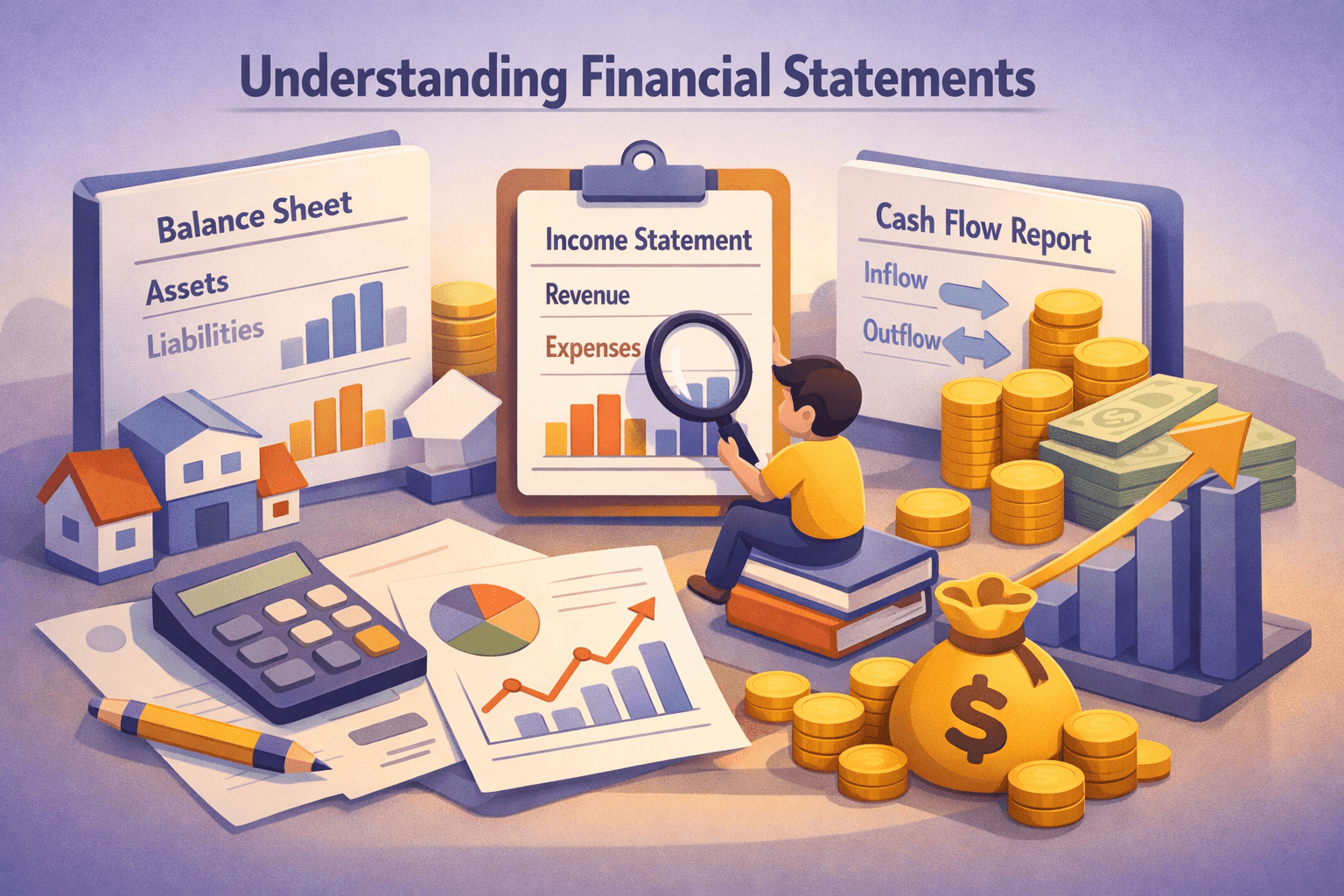
Reading financial statements is an essential skill that turns raw accounting numbers into insights about a company’s performance, risks, and value. The income statement shows profitability; the balance sheet shows financial position; the cash flow statement proves whether profits convert into cash.
Begin by mastering key line items and simple ratios, then integrate statements to form a holistic view. Regularly review trends, read footnotes, and compare peers within the same industry. With practice, you’ll use financial statements to make clearer, more disciplined investment assessments.
Next steps: pick a company you follow, pull its latest 10-Q/10-K, and walk through the three statements using the checklist in this guide, focus on revenue drivers, margin stability, cash flow conversion, and balance sheet strength.