Key Takeaways
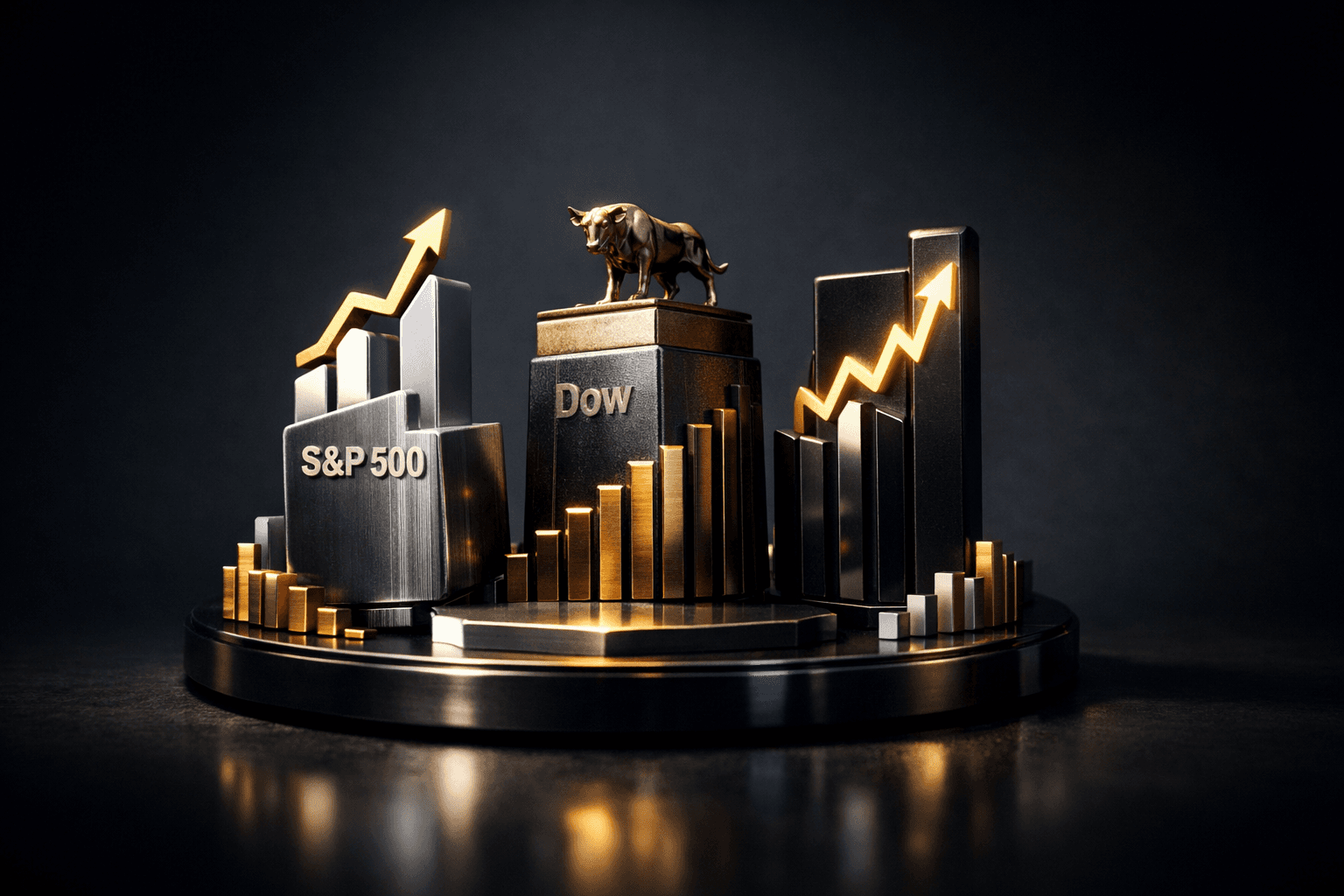
- The S&P 500 tracks 500 large U.S. companies and is market-cap weighted, so bigger companies like $AAPL and $MSFT influence it most.
- The Dow Jones Industrial Average contains 30 large companies and is price-weighted, which makes high-priced stocks move the index more.
- The Nasdaq refers to marketplaces and indexes; the Nasdaq-100 focuses on 100 large nonfinancial companies and is tech-heavy, often tracked by $QQQ.
- Indices are benchmarks you can use to measure performance, build low-cost index funds or ETFs, and decide asset allocation.
- Index performance affects your investments when you own index funds, ETFs, or stocks that are large components of an index.
Introduction
A market index is a single number that represents the performance of a group of stocks. Indexes like the S&P 500, Dow Jones Industrial Average, and Nasdaq offer quick snapshots of how parts of the market are doing.
Why should you care about these indexes as an investor? They act as benchmarks, guide portfolio decisions, and are the basis for many low-cost funds you may buy. How exactly do they differ, and what do those differences mean for your portfolio?
This article explains how the major U.S. indices are built, how they behave, how they affect index funds and ETFs such as $SPY, $DIA, and $QQQ, and practical steps you can take to use them in your investing. Ready to demystify market barometers?
What Is a Market Index and Why It Matters
A market index is a statistical measure that tracks the performance of a specific group of stocks. Indices simplify complex markets so you can see the overall trend without watching many individual positions.
Investors use indices as benchmarks, research tools, and the basis for index funds and ETFs. If you want to know how U.S. large-cap stocks are doing, looking at the S&P 500 is faster than scanning 500 tickers.
Indices also set expectations. For example, if your mutual fund says it “beats the S&P 500,” that index is the yardstick for performance and risk comparisons.
How Major Indices Are Constructed
Different indexes use different rules to decide which companies are included and how much weight each company carries. Those rules drive how the index reacts to price moves.
S&P 500: Market-cap weighting
The S&P 500 includes about 500 large U.S. companies chosen by a committee based on size, liquidity, and sector representation. It is weighted by market capitalization, which means companies with larger total market values have bigger influence.
For example, $AAPL and $MSFT, with market caps in the trillions, move the S&P more than a smaller $10 billion company. The S&P 500 covers roughly 80% of the U.S. equity market by capitalization, so it’s widely used to represent large-cap U.S. stocks.
Dow Jones Industrial Average: Price weighting
The Dow includes 30 well-known large companies and uses a price-weighted method. That means a higher-priced share has a bigger effect on the index than a lower-priced share, regardless of company size.
Imagine two stocks in a simplified Dow: Stock A at $200 and Stock B at $50. If Stock A rises 10% and Stock B falls 10%, the Dow will not be neutral because Stock A’s higher price moves the index more. Because of price weighting, share splits and stock prices can change influence over time.
Nasdaq indexes: tech and growth exposure
When people say "the Nasdaq" they might mean the Nasdaq Composite, which tracks many stocks listed on Nasdaq, or the Nasdaq-100, which tracks the 100 largest nonfinancial companies on the exchange. Nasdaq indexes tend to be heavier in technology and growth-oriented companies.
The Nasdaq-100 is market-cap weighted and includes names like $GOOG, $AMZN, and $TSLA. Because it’s concentrated in growth sectors, it can outperform or underperform the broader market during technology-driven cycles.
How Indices Are Used by Investors
Indices are not tradeable themselves, but index funds and ETFs make it easy to invest in the performance of an index. These funds buy the underlying stocks or use methods to track the index closely.
Benchmarks for performance
Professional and retail investors compare returns to an index to see if a strategy adds value. If your retirement portfolio is mostly large-cap U.S. stocks, comparing its performance to the S&P 500 is logical.
Building passive exposure
Index funds and ETFs such as $SPY (tracks the S&P 500), $DIA (tracks the Dow), and $QQQ (tracks the Nasdaq-100) let you own a slice of the market with low fees. That’s a common, low-effort way for you to get diversified exposure.
Asset allocation and risk management
Indices help you balance risk across asset classes. If U.S. large-cap stocks have had a long run, you might diversify into international stocks or bonds to lower overall volatility. Indices provide the reference points you need to make those decisions.
How Index Construction Changes Outcomes: A Practical Example
Let’s compare how a 5% move in different index components affects an index. Suppose $AAPL is 7% of the S&P 500 by market cap and a separate company $X is 0.1%.
- If $AAPL rises 5%, its contribution to the S&P change is roughly 0.35 percentage points (5% times 7%).
- If $X rises 5%, its contribution is about 0.005 percentage points (5% times 0.1%).
That math shows why big companies drive market-cap weighted indexes. Now imagine a Dow example: if a high-priced Dow component at $300 rises 5% and a lower-priced component at $50 falls 5%, the index will likely rise because the higher-priced stock exerts more weight.
When you own an index fund, those weighting rules determine which stocks push your fund higher or lower. If you own a tech-heavy ETF like $QQQ, your portfolio will track tech moves closely.
Real-World Scenarios: What Index Moves Mean for Your Money
Scenario 1: You own $SPY in an IRA. When the S&P 500 gains 10% in a year, your $SPY position will roughly gain 10% before fees and taxes. That means broad market gains flow directly to your holdings.
Scenario 2: You hold a few individual stocks, including $TSLA, and the Nasdaq rallies 20% driven by large-cap tech moves. Your $TSLA may rise a lot or lag. If your portfolio is concentrated in those big winners, you may outperform or underperform the Nasdaq depending on your stock picks.
Scenario 3: A company in the Dow splits its stock, reducing its price. Because the Dow is price-weighted, the split lowers that company's influence on the Dow even if its market value is unchanged. That can subtly change how future price moves affect the index.
How to Use Indices in Your Investing
Use indices to set expectations, choose funds, and build diversified portfolios. Here are practical steps you can take.
- Pick the right benchmark: If you own large-cap U.S. stocks, follow the S&P 500; if you focus on tech growth, monitor the Nasdaq-100.
- Consider low-cost index funds: Many investors use ETFs like $SPY, $DIA, or $QQQ to get broad exposure with low expense ratios.
- Use dollar-cost averaging: Investing a fixed amount regularly into an index fund helps smooth out market volatility over time.
- Check your allocation: Compare your portfolio to index weights to avoid overconcentration in any single sector or stock.
Common Mistakes to Avoid
- Confusing an index with a tradable asset, thinking you can buy the index directly. You buy funds or ETFs that track the index instead.
- Assuming all indexes move the same way. Different construction methods and sector weightings mean indexes can diverge significantly.
- Overlooking fees and tracking error when choosing index funds. Even small fees compound over time, so compare expense ratios.
- Chasing the hottest index because it recently outperformed. Past performance is not predictive, and momentum can reverse quickly.
- Ignoring your personal goals. Benchmarking to an index that does not reflect your risk tolerance or time horizon can lead you astray.
FAQ
Q: What is the difference between the Nasdaq Composite and the Nasdaq-100?
A: The Nasdaq Composite includes thousands of stocks listed on the Nasdaq exchange, covering many small and mid-cap companies. The Nasdaq-100 tracks the largest 100 nonfinancial companies and is more concentrated and tech-focused.
Q: If I own $SPY, do I need to own individual large-cap stocks like $AAPL?
A: Owning $SPY gives you broad exposure to the S&P 500, including $AAPL. You don't need to own $AAPL separately unless you want concentrated exposure or to pursue a specific strategy.
Q: Can an index be manipulated by a single company?
A: It’s unlikely that a single company can manipulate a major index because these indexes include many companies and market-cap weighting dilutes one company's effect. However, very large-cap moves can materially affect market-cap weighted indexes.
Q: How often do index components change?
A: Indexes periodically review and adjust components. The S&P 500 is reviewed by a committee and companies are added or removed as needed. The Nasdaq-100 and Dow also update components to reflect market changes.
Bottom Line
Market indices like the S&P 500, Dow Jones, and Nasdaq are essential tools for measuring market performance, comparing investments, and building diversified portfolios. Each index has its own construction rules and therefore different behavior.
If you’re getting started, use indices as benchmarks and consider low-cost index funds or ETFs for broad exposure. Remember to align your choices with your goals, use dollar-cost averaging to manage timing risk, and keep an eye on fees and diversification.
At the end of the day, understanding how indices work helps you make clearer, more deliberate investing choices. Start by picking a benchmark that matches your goals, consider an appropriate index fund, and track your progress over time.