Introduction
Compound interest means you earn returns not only on the money you put in, but also on the returns that money has already earned. Over time those returns themselves start to generate returns, and the effect can be powerful for long-term investors.
Why does this matter to you as an investor? Because even small, consistent investments can grow significantly if you start early and stay invested. Want to see how $50 a month can turn into thousands in a few decades, or how delaying a few years can cost you tens of thousands? You will by the end of this article.
- Start early, even with small amounts, because time magnifies compounding.
- Reinvest returns, including dividends, to capture compounding returns.
- Understand the difference between annual returns and compounding frequency.
- Use dollar-cost averaging to smooth market ups and downs while compounding grows your balance.
- Avoid common mistakes like frequent trading and ignoring fees, which reduce compounding benefits.
How Compound Interest Works
At its core compound interest is simple. You begin with a principal amount, you earn a return, and then that return becomes part of your principal for the next period. Each period your balance grows a little faster because it's larger.
Here are key terms you should know.
Key terms
- Principal, the original amount you invest.
- Rate, the percentage return per year on your investment.
- Compounding frequency, how often earnings are added to your balance, for example annually or monthly.
- Time, the number of years you leave money invested.
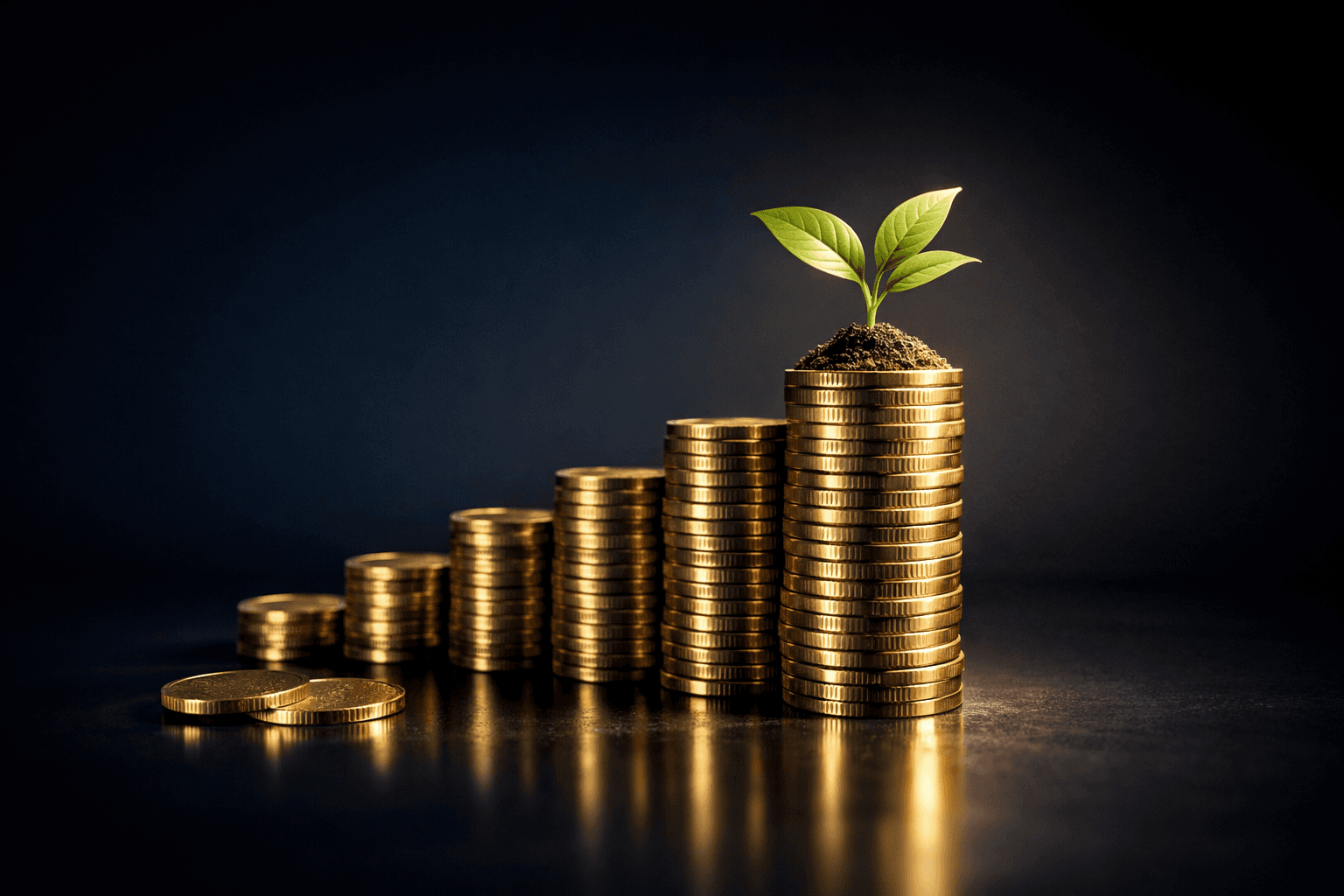
You can think of compounding like a snowball rolling downhill. At first it's small, but as it picks up more snow it grows faster and faster. That's why time is your most powerful ally when you invest.
Simple Formulas and an Easy Rule of Thumb
You do not need advanced math to benefit from compounding, but a basic formula helps you estimate future value. For annual compounding, future value equals your principal times one plus the annual rate raised to the number of years.
Expressed simply, if you invest P dollars at r percent per year for t years, the future value is P times one plus r to the power of t. This describes how money grows when returns are reinvested each year.
The Rule of 72
A helpful mental shortcut is the Rule of 72. Divide 72 by an annual return rate to estimate how many years it takes to double your money. For example, at 8 percent per year, 72 divided by 8 equals nine years to double. This rule isn't exact but it's easy to use and good for planning.
Examples That Make It Real
Examples help turn abstract ideas into real expectations. Below are practical scenarios any new investor can relate to. All examples assume returns are reinvested and taxes and fees are ignored for simplicity.
Example 1: Small monthly investment over long time
Imagine you invest $100 each month into a broad US market fund like $VTI and earn an average 7 percent annual return. After 30 years, your balance will be roughly $100 times the future value of a series of monthly contributions. Using standard compounding math that ends up around $100 times 1,000 equals about $120,000. That means $36,000 you contributed turned into roughly $120,000 thanks to time and compounding.
Example 2: The cost of waiting
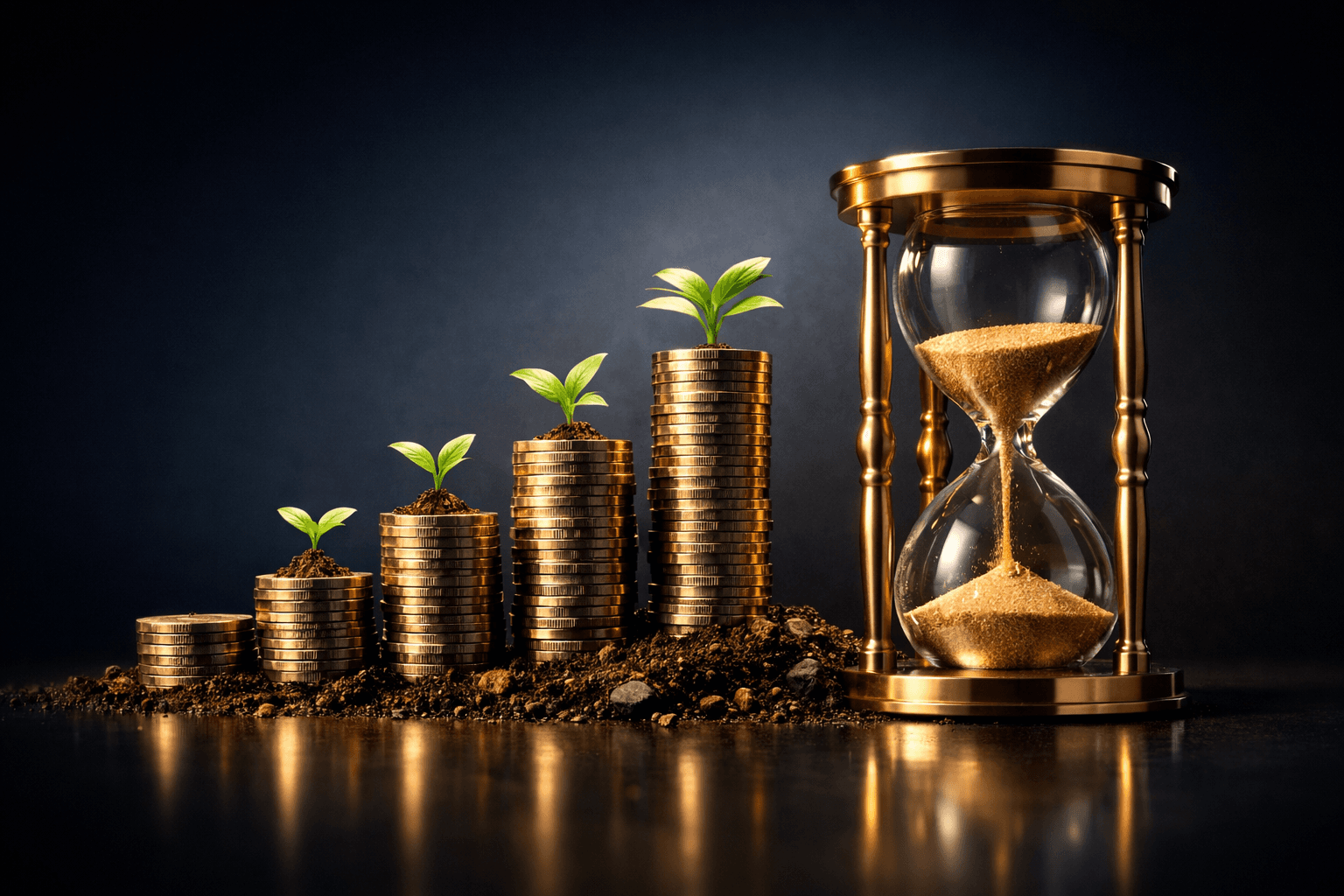
Two people each plan to save for retirement. Person A starts at age 25 and invests $200 a month for 20 years then stops contributing and leaves the money invested. Person B waits until age 45 and then invests $200 a month for 20 years. If both get a 7 percent annual return, Person A ends up with much more. The early starter benefits from compounding on the earlier contributions even though both invested the same total amount during their active saving years.
Starting early can be worth tens of thousands of dollars or more, depending on contribution sizes and returns.
Example 3: Lump sum versus time
Suppose you have a lump sum of $5,000 and put it into $AAPL or a broad fund like $VOO that averages 9 percent a year over decades. In 30 years that $5,000 could grow to roughly $70,000. If you waited five years to invest, you'd lose the compound growth of those five years and end up with a significantly smaller balance at year 30.
Compounding in the Stock Market
Stocks and stock funds offer a natural compounding engine because they produce both capital gains and dividends. When you reinvest dividends they buy more shares which then generate more dividends. Over many years this reinvested income becomes a growing part of total returns.
For example, reinvesting dividends in a dividend-paying stock like $MSFT or a total market ETF like $VTI can significantly increase total returns compared to taking dividends as cash. Historical data show that dividends and their reinvestment have accounted for a large portion of long-term stock market gains.
Practical steps to capture compounding in the market
- Pick diversified funds, such as broad market ETFs, to capture steady long-term growth.
- Use automatic dividend reinvestment plans so earnings buy more shares automatically.
- Keep cashing out to a minimum, because taking money out interrupts compounding.
Strategies That Work With Compounding
Compounding rewards consistency more than perfect timing. Here are simple strategies you can use to harness compounding in real life.
Dollar-cost averaging
Dollar-cost averaging means investing a fixed amount on a regular schedule, such as monthly. This reduces the risk of investing a lump sum at the wrong time and helps you keep contributing through market ups and downs. Over time those regular contributions benefit from compounding as the invested amounts grow.
Automatic contributions
Set up automatic transfers from your paycheck or checking account to your investment account. This enforces discipline, keeps you investing consistently, and ensures your contributions start compounding right away.
Tax-advantaged accounts
Use tax-advantaged accounts like an IRA or 401k when possible. These accounts let your investments compound without annual tax drag, which can make a big difference over long time periods. If you leave your earnings to compound without yearly taxes, your balance grows faster.
Real-World Numbers: How Small Changes Add Up
Seeing numbers side by side makes compounding easier to appreciate. Below are a few scenarios showing the long-term impact of small changes.
- Saving $50 per month at 7 percent for 40 years grows to about $110,000.
- Saving $200 per month at 7 percent for 40 years grows to about $440,000.
- Doubling your contribution has a linear effect on the principal contributed, but the compound growth on a larger base can more than double your final balance over long periods.
Small increases in your monthly savings or small improvements in average return percentages make substantial differences over decades. Time multiplies both contributions and returns.
Common Mistakes to Avoid
- Starting late, then expecting quick fixes, which reduces the time compound interest has to work. Start as soon as you can, even with small amounts.
- Withdrawing frequently, which interrupts compounding. Leave earnings invested to let them grow.
- High fees and frequent trading, which lower your effective return and slow compounding. Choose low-cost funds and avoid excessive turnover.
- Ignoring dividends and reinvestment, which forgoes a large component of total stock returns. Reinvest dividends automatically when possible.
- Chasing short-term market timing instead of following a consistent plan, which often leads to missed compounding opportunities. Stick to a long-term approach.
FAQ
Q: What rate of return should I expect from the stock market?
A: Historically, broad US stock market returns have averaged roughly 7 to 10 percent annually before inflation. Past performance does not guarantee future results, but using a conservative long-term estimate like 7 percent for planning gives you a reasonable base to model compounding effects.
Q: How much should I start investing to get the benefits of compounding?
A: You can start small. Even $25 or $50 per month will grow over decades because of compounding. The important part is consistency and time, so start with an amount you can maintain and increase it when possible.
Q: Do dividends really make a difference over time?
A: Yes. Dividends and their reinvestment can account for a substantial portion of long-term stock market returns. Reinvested dividends buy more shares which in turn produce more dividends, creating a compounding loop.
Q: Will compounding still work if the market is volatile?
A: Volatility may slow short-term growth, but compounding still works over long periods if you stay invested. Regular contributions and reinvestment help smooth the impact of ups and downs and let compounding do its job.
Bottom Line
Compound interest is one of the simplest and most powerful forces in investing. Time, consistent contributions, and reinvestment of returns combine to turn modest savings into meaningful wealth. You do not need to be rich to benefit, but you do need to start and be patient.
Actionable next steps for you are straightforward. Open a low-cost account, set up automatic contributions, choose diversified funds or ETFs like $VTI or $VOO, and enable dividend reinvestment. At the end of the day, the best plan is the one you start and stick with.