Introduction
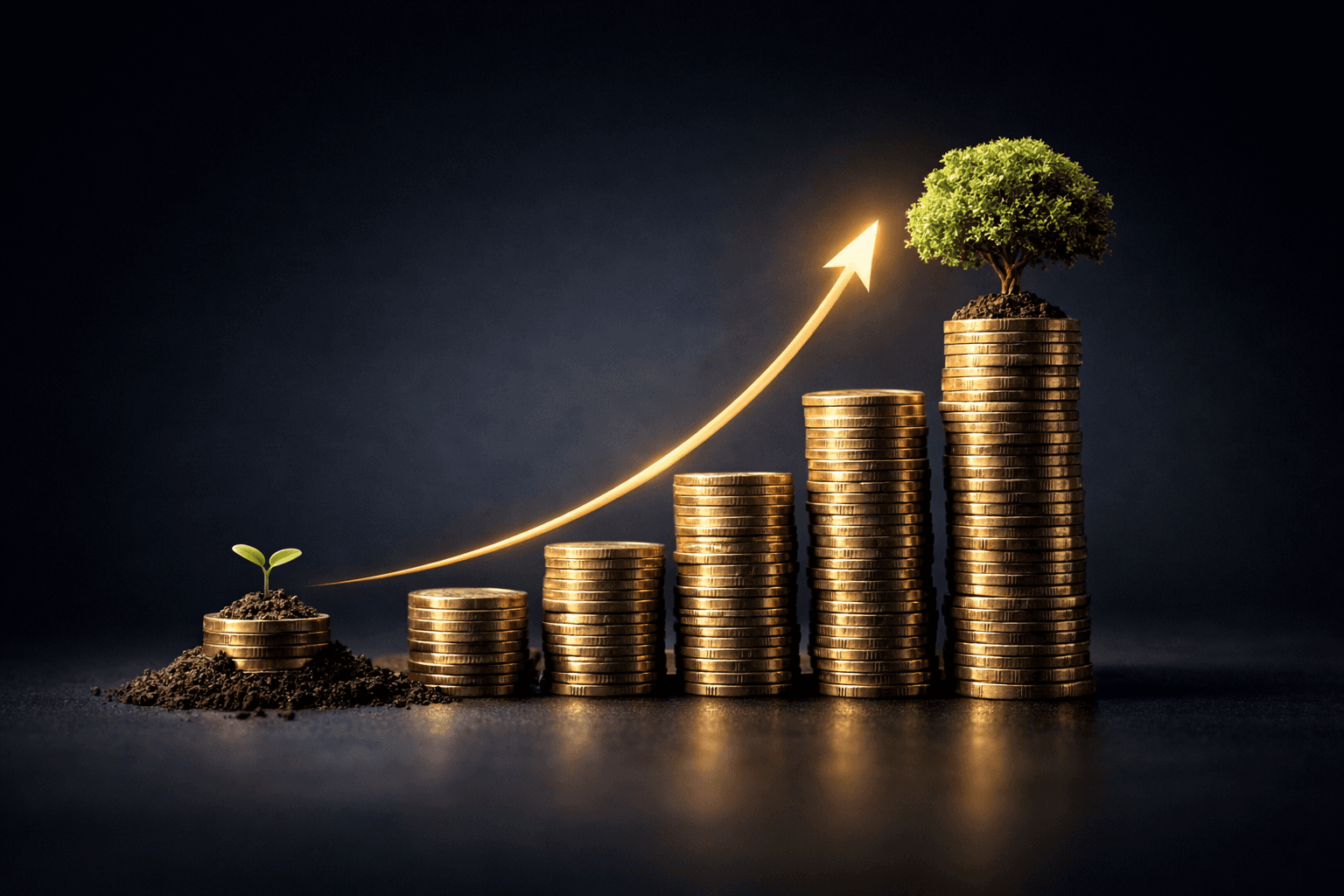
Compound interest is the process where your investment earnings generate their own earnings. Put simply, you earn returns on both the money you put in and on the returns you already earned. That creates exponential growth that accelerates the longer you stay invested.
Why does this matter to you? Because starting even a few years earlier can make a huge difference to your long-term wealth. If you want to retire sooner, meet financial goals, or simply get more from modest monthly contributions, compounding is the single most powerful tool you can use.
In this article you will learn how compounding works, why time matters more than the exact dollar amount, practical ways to harness compounding, and realistic examples using familiar tickers like $AAPL and broad-market funds. Ready to see how small actions today can turn into big results later?
- Compound interest means earning returns on prior returns, creating exponential growth over time.
- Time in the market usually beats timing the market, because compounding needs time to accelerate.
- Small monthly contributions add up: $100 per month at 7% for 30 years grows to about $122,000.
- Reinvesting dividends and minimizing fees significantly improves long-term returns.
- Start early, be consistent, and choose low-cost diversified investments to benefit the most.
How Compound Interest Works
Compound interest takes place when investment gains are added back to the original principal so future gains are calculated on a larger base. The process repeats each period, which can be annually, monthly, or daily. The faster you reinvest earnings, the sooner compounding kicks in.
Simple versus compound growth
Simple interest pays only on the original amount. Compound interest pays on the original amount plus accumulated earnings. Over long periods compound growth pulls ahead dramatically, because each cycle earns on a bigger balance.
A basic formula, explained plainly
For regular monthly contributions you can think of future value as the sum of each contribution grown by the investment return for the remaining time. In plain language, every dollar you invest keeps working and grows at the same rate until the end date.
Example numbers help more than a formula for beginners. Below you'll see clear scenarios that show compounding in action, and you can use online calculators or your brokerage app to test different rates and timeframes.
Why Starting Early Matters More Than You Might Think
Time is the multiplier in compounding. The longer money is allowed to compound, the more powerful the effect. That means a younger start often beats larger contributions started later.
Ask yourself, what happens if you start 10 years earlier? The answer is not linear. Early contributions grow for more periods and then compound on larger balances, so they can produce outsized results compared with later additions.
Two investors, same total contributions, different starts
Imagine two people each contributes $200 per month. Person A starts at age 25 and contributes for 10 years, then stops and lets the balance grow. Person B starts at age 35 and contributes $200 per month for 30 years. Both stop at age 65. Using a 7% annual return for both, Person A ends up with more money even though they contributed for fewer years. That illustrates time beating extra years of contributions later on.
At the end of the day, even modest early habits can compound into meaningful sums. You don't need to be rich to start, you just need time and consistency.
Practical Ways to Harness Compounding
Compounding works best when you combine early starts with steady habits and low costs. Here are practical steps you can take today to maximize compounding for your goals.
- Start small and be consistent: automated monthly investments turn saving into a habit and avoid decisions based on emotions.
- Reinvest dividends and distributions: choose the automatic dividend reinvestment option in your brokerage to buy more shares automatically.
- Prefer low-cost, diversified investments: index funds and ETFs like broad-market funds reduce fees that eat into returns over decades.
- Minimize taxable events: long-term accounts such as IRA or Roth IRA let compounding grow with fewer tax interruptions.
- Watch fees and expenses: even one percentage point of extra fees can cut decades of growth by a large amount.
Investment examples for beginners
If you want simplicity, a broad-market ETF or mutual fund is a good place to start. Examples include a total U.S. stock market fund or a global stock fund. For example, a low-cost ETF similar to $VTI can provide diversified exposure that compounds as the underlying companies grow and pay dividends.
Individual stocks like $AAPL or $MSFT can also compound if you reinvest dividends and hold for the long term, but they carry company-specific risk. For most beginners a diversified low-cost fund is easier and safer for compounding to work predictably.
Real-World Examples
Numbers make compounding tangible. Below are simple, realistic scenarios that show how small monthly contributions grow over time at different rates.
Example 1: $100 per month at 7% for 30 years
Assume you invest $100 every month into a diversified fund that averages 7% annually. Over 30 years this grows to about $122,000. You contributed $36,000 in total, so compound interest produced roughly $86,000 in earnings. That shows how earnings on earnings add up.
Example 2: The benefit of starting 10 years earlier
If you invest $200 per month at 7% for 40 years you end up with about $263,000. If instead you start 10 years later and invest $200 per month for 30 years, you end up with about $244,000. Starting earlier, even with the same monthly amount, produced a larger outcome.
Example 3: Lump-sum versus regular saving
A single $10,000 lump sum invested at 7% for 30 years grows to about $76,000. If you contribute $100 per month instead, you get to roughly $122,000 after 30 years. Regular contributions plus compounding can beat a one-time investment of similar size because you add more capital over time and capture growth along the way.
Reinvesting dividends in practice
Dividends are a concrete source of compoundable returns. A fund with a 2% yield that reinvests distributions adds to total return. Over decades reinvested dividends can account for a significant portion of the long-term gain, sometimes half or more of total returns depending on the market and the period.
Common Mistakes to Avoid
- Waiting for the perfect moment: Trying to time the market often means missing years when most of the returns happen. Start now and stay consistent to capture compounding.
- Ignoring fees and expenses: High expense ratios and trading costs reduce the money that can compound. Use low-cost funds and limit unnecessary trades.
- Not reinvesting dividends: Cashing dividends interrupts compounding. Use automatic dividend reinvestment when possible.
- Changing strategies too often: Frequent shifts in allocation reset the compounding process and can incur costs and taxable events. Decide on a plan and stick with it long enough to see compounding work.
- Underestimating inflation: Nominal compound returns can look large, but inflation reduces purchasing power. Aim for real returns above inflation and consider tax-advantaged accounts.
FAQ
Q: How much return should I assume when planning?
A: For planning purposes many investors use a long-term nominal equity return between 6% and 8% per year. The S&P 500 has historically averaged around 10% nominal annually, which is roughly 6% to 7% after inflation. Use conservative estimates for planning and test different rates with a calculator.
Q: Can I get compounded returns with savings accounts or bonds?
A: Yes, compounding works wherever returns are reinvested. High-yield savings accounts and bonds compound at their respective rates, but those rates are usually lower than long-term stock returns, so growth over decades will be smaller.
Q: How important are dividends to compounding?
A: Dividends are an important part of total returns for many stocks and funds. Reinvested dividends buy more shares, which then generate their own dividends and growth, accelerating compounding over long periods.
Q: What if I can't start much today? Is it still worth investing small amounts?
A: Absolutely. Small amounts invested consistently still benefit from compounding. Starting small builds the habit and gives your money time to grow, and increases in income can be redirected to savings later to accelerate results.
Bottom Line
Compound interest is one of the most powerful principles for building long-term wealth. Time in the market and consistent contributions usually beat attempts to time the market. By starting early, reinvesting earnings, minimizing fees, and choosing diversified low-cost investments you give compounding the best chance to work for you.
Next steps you can take today include setting up automatic monthly investments, enabling dividend reinvestment in your brokerage, and using an online compound interest calculator to model scenarios for your timeline. Remember, you do not have to be perfect to succeed. Small, consistent actions taken early will grow over time.