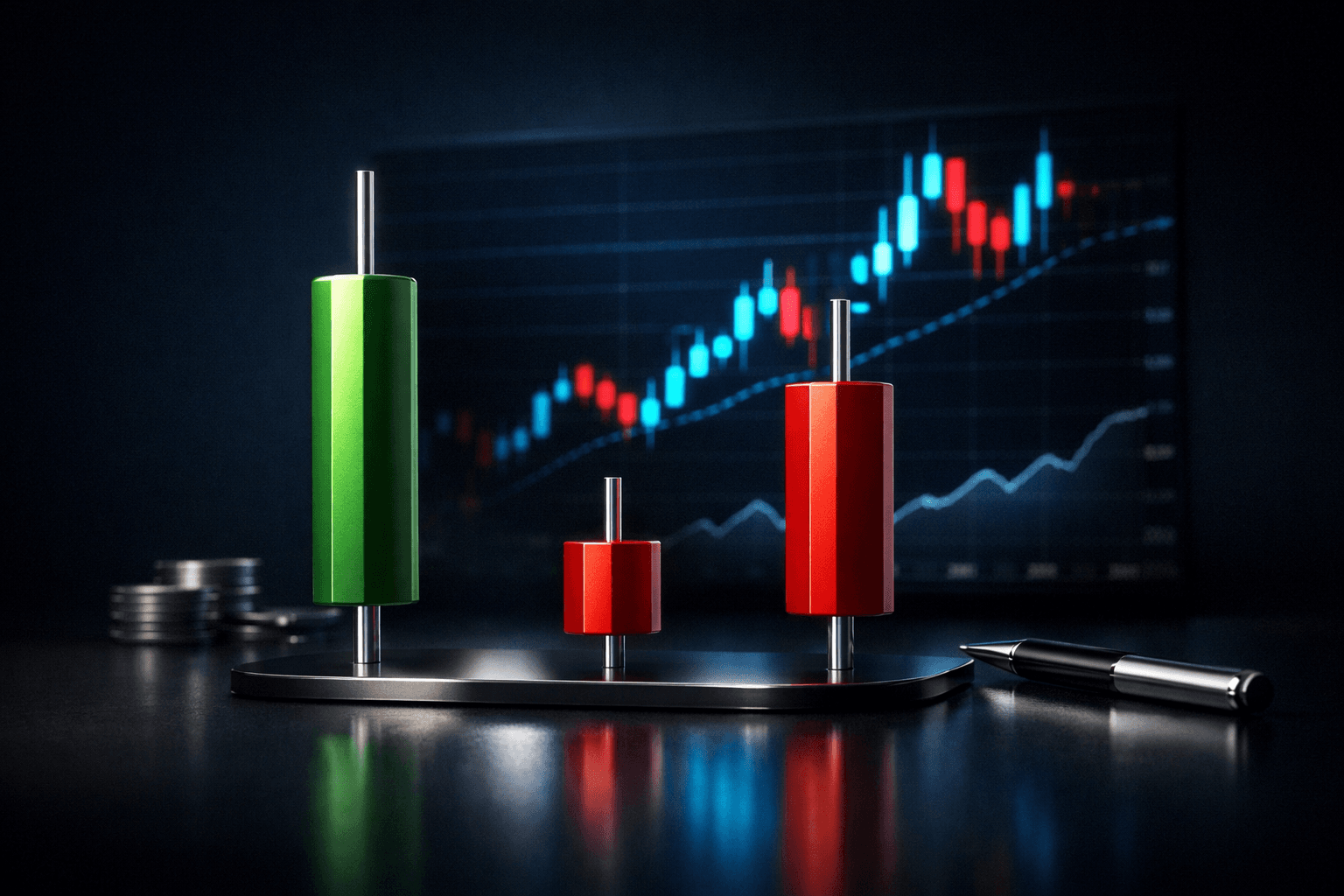
- Candlesticks show four prices per period, open, high, low, close, and the body and wicks reveal buyer/seller strength.
- Single-bar patterns (doji, hammer) indicate possible indecision or reversal; multi-bar patterns (engulfing, morning star) add confirmation.
- Use patterns with trend context, volume, and support/resistance, patterns alone aren’t reliable signals.
- Risk management (stop-losses, position sizing) is essential because candlestick patterns can fail often.
- Practice spotting patterns on real tickers like $AAPL and $TSLA to build pattern recognition and timing skills.
Introduction
Candlestick patterns are a visual language traders use to read price action and infer short-term market sentiment. Each candlestick compresses a period’s price movement into a simple shape that hints whether buyers or sellers were in control.
For beginner investors, learning candlesticks matters because they provide quick, actionable context, when combined with trend analysis and volume, about potential reversals, continuations, or pauses in price. This guide explains what candlesticks represent, walks through the most common patterns, and shows how to use them in real-world scenarios.
What you’ll learn: how to read a candlestick, the meaning of common single- and multi-bar patterns (doji, hammer, engulfing, etc.), practical examples with $AAPL and $TSLA, and rules to avoid common mistakes.
How Candlesticks Work: The Basics of Price Action
A candlestick summarizes four prices during a time period: open, high, low, and close. The rectangular body is the distance between the open and close. Thin lines above and below the body are wicks or shadows and show the high and low.
Color or fill indicates direction: a bullish candle (close > open) often shows as white or green; a bearish candle (close < open) shows as black or red. The body size signals the strength of buying or selling; long bodies show conviction, short bodies indicate indecision.
Key terms
- Body: distance between open and close.
- Wick/shadow: high/low extremes for the period.
- Bullish candle: close above open.
- Bearish candle: close below open.
Single-Candle Patterns: Signals of Indecision or Reversal
Single-candle patterns are quick to spot and useful for intraday and swing traders. They are best read in context of the prevailing trend and nearby support/resistance.
Doji
A doji forms when open and close are nearly equal, producing a very small or non-existent body. It signals market indecision, buyers and sellers reached balance during the period.
Interpretation: A doji after a long uptrend can warn of a potential reversal or pause. Confirmation from the next candle (e.g., a bearish close) improves reliability.
Hammer and Hanging Man
Both have small bodies and long lower wicks. A hammer appears in a downtrend and suggests buyers pushed price up from a low, possible bullish reversal. A hanging man looks similar but occurs in an uptrend and can warn of a bearish reversal.
Look for confirmation: a higher close following a hammer (buyer's follow-through) or a lower close after a hanging man (seller confirmation).
Shooting Star and Inverted Hammer
A shooting star has a small body near the low of the session and a long upper wick; it appears during an uptrend and indicates buyers failed to sustain highs. An inverted hammer is the upside-down mirror and can signal a bottom when it appears in a downtrend.
Multi-Candle Patterns: Stronger Signals with Context
Two- and three-bar patterns combine information across periods and generally provide stronger evidence than single-bars. Traders usually prefer multi-bar confirmations before acting.
Bullish and Bearish Engulfing
An engulfing pattern occurs when one candle’s body fully engulfs the previous candle’s body. A bullish engulfing happens when a bullish candle engulfs a bearish one, commonly seen as a strong reversal signal at a bottom. The bearish engulfing is the opposite and can mark tops.
Example: If $AAPL is in a short downtrend and you see a large bullish candle completely encompassing the prior bearish candle, the pattern hints at a change in control from sellers to buyers. Confirm with higher volume and a follow-through close above the engulfing candle’s high.
Morning Star and Evening Star
These are three-bar reversal patterns. A morning star starts with a strong bearish candle, a small-bodied candle (often a doji) showing indecision, and then a strong bullish candle, indicating a shift to buying. The evening star is the bearish equivalent at highs.
These patterns are more reliable when the middle candle gaps away from the trend candle and when the final candle closes well into the body of the first candle.
Putting Patterns into Practice: Rules and Examples
Candlestick patterns are most useful when combined with trend analysis, support/resistance levels, and volume. Use a checklist before treating a pattern as an actionable signal.
- Confirm the trend: is the pattern forming at a logical point, a swing high, swing low, or consolidation area?
- Look for confirmation: wait for the next candle to validate the signal (e.g., follow-through close).
- Check volume: higher volume on the confirming candle adds credibility.
- Use risk management: set stop-losses and use sensible position sizing.
Real example: Suppose $TSLA has been rising and hits a resistance zone around a prior high. A shooting star forms on heavy volume followed by a bearish candle closing below the low of the shooting star. That sequence provides a clearer signal that the up-move may be exhausted.
Another example: $AAPL is in a downtrend and forms a hammer at a long-term support level. The next day, volume increases and price closes above the hammer’s high. With a stop below the hammer’s low, this pattern offers a measured trade setup with defined risk.
Real-World Examples: Step-by-Step Scenarios
Example 1, Bullish Engulfing on $AAPL: Imagine $AAPL trades lower three consecutive days, each closing near the low. On day four, a large bullish candle opens below the prior close then rallies to close above the previous day’s open, fully engulfing it. Volume is 30% above average. Interpretation: buyers stepped in aggressively; a trader might watch for a follow-through close above the engulfing candle to consider a bullish thesis, while managing risk with a stop under the engulfing low.
Example 2, Doji at Resistance on $TSLA: $TSLA advances into a prior resistance price range. A doji forms on high volume, signaling indecision at that level. If the next session closes lower, this supports a short-term reversal view. Traders would emphasize position sizing and use a stop above the high to limit loss if the breakout continues.
How to Use Candlesticks with Other Tools
Candlesticks work best as part of a toolkit. Combine them with moving averages, support/resistance, and simple momentum indicators like RSI for better context.
- Support/Resistance: Patterns at established levels are more meaningful than patterns in the middle of a range.
- Moving Averages: A hammer near a rising 50-day moving average may suggest a continuation; a shooting star above a long-term moving average could indicate exhaustion.
- Volume: Confirmation on higher-than-average volume increases confidence in the pattern.
Common Mistakes to Avoid
- Seeing patterns in isolation: Relying only on the candle pattern without trend or volume context can produce many false signals. Always use a checklist (trend, confirmation, volume).
- Ignoring timeframes: A pattern on a 5-minute chart is different from the same pattern on a daily chart. Match the timeframe to your trading horizon.
- Overtrading minor patterns: Not every doji or hammer requires action, look for meaningful location and confirmation before trading.
- No risk plan: Entering trades without defined stops or position sizing leads to outsized losses when patterns fail. Define risk per trade first.
- Confirmation bias: Seeing what you want to see is common, use objective rules (e.g., wait for a close beyond a reference price) to reduce bias.
FAQ
Q: What timeframe should I use to read candlestick patterns?
A: It depends on your goals. Day traders use 1, 15 minute charts; swing traders prefer hourly to daily charts. Use a timeframe aligned with your holding period and confirm patterns across higher timeframes for reliability.
Q: Can candlestick patterns predict price direction perfectly?
A: No. Candlestick patterns indicate probabilities, not certainties. Many patterns fail; they become useful when combined with trend, volume, and risk controls to manage probabilities.
Q: How important is volume when interpreting patterns?
A: Volume is a valuable confirmatory tool. A reversal pattern on low volume is weaker than the same pattern on high volume, which suggests stronger conviction by market participants.
Q: Should beginners trade every pattern they see?
A: No. Beginners should focus on a few reliable patterns, apply simple confirmation rules, and practice with paper trading or small sizes to build experience before increasing exposure.
Bottom Line
Candlestick patterns are a compact, visual way to read price action and gauge short-term shifts in buyer and seller behavior. Single-bar patterns like doji and hammer flag indecision or possible turnarounds, while multi-bar patterns like engulfing and morning star provide stronger clues when confirmed with volume and trend context.
Actionable next steps: study a handful of patterns, practice identifying them on historical charts (use $AAPL and $TSLA), create a simple confirmation checklist (trend, volume, follow-through), and always define risk before entering trades. With practice and discipline, candlesticks become a useful part of your analysis toolkit.