Key Takeaways
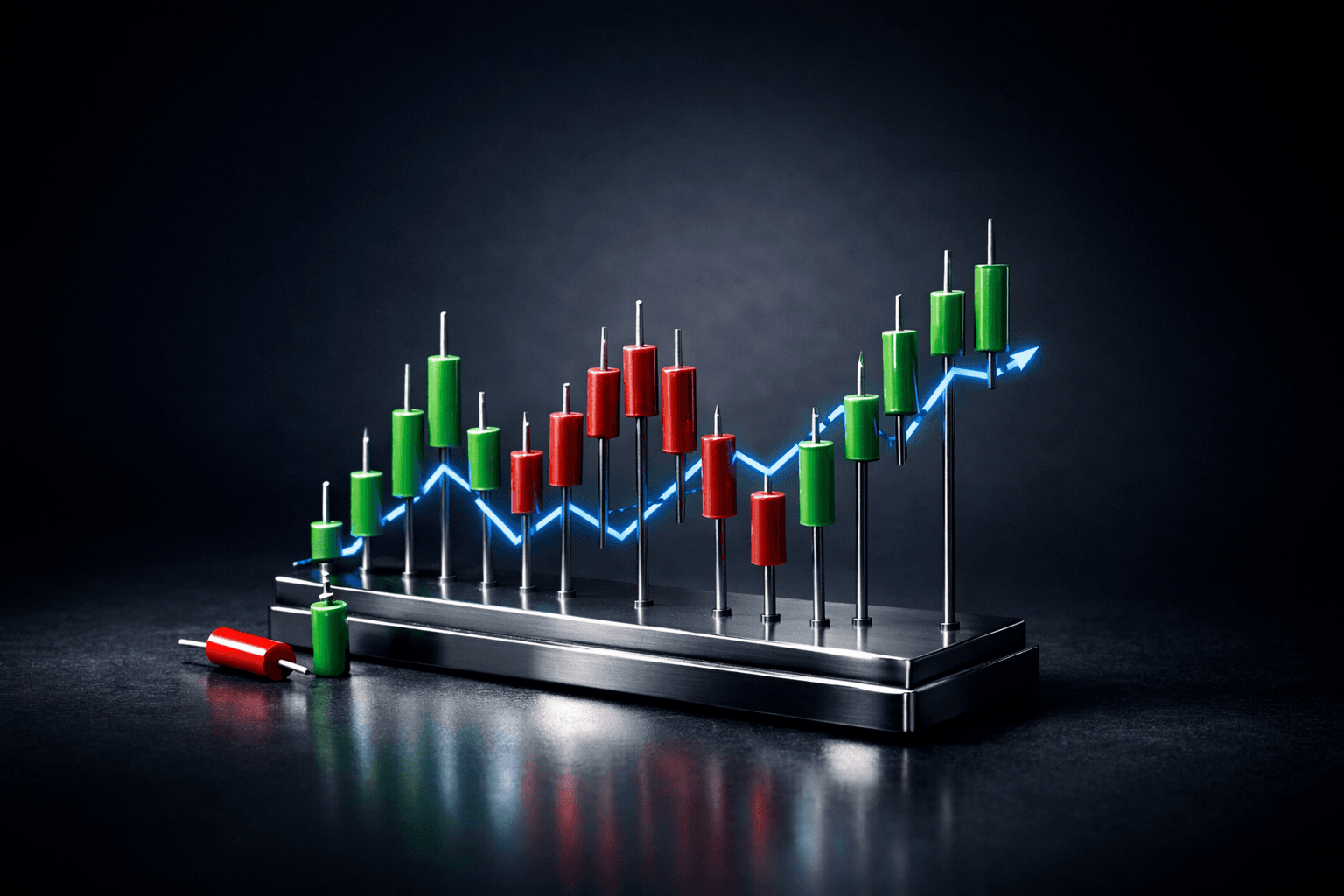
- Candlestick charts show open, high, low, and close prices for a time period, using a body and wicks to make price action visual.
- A bullish candle usually closes above its open, a bearish candle closes below, and a doji shows indecision when open and close are nearly equal.
- Look at candle size, wick length, and context with nearby candles to assess strength and potential reversals.
- Combine candlesticks with volume and trend direction to reduce false signals and improve reading of momentum.
- Avoid overtrading on single candles, and practice on charts for $AAPL, $MSFT, or $TSLA to build pattern recognition skills.
Introduction
Candlestick charts are a type of price chart that show four key numbers for a time period: the opening price, the closing price, the high, and the low. They package those numbers into a simple visual that helps you see what traders did during the period and how they felt about price direction.
Why does this matter to you as an investor or new trader? Because candlesticks let you read short term sentiment and momentum without getting lost in raw price numbers. If you want to understand market emotions and spot potential turning points, candlesticks are one of the best starting tools.
In this article you'll learn how to read a single candlestick, recognize a few basic patterns like bullish candles, bearish candles and doji, and use candlesticks alongside trend and volume to make smarter observations. Ready to start learning how the chart speaks to you?
How to Read a Single Candlestick
One candlestick represents price movement for a chosen time frame, such as one day, one hour, or one minute. Each candle has a body that shows the open and close, and wicks that show the high and low. You can tell at a glance whether buyers or sellers dominated that period.
Body, wicks, open and close
The body is the rectangular part of the candlestick. When the closing price is higher than the opening price, the body is a bullish candle. When the close is lower than the open, the body is a bearish candle. The lines above and below the body are wicks or shadows and they show the highest and lowest traded prices during the period.
Color and size meaning
Colors vary by charting platform, but the principle is the same. A bullish candle often appears lighter or green, and a bearish candle often appears darker or red. The length of the body shows how much price moved between open and close. A long body signals strong buying or selling pressure. A short body suggests indecision or a balance between buyers and sellers.
Wick interpretation
Wicks tell you about rejection and testing of price levels. A long upper wick means prices reached higher levels but sellers pushed price back down before close. A long lower wick means buyers pushed price up after testing lower levels. Short wicks indicate that price stayed near the open and close most of the time.
Basic Candlestick Patterns and What They Mean
Patterns are simply commonly seen shapes of one or more candles that traders use to infer likely next steps. For beginners, focus on a few simple, reliable patterns and the context around them. Knowing patterns is less important than reading the trend and volume at the same time.
Bullish candle
A bullish candle closes above its open and usually has a relatively long body. If you see a series of bullish candles trending higher, that suggests buying momentum. For example, a multi-day run of bullish candles on $AAPL with rising volume suggests the uptrend has conviction.
Bearish candle
A bearish candle closes below its open and often appears after selling pressure. If you see a sudden large bearish candle after a rally, it could signal a shift in sentiment. For instance, a large bearish day on $TSLA following disappointing news can reflect strong seller dominance.
Doji
A doji occurs when open and close are nearly the same, producing a very small body. Doji candles show indecision and can appear at tops or bottoms. A doji alone is not a reversal signal, but if it appears after a long trend and is followed by confirmation in the next candle, it can indicate a change in direction.
Hammer and Shooting Star
A hammer has a small body near the top of the range and a long lower wick, and it appears after a decline. It suggests buyers stepped in after sellers pushed price down. A shooting star is the mirror opposite. It has a small body near the low and a long upper wick, and it can signal a bearish reversal after an advance.
Engulfing patterns
An engulfing pattern involves two candles. A bullish engulfing pattern is a large bullish candle that completely covers the prior bearish candle's body. That may indicate a strong shift to buying pressure. A bearish engulfing pattern is the reverse and can suggest a shift to selling pressure.
Using Candlesticks to Gauge Momentum and Sentiment
Candlesticks don't exist in isolation. The same candle can mean different things depending on trend, support and resistance, and volume. Use them as a visual amplifier of price action and market feeling, not as a standalone trading signal.
Context is everything
If you see a bullish candle during an uptrend, it's confirmation of strength. If the same bullish candle appears inside a downtrend, it might be a temporary pullback. Look at recent swing highs and lows. Ask whether this candle brings price closer to a known support or resistance level.
Volume and candle strength
Volume shows how many shares changed hands during the candle. A long bullish candle with high volume suggests true buying interest. A long candle on low volume is less convincing. For example, a strong green candle on $MSFT with a 50 percent rise in volume is more meaningful than the same candle on average volume.
Multiple timeframe confirmation
Check candles on higher and lower timeframes to see if signals align. A bullish intra-day candle may be noise if the daily chart still shows strong bearish momentum. You want confirmation across timeframes before you treat a candle as a reliable signal.
Real-World Examples
Seeing candlesticks applied to real tickers helps make abstract ideas concrete. Below are brief scenarios using commonly followed stocks so you can practice pattern recognition on live charts.
-
Example 1, $AAPL daily reversal: After a three-week uptrend $AAPL prints a long upper wick candle followed by a bearish engulfing candle the next day. Volume rises on the engulfing candle. Interpretation, the long upper wick suggested buyers could not sustain higher prices, and the engulfing day with higher volume signaled stronger selling pressure. This is an example where candle shape, sequence, and volume align to indicate a probable short-term pullback.
-
Example 2, $TSLA intraday hammer: During a sharp intraday drop $TSLA forms a hammer with a long lower wick and small body, and the next candle is bullish. Interpretation, buyers stepped in after sellers pushed price down, and intraday confirmation supports a possible recovery. Traders often look for the next candle to close above the hammer's high for added confidence.
-
Example 3, $MSFT doji at resistance: $MSFT approaches a known resistance level and prints a doji on the daily chart. Volume is slightly below average. Interpretation, the doji shows indecision at resistance. Without volume and follow-through, the doji alone is not decisive. Wait for a breakout candle above resistance on increased volume to favor bulls, or a bearish candle to favor sellers.
Putting Candlesticks into a Routine You Can Practice
Practice makes candlestick reading useful. Set a simple routine you can repeat and improve over time. That way you'll build pattern recognition and learn to filter noise.
-
Choose a timeframe and stick with it while learning. Daily charts are a common place for beginners. They reduce noise compared to intraday charts and teach bigger-picture sentiment.
-
Scan for trends first. Ask, is the market in an uptrend, downtrend, or range? Candlestick signals are easier to interpret once you know the trend context.
-
Mark support and resistance levels. Note where prior highs and lows cluster and watch how candles behave near those areas.
-
Check volume when you see a pattern that could matter. Higher volume increases the credibility of a signal.
-
Keep a simple journal. Record the candlestick pattern, context, and what happened next. Reviewing past entries helps you learn which signals work for you.
Common Mistakes to Avoid
- Relying on a single candle to make decisions, without considering trend, volume, or support and resistance. How to avoid, always look for confirmation and context before drawing conclusions.
- Ignoring timeframes. How to avoid, cross-check signals on a higher timeframe and a lower timeframe for consistency before acting.
- Forcing patterns where none exist, by fitting ambiguous candles to a desired outcome. How to avoid, be objective and only label patterns that match clear definitions.
- Overweighting low-volume candles, which often reflect thin trading and can produce false signals. How to avoid, use volume as a filter and treat low-volume moves with caution.
- Neglecting risk management because patterns can fail. How to avoid, decide in advance how much risk you will accept and where you will exit if the market moves against you.
FAQ
Q: What time frame should I use to read candlesticks?
A: Use daily charts to start because they reduce short-term noise and teach broader trends. Once you are comfortable, study intraday charts for trade timing and weekly charts for longer-term context.
Q: Can candlesticks predict future prices?
A: Candlesticks show probable market sentiment and momentum but they do not predict with certainty. They provide clues that are stronger when combined with volume, trend analysis, and support or resistance levels.
Q: How do I practice recognizing patterns?
A: Practice by reviewing past charts for $AAPL, $MSFT, or $TSLA and marking recurring candle shapes. Keep a short journal of what you see and how the market reacted after each pattern to build real experience.
Q: Are candlestick patterns more useful for trading or investing?
A: Candlesticks are often used for short to medium term trading because they show short-term sentiment. Investors can use them to time entries and exits around key levels but should combine them with fundamental analysis for longer-term decisions.
Bottom Line
Candlestick charts are a compact, visual way to read market sentiment and price momentum. By learning how to interpret a single candle and a few basic patterns, you can quickly gain insights into what buyers and sellers are doing.
To build skill, practice on daily charts for familiar tickers like $AAPL and $MSFT, use volume and trend context, and keep a short journal of patterns and outcomes. At the end of the day, candlesticks are tools to help you see price action more clearly, and with consistent practice you will get better at spotting meaningful signals.