Key Takeaways
- AI excels at processing large, unstructured data sets, detecting nonlinear patterns, and executing high-frequency strategies, while humans bring macro judgment, context, and ethical considerations.
- Out-of-sample performance, transaction costs, capacity, and regime robustness matter more than in-sample backtest returns when assessing AI models.
- Common pitfalls for AI strategies include look-ahead bias, overfitting, data-snooping, and underestimating market impact; rigorous walk-forward testing mitigates these risks.
- Best practical approach for many investors is a quantamental blend: automated screening and risk models with human oversight and scenario analysis.
- Evaluate AI stock pickers using risk-adjusted metrics (Sharpe, Information Ratio), drawdown analysis, turnover-adjusted returns, and governance transparency.
Introduction
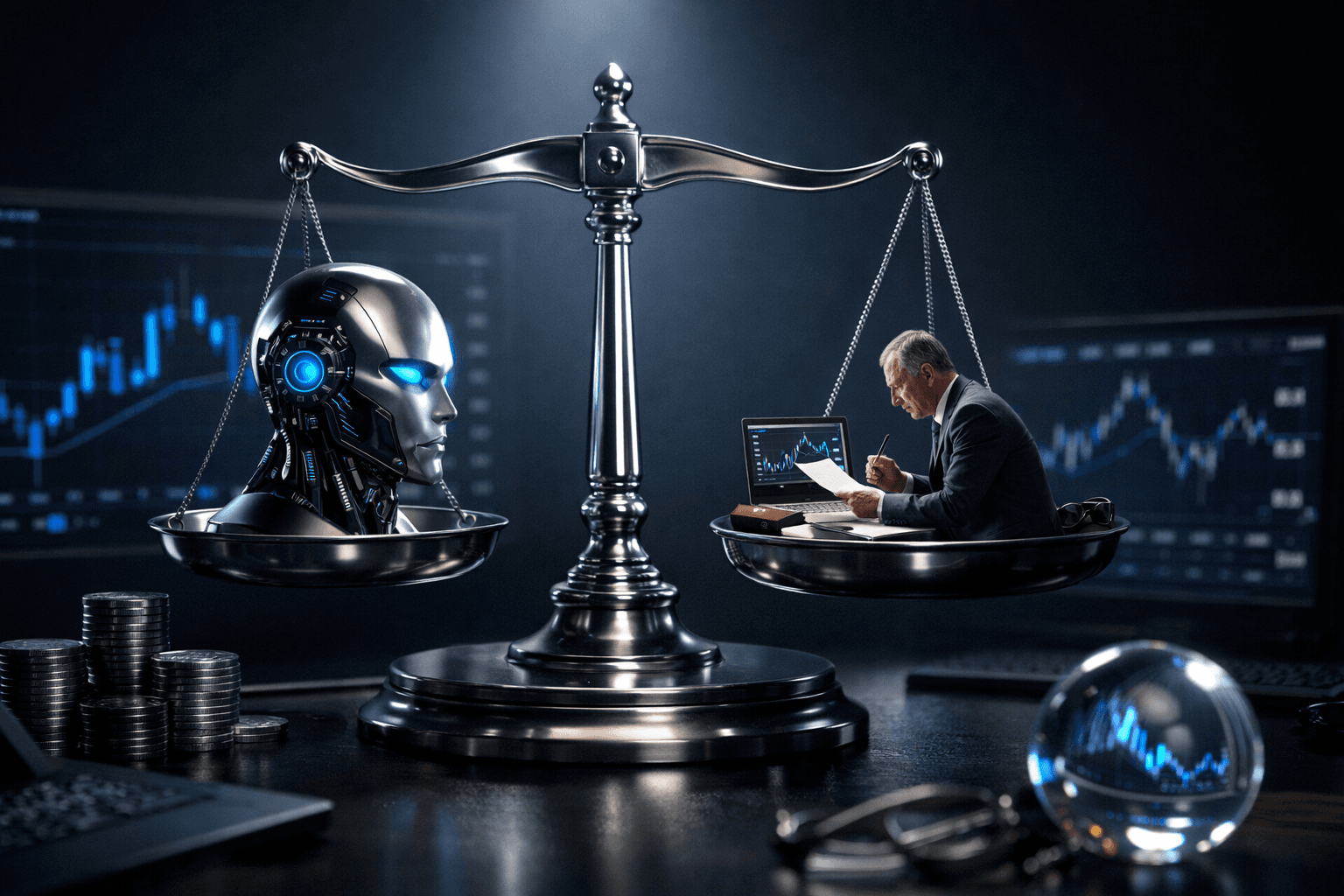
AI vs. human stock picking asks whether machine learning and algorithms can consistently outperform experienced investors and analysts. This question matters because AI tools are increasingly embedded in everything from retail robo-advisors to institutional hedge funds and portfolio risk systems.
In this article you will get a rigorous, practical framework to compare AI-driven stock selection with human-driven approaches. We cover how AI works in practice, the statistical and operational pitfalls, real-world examples, evaluation metrics, and a playbook for integrating AI and human judgment.
How AI Stock Picking Works: Methods and Mechanics
AI-driven stock picking typically uses supervised learning, unsupervised learning, reinforcement learning, or natural language processing (NLP). Models ingest structured financials, price histories, alternative data (satellite, credit card flows, web traffic), and textual sources (news, filings) to generate buy/sell signals or ranked universes.
Key architectural choices shape outcomes: feature engineering, choice of algorithm (gradient boosted trees, neural networks, random forests), training window, and the approach to cross-validation. Institutional deployments also layer in portfolio construction engines, transaction-cost models, and risk limits.
Common AI techniques
- Supervised models to predict returns or regimes (e.g., classification of earnings surprises).
- NLP to convert earnings calls and news into sentiment or event flags that feed models.
- Reinforcement learning for execution and tactical allocation where the model learns from simulated market interactions.
- Unsupervised clustering for sector/peer detection and anomaly discovery.
What Machines Do Better Than Humans
AI systems shine when the task involves high-dimensional input, fast pattern recognition, and repeatable decision rules. They can process millions of data points, run exhaustive scenario analyses, and operate continuously without emotional bias.
Examples include: high-frequency arbitrage, statistical factor harvesting, and sentiment-based signal extraction at scale. Institutional quant firms such as Two Sigma and many hedge funds use ML as an edge for specific systematic strategies.
Advantages in practice
- Scale: AI processes alternative datasets and tick-level data that humans cannot digest manually.
- Speed: Models can reweight positions within milliseconds, enabling exploitation of short-lived inefficiencies.
- Consistency: Algorithms apply the same rules across cycles, removing individual behavioral biases like anchoring or herding.
- Nonlinear pattern capture: ML models can detect interactions among predictors that linear models miss.
What Humans Still Do Better
Humans excel at synthesizing macroeconomic narratives, interpreting rare, novel events, applying judgment to regulatory and geopolitical risk, and integrating qualitative insights. Analysts can contextualize data in ways that current AI often cannot, especially in low-data or regime-change environments.
Case in point: during sudden crises (e.g., unexpected policy shifts or pandemic onset), models trained on historical data may fail to generalize, while experienced managers can apply judgment, pivot assumptions, and communicate rationale to stakeholders.
Human advantages
- Contextual reasoning about unprecedented events and structural breaks.
- Ethical and regulatory judgment, machines can propagate biases if trained on biased data.
- Ability to interrogate cause vs correlation with domain expertise and qualitative research.
- Client communication and governance: humans manage expectations and compliance reporting.
Evaluating AI vs. Human Performance: Metrics and Tests
Comparisons must focus on out-of-sample, transaction-cost-adjusted, risk-adjusted returns across multiple market regimes. Raw backtest returns are misleading unless you evaluate robustness and economic plausibility.
Key metrics and tests to run:
- Risk-adjusted performance: Sharpe ratio, Sortino, and Information Ratio to control for volatility and benchmark tracking.
- Drawdown analysis: peak-to-trough declines and recovery periods during stress events.
- Turnover and transaction costs: apply realistic slippage and market impact models to backtests.
- Capacity testing: estimate AUM at which performance degrades due to market impact or liquidity limits.
- Walk-forward and rolling-window validation: ensure the model's parameters survive time and different regimes.
Statistical robustness checks
- Out-of-sample and true forward testing with data the model has never seen.
- Bootstrapping and Monte Carlo simulations to test sensitivity to data selection.
- Permutation tests to assess whether alpha is likely due to chance.
Real-World Examples and Scenarios
Robo-advisors like Betterment and Wealthfront use rule-based and optimization engines for retail portfolio construction, combining simple factor tilts and tax-loss harvesting to deliver systematic outcomes at scale.
At the institutional level, firms such as Two Sigma and Renaissance leverage ML across signal generation, risk, and execution. BlackRock’s Aladdin operates as a risk and portfolio-management platform; it integrates quantitative analytics and scenario analysis across large portfolios.
Illustrative numerical scenario (hypothetical)
Consider a mid-frequency ML stock-ranking model that backtested on 2010, 2019. The in-sample annualized return was 14% versus a benchmark 8%, Sharpe 1.2 vs 0.7. After realistic transaction costs (0.4% per round-trip) and market-impact constraints at scale, out-of-sample annualized excess return compressed to roughly 3, 4%, with Sharpe ~0.9.
This illustrates two lessons: in-sample outperformance often shrinks materially once costs and capacity are included, and preservation of risk-adjusted return matters more than headline alpha.
Best Practices for Building and Using AI Stock Pickers
Whether you build models or evaluate third-party AI stock pickers, adhere to rigorous practices: separate training and execution data, maintain an economic rationale for signals, and embed governance and human oversight.
Practical checklist for investors and allocators
- Demand transparent performance records with transaction-cost adjustments and capacity estimates.
- Insist on walk-forward testing and documentation of feature engineering choices.
- Review governance: model retraining cadence, monitoring triggers, and escalation paths for anomalies.
- Simulate stress scenarios: how did/does the model behave in volatility spikes, liquidity droughts, or sudden macro shocks?
Common Mistakes to Avoid
- Relying solely on in-sample backtests: avoid deploying models without robust out-of-sample validation and forward runs.
- Ignoring transaction costs and capacity: a high-turnover strategy with low liquidity stocks will see alpha evaporate once market impact is modeled.
- Neglecting governance and explainability: black-box systems without monitoring can generate unacceptable tail risks.
- Overfitting to alternative data: more features increase the risk of spurious correlations if not regularized and validated.
- Underestimating regime shifts: models trained on calm markets may fail during market stress or structural change.
FAQ
Q: Can AI consistently beat professional analysts over long horizons?
A: AI can outperform in specific niches where patterns are stable and data is abundant, but consistent long-term outperformance across all market regimes is rare. The best outcomes often come from combining AI for signal generation with human oversight for macro and regime judgment.
Q: How do I tell if an AI stock picker's backtest is trustworthy?
A: Look for out-of-sample performance, turnover-adjusted returns, walk-forward testing, disclosure of data sources, and explanations of how look-ahead bias and survivorship bias were mitigated. Independent audits or live-paper trading results add credibility.
Q: Are there types of stocks or strategies where AI has a clear edge?
A: AI has an edge in high-frequency trading, processing alternative data for short- to medium-term signals, and uncovering nonlinear factor interactions. It is also effective for execution optimization and liquidity-sensitive strategies.
Q: How should an investor combine AI and human judgment in a portfolio?
A: Use AI for systematic signal generation and risk monitoring, then apply human judgment for portfolio construction, capacity planning, stress testing, and governance. Allocate a pilot portion of capital to live-test AI strategies before scaling.
Bottom Line
AI is a powerful tool in the investor toolkit but not a silver bullet. Machines outperform humans on scale, speed, and complex pattern recognition, while humans still lead on contextual judgment, interpreting novel events, and governance. Success depends on rigorous testing, realistic cost modeling, and clear oversight.
Next steps: insist on out-of-sample, turnover-adjusted performance when evaluating AI stock pickers; run stress and capacity tests; and consider a quantamental approach that pairs automated signal generation with human-led scenario analysis and portfolio governance.