The Big Picture
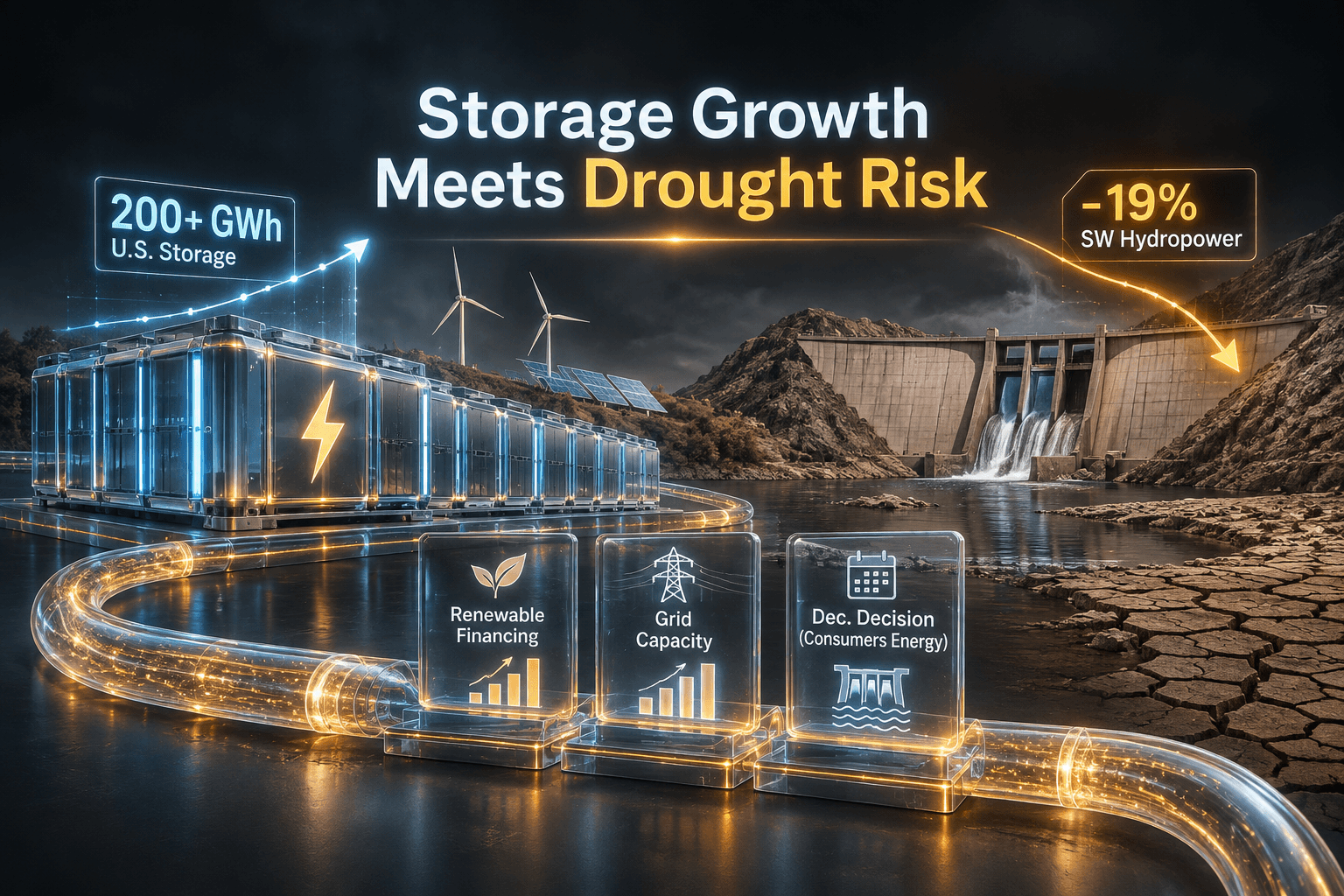
U.S. energy storage has crossed 200 GWh just as drought pushes Southwest hydropower to record lows, putting the sector’s transition and reliability challenges in sharp view. Storage additions and fresh financing for renewable projects suggest developers are still building, but they don’t erase the near-term strain on water-dependent generation or uncertainty over existing power assets.
For utilities and their investors, the question is how quickly new resources and grid improvements can meet demand while keeping supply dependable. The stories offer mixed signals, so your focus today should be on execution, policy decisions and regional differences rather than a single sector-wide trend.
Market Highlights
The strongest expansion signal came from a new report by the Solar Energy Industries Association and Benchmark Mineral Intelligence. It said U.S. installed energy storage capacity has topped 200 GWh, with 14.3 GWh added in the third quarter. That marks a significant buildout, though the report summary doesn’t provide a stock-price reaction or detail how much capacity is available to utilities in specific regions.
Water and conventional generation point to a tougher reliability picture. The U.S. Energy Information Administration reported that Southwest hydropower production fell 19% from last year and reached a record low this summer amid drought in the Colorado River Basin. Separately, a report says the Trump administration is requiring a seventh aging coal plant to stay open; the available summary doesn’t identify the facility or quantify its costs.
- U.S. installed energy storage: more than 200 GWh; 14.3 GWh added in Q3.
- Southwest hydropower: down 19% year over year this summer, to a record low.
- Exus Renewables North America: $345 million in senior secured holding company financing for its U.S. project portfolio.
- Consumers Energy dam sale: Michigan regulators expect a decision by December 17.
No utility share-price moves were included in the reports available this morning, so the developments provide operating and policy context rather than a read on today’s trading. What matters next is whether capacity additions and financing translate into projects that can come online where and when power is needed.
Key Developments
Storage and renewables build, while grid capacity faces a test
The 200 GWh storage milestone signals that batteries are becoming a larger part of the U.S. electricity system. In a related development, Soneil Spark introduced a mobile battery energy storage system built into a towable trailer. The company says the modular unit is designed to provide temporary backup and off-grid power, and is presenting it at RE+ 2026.
These announcements cover different scales, from nationwide installed capacity to a portable product, but both reflect growing interest in flexibility and backup power. Exus Renewables’ $345 million financing, led by Goldman Sachs Alternatives, is intended to support construction and development across its U.S. wind, solar and storage portfolio. Financing is an important step, though it isn’t the same as completed projects or operating generation.
Meanwhile, a survey commissioned for ADIPEC found that most senior energy-industry decision-makers surveyed believe current electricity-demand forecasts are too low. The article argues that making better use of the existing grid may be the fastest route to added capacity. For utilities, that puts attention on network efficiency and infrastructure constraints as well as new generation. You’ll want to distinguish the survey’s views from confirmed demand forecasts.
Drought deepens the reliability challenge
The 19% drop in Southwest hydropower is a direct reminder that generation depends on local conditions. When water levels and river flows are constrained, utilities may have less hydroelectric output available, increasing the importance of other generation, storage and transmission options. The report provides no estimate of resulting power prices or individual utility impacts, so the regional production figure shouldn’t be treated as a uniform sector-wide earnings signal.
The decision to keep a seventh aging coal plant open raises a different reliability and cost question. The source characterizes the plant as expensive and inefficient, but the summary doesn’t give its name, operating costs or the order’s terms. That lack of detail leaves investors with a policy development to monitor, not enough information to assess its financial impact on a particular utility.
Regulatory review and electrification developments
Consumers Energy has asked Michigan regulators to delay a sale of 13 hydroelectric dams. The Michigan Public Service Commission has set December 17 as the expected date for a final decision. The outcome could clarify ownership of those assets, but the reports don’t specify the proposed buyer, transaction value or reasons for the requested delay. If you follow CMS Energy (CMS), Consumers Energy’s parent, the proceeding is a company-specific regulatory item to watch.
Two automotive stories offer broader context for electrification, rather than a direct utility earnings catalyst. BMW opened a battery plant near its major Spartanburg facility in South Carolina, while XPENG ($XPEV) reported third-quarter revenue of 24.28 billion yuan, about $3.643 billion, and forecast 45% sales growth in the fourth quarter. More battery production and electric-vehicle sales may affect future electricity needs, but neither report quantifies added utility demand or near-term infrastructure requirements.
Solar and storage operations are also drawing software investment. enSights launched a business-management platform intended to bring together tasks such as power purchase agreements, warranties, billing, compliance and project profitability. Its launch reflects the operational complexity of growing portfolios, although the announcement doesn’t report customer adoption or financial results.
What to Watch
Today, watch for company or regulator updates that put numbers around these developments. The available news doesn’t list scheduled utility earnings or provide pre-market moves, so don’t assume the reports alone will drive trading. Regional exposure matters: drought-related hydro output is concentrated in the Southwest, while Michigan’s dam proceeding is specific to Consumers Energy.
Near-term checkpoints include the Michigan commission’s expected December 17 decision, updates on Exus project construction and further details about the coal plant directive. For storage, look for evidence that the 14.3 GWh installed in Q3 is connecting to the grid and supporting system needs. Investors can also compare future demand forecasts with actual load growth and track whether grid upgrades help unlock capacity.
Key risks include prolonged drought, delays in projects or transmission, and uncertainty about the costs and obligations associated with keeping an aging plant open. The potential supports are continued storage deployment, access to project financing and improved use of existing grid infrastructure. A selective approach to the news is warranted until operating and regulatory details become clearer.
Bottom Line
- Storage passed 200 GWh nationally, with 14.3 GWh added in the third quarter, a notable buildout but not a guarantee of regional reliability.
- Southwest hydropower fell 19% to a record low this summer, highlighting drought exposure for water-dependent generation.
- Exus secured $345 million to support renewable and storage development; track project execution, not just financing announcements.
- Michigan regulators expect a decision on Consumers Energy’s 13 dams by December 17, a specific catalyst for the company and its parent, CMS Energy.
- Demand expectations, grid constraints and the coal plant directive add uncertainty, making company-specific exposure and follow-up data important.
FAQ
Q: What is the main positive development for utilities today? A: U.S. installed energy storage capacity has topped 200 GWh, and developers continue to secure financing for renewable and storage projects.
Q: Why is the Southwest hydropower decline important? A: Production fell 19% year over year to a record low this summer, showing how drought can reduce available generation in the region.
Q: What is the next major regulatory date to watch? A: Michigan regulators are expected to decide by December 17 on Consumers Energy’s proposed sale of 13 hydroelectric dams.