The Big Picture
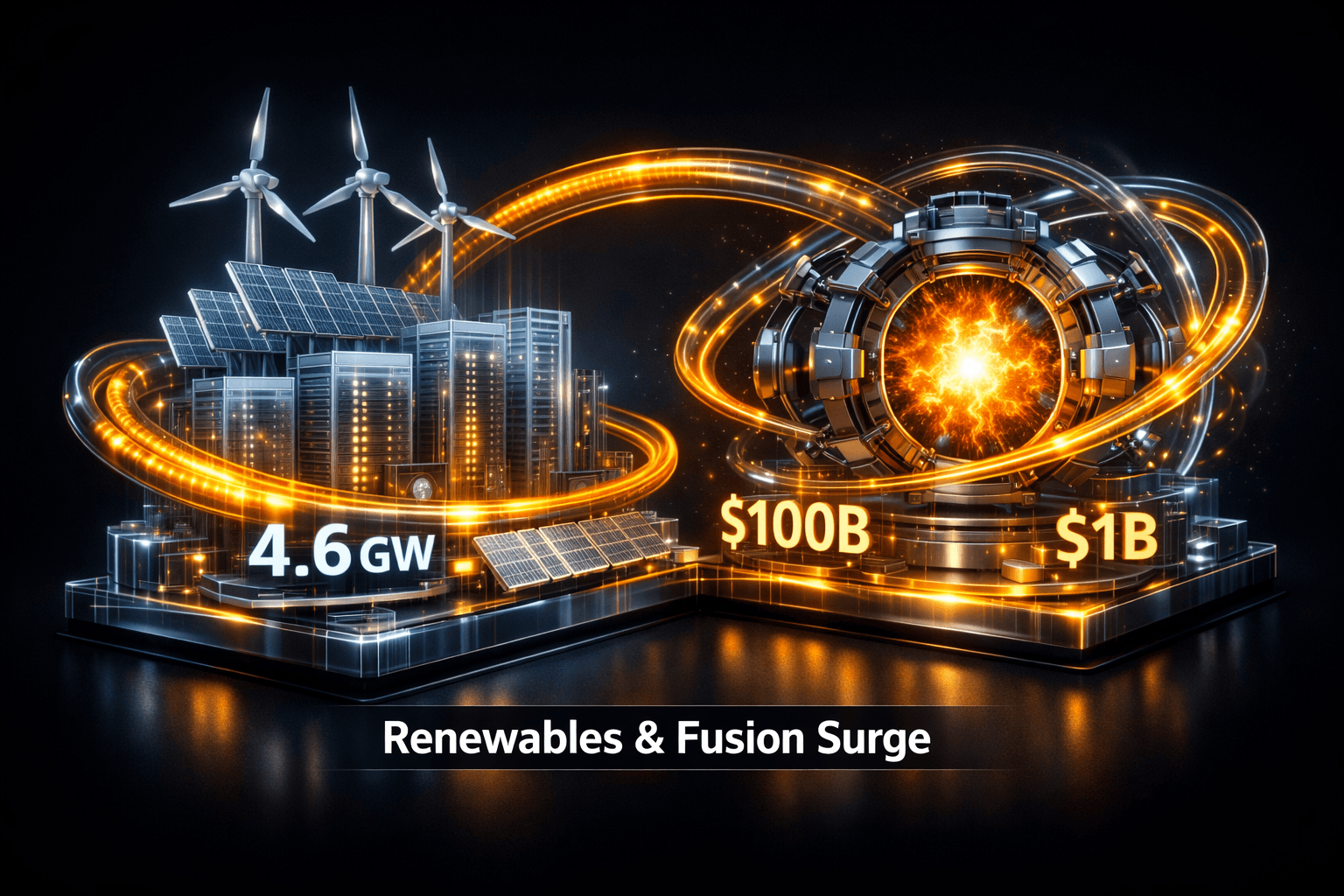
The biggest overnight development is the Brookfield and NextEra-led plan to build a $100 billion AI data center campus at the DOE Paducah site, paired with up to 4.6 GW of dedicated generation. That's a direct, large-scale demand signal for new power capacity and firming resources, and it could reshape regional transmission and buildout timetables.
At the same time Commonwealth Fusion Systems announced another $1 billion in equity funding to push toward a commercial fusion plant. Together with large corporate offtake deals and continued solar and storage deployments, these headlines show capital flowing into both near-term renewables and longer-term clean technology. What does this mean for you as a utilities-focused investor or watcher of the sector?
Market Highlights
Quick facts and salient numbers from today's utilities headlines.
- Brookfield and NextEra announced a $100 billion private AI data center campus at the DOE Paducah site, paired with up to 4.6 GW of dedicated new generation to serve the campus.
- Commonwealth Fusion Systems raised another $1.0 billion in equity to advance work on a commercial fusion power plant.
- Tesla and ContourGlobal signed a long-term power agreement covering roughly 1 terawatt-hour per year for the Sterling hybrid solar PV plus battery storage project, which includes more than 1.4 GWh of battery capacity.
- CMS Energy plans to sell renewable assets to simplify its structure and expects to net about $500 million, moving toward nearly all earnings from regulated utilities after 2027, according to the company.
- Array Technologies launched Atlas, a new foundation-to-tracker solution aimed at simplifying installation and correcting alignment on tracker systems, while Cherry Street completed a 6-MW on-site solar project and Sugar Hollow Solar launched a lease promotion.
- POWER Magazine published a piece calling out hidden biases in utility resource modeling that can disadvantage clean energy in planning decisions.
Key Developments
Paducah Campus and the 4.6 GW Buildout
Brookfield and NextEra's plan is notable for scale and for pairing a massive load profile with dedicated generation. A $100 billion data center campus will need firm, reliable power and that 4.6 GW figure signals multi-year build programs for generation and transmission upgrades. You should expect accelerated permitting, interconnection fights, and a pipeline of long-term offtake or ownership structures tied to this project.
Big Corporate PPA, Battery Scale and Project Sterling
The Tesla and ContourGlobal agreement covering about 1 TWh per year and a hybrid plant with more than 1.4 GWh of storage is one of the largest single-plant corporate PPAs reported. Large offtake deals like this reduce offtaker risk for developers and move the needle on utility-scale storage economics. This kind of contract shows corporate demand for firm zero-carbon power and will be a bellwether for future corporate PPAs.
Fusion Funding, Tracker Innovation and Distributed Wins
Commonwealth Fusion Systems' $1 billion equity round keeps fusion on the radar as a long-term option for low-carbon baseload. While timelines remain long, the funding validates private investor appetite for game-changing tech. On nearer-term hardware, $ARRY's Atlas foundation offering aims to lower installation complexity and improve tracker alignment, potentially trimming balance-of-systems costs. Smaller wins matter too, as Cherry Street's 6-MW project and Sugar Hollow's residential lease push show steady activity across market segments.
Modeling Biases and Corporate Refocus
Two more cautious notes arrived: an analysis highlighting biases in utility resource modeling that can stack the deck against clean energy, and $CMS Energy's plan to sell renewables to concentrate on regulated earnings and net roughly $500 million. Those stories underscore that policy, modeling assumptions and capital allocation choices still shape the pace and recipients of clean energy growth.
What to Watch
Expect headlines and regulatory filings to dominate near-term action. Watch federal and state permitting for the Paducah project and any interconnection queue filings tied to the 4.6 GW of generation. How quickly transmission upgrades are approved will determine project timelines and regional price impacts.
Keep an eye on fusion milestones from Commonwealth Fusion Systems; funding infusions accelerate development but technical and regulatory hurdles remain. Which names could benefit most from these trends, and how will utilities reallocate capital when projects are sold or spun? Those are practical questions for you to track this quarter.
Also monitor resource planning cycles at major utilities. If modeling biases are corrected or challenged in hearings, that could change procurement outcomes for renewables and storage. Earnings or investor calls from $NEE and $CMS in the coming weeks may offer guidance on capital plans and how these initiatives fit corporate strategies.
Bottom Line
- Large-scale demand is here, with a $100 billion data center plan and 4.6 GW of dedicated generation signaling sustained need for new capacity and firming resources.
- Capital continues to flow across time horizons, from a $1 billion raise for fusion to practical deployments in solar, storage and tracker hardware.
- Corporate PPAs and hybrid projects are scaling rapidly, improving the bankability of renewables plus storage deals.
- Regulatory and modeling risks remain important, and corporate asset sales like $CMS's shift show utilities are actively reshaping portfolios.
- Watch permitting, interconnection and utility resource plans closely, because those processes will determine which projects move forward and when.
FAQ
Q: How soon could the Paducah data center and dedicated generation start affecting power demand and prices? A: Large campus projects typically drive multi-year build schedules, so you may see early procurement and permitting activity this year, with construction and grid impacts ramping over several years.
Q: Does Commonwealth Fusion Systems' $1 billion raise mean fusion will be a near-term grid resource? A: The funding accelerates development but fusion still faces technical, regulatory and commercialization steps, so it's a longer horizon prospect rather than an immediate supply source.
Q: Should changes in utility resource modeling change your view of renewables? A: Modeling assumptions can materially affect procurement outcomes. Data suggests you should track planning reforms and regulatory hearings because they influence which technologies win contracts and which projects advance.