The Big Picture
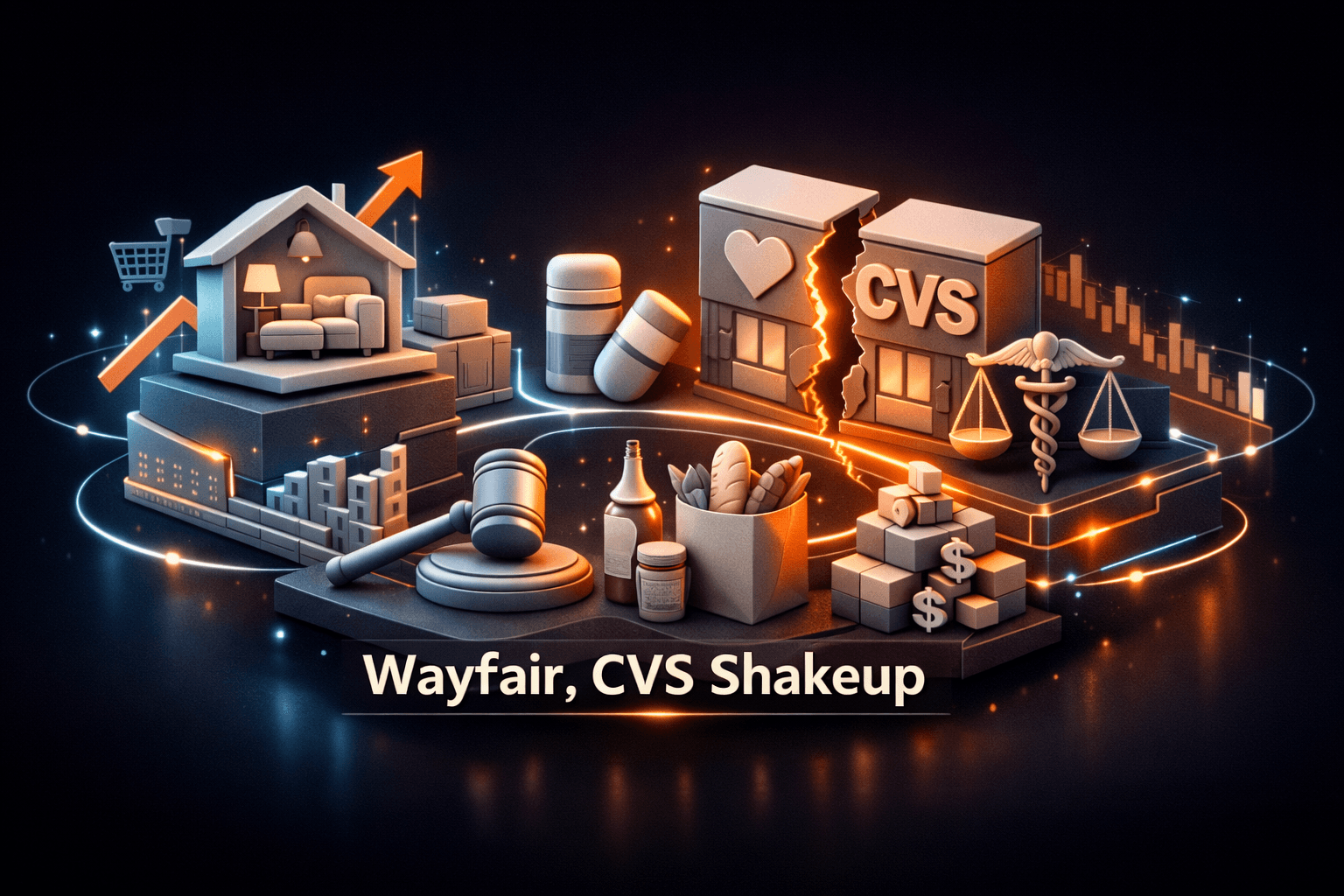
CVS Health's surprise plan to separate its retail pharmacy business from its health-care services arm dominated today's headlines, and it matters because it reshapes two decades of strategy that combined pharmacy retail with payer and services operations.
At the same time, the sector produced a string of mixed operational updates, from Wayfair (W)'s nearly 10% revenue gain to Kroger's tech pilots and a $650 million sale of Kraft Heinz's North American coffee unit. Those moves give you both growth and risk signals as holiday season spending approaches.
Market Highlights
Key metrics and moves investors should note from today's reports.
- CVS Health (CVS) announces a split of its retail pharmacy and health-care services businesses, reversing parts of its Caremark and Aetna-era integration strategy.
- $W reports its strongest quarter of growth since the pandemic, with nearly 10% revenue gains and 4.7% growth in active customers in Q3.
- Kroger is piloting RFID and computer vision at 1,500 store bakeries to improve inventory and supplier data sharing.
- Kraft Heinz agrees to sell its North American coffee business, including Maxwell House and Sanka, in a deal valuing the segment at $650 million.
- Ahold Delhaize flags a cyber incident that will trim net sales this quarter despite strong U.S. online growth in Q3.
- Festival Foods launches a revamped loyalty program and app offering 2% back on purchases, moving to a more modern digital rewards model.
Key Developments
CVS split rewrites a long strategy
CVS Health said it will break its retail pharmacy chain away from its health-care services units, a move that undoes aspects of its 2007 Caremark acquisition and the 2018 Aetna deal. For investors, the separation raises questions about capital allocation, margin profiles, and regulatory complexity, and analysts note we'll want to see the timeline and any tax or debt plans that accompany the split.
Mixed retail performance: Wayfair strength, Adidas caution
$W's nearly 10% revenue gain and 4.7% active customer growth in Q3 stand out as a positive signal for the home category, suggesting select e-commerce demand remains resilient. On the other hand, Adidas management described lifestyle footwear market pressures and signaled the sector needs to normalize before growth returns, a reminder that demand is uneven across categories.
Grocers and CPG reshuffle: tech, divestitures, and legal noise
Kroger is expanding machine learning and RFID pilots to tighten availability and share insights with suppliers, which could lift in-stock rates and margins if scaled. Ahold Delhaize's cybersecurity hit shows operational risk can translate quickly into sales impacts, and Kraft Heinz's $650 million sale of its coffee brands signals continued portfolio pruning in CPG. Meanwhile, Mondelez's lawsuit against Joyride and the class action against Celsius add legal overhangs for snacking and energy drink firms.
What to Watch
Expect several near-term catalysts and risks that could move names across the sector.
- CVS timeline: Watch for a formal separation plan, proposed leadership structure, and any regulatory filings that clarify tax, debt, and shareholder return plans.
- Earnings and holiday guidance: With the holiday shopping season approaching, monitor retailers' November and December commentary for changes in demand patterns and margin assumptions.
- Cyber and legal outcomes: Ahold Delhaize's ongoing remediation and the outcomes of Mondelez's and Celsius's legal actions could affect sales, reputations, and marketing spend.
- Technology rollouts: See whether Kroger's RFID and computer vision pilots translate into measurable availability gains, and ask how quickly suppliers can adopt shared data practices.
- Portfolio moves in CPG: Track whether Kraft Heinz's divestiture resets management focus, and whether buyers pursue other legacy beverage or commodity brands.
Which companies can scale what they pilot, and who will bear the short-term costs? Those are the questions you should be asking as results and implementation updates arrive.
Bottom Line
- Neutral near term, because strong company-level beats and technology pilots sit alongside legal and operational headwinds that could pressure sales and costs.
- CVS's split is the top structural story. Analysts note it could unlock value but also raises execution and regulatory questions you should track closely.
- Retail winners remain selective. $W shows resilient online demand in home goods, while grocers are investing in tech to solve inventory shortages.
- Legal and cybersecurity risks are active threats. Ahold Delhaize's incident and lawsuits at Mondelez and Celsius show operational and reputational exposure can hit sales quickly.
- Stay selective and watch catalysts, including separation filings, holiday commentary, and pilot metrics that will clarify how pilots scale.
FAQ Section
Q: What does the CVS split mean for retail pharmacy competition? A: The split could allow each business to focus on a sharper strategy, but it also increases execution risk as two companies navigate capital needs and regulatory obligations.
Q: How material is Wayfair's quarter for the broader home retail category? A: $W's nearly 10% revenue gain and 4.7% active customer growth suggest pockets of resilience in home spending, yet category performance varies by price tier and channel.
Q: Should I be worried about cyber and legal headlines at grocers and CPG firms? A: Those incidents can create short-term sales hits and higher costs, so monitor remediation progress and any customer or supplier impacts to judge longer term effects.