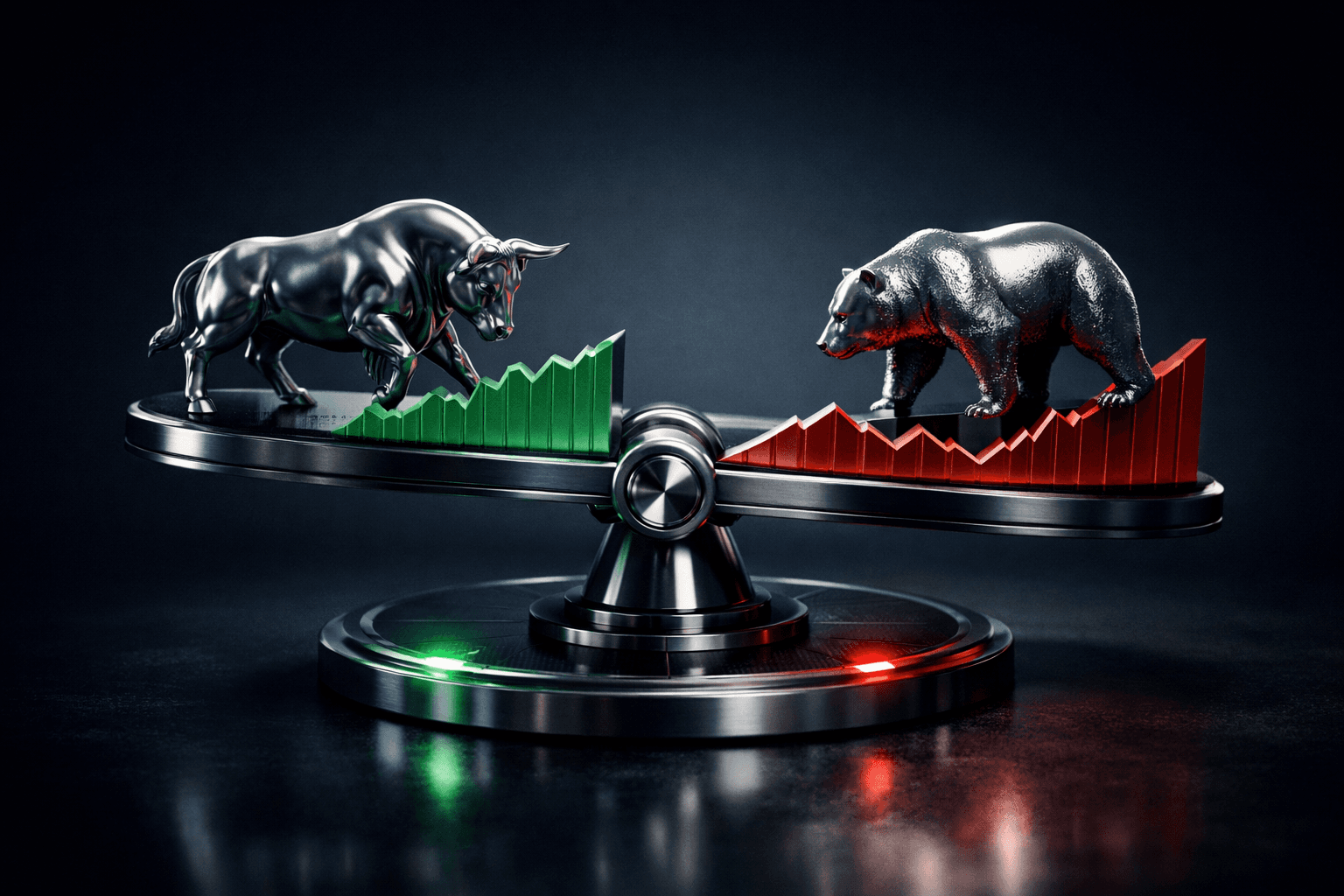
- Bull markets are sustained periods of rising prices, bear markets are sustained declines of about 20% or more.
- Market cycles are driven by economics, corporate profits, investor psychology, and shocks like crises or policy changes.
- Diversification, dollar-cost averaging, and long-term plans help you navigate both up and down markets.
- Short-term drops create risk, but they also create opportunities for long-term investors with a plan.
- Avoid trying to time the market, rebalance regularly, and keep an emergency fund to reduce stress during downturns.
Introduction
A bull market means rising prices and optimism. A bear market means falling prices and pessimism. These two states describe how markets move over time and how investors feel while they are moving.
Why does this matter to you as an investor? Because knowing the difference between bull and bear markets helps you make clearer decisions, keeps you calmer during volatility, and helps you build a plan that fits your goals. How long do cycles last, and what causes them to flip from up to down or back again? Those are the questions we will answer in plain language.
This article explains what causes market cycles, shows how long they can last, and gives practical steps you can use to protect your portfolio and take advantage of opportunities. You will also find real-world examples and common mistakes to avoid so you can feel confident when the market moves.
What Are Bull and Bear Markets?
At the simplest level, a bull market is a period when prices rise over time and investor sentiment is positive. A bear market is when prices fall significantly and sentiment turns negative. Professionals often define a bear market as a drop of 20% or more from a recent high, though the exact number is less important than the overall trend.
Key characteristics of a bull market
- Rising stock prices across many sectors.
- Strong corporate earnings growth and healthy economic data.
- High investor confidence and more buying than selling.
Key characteristics of a bear market
- Broad declines in stock prices, often 20% or more.
- Weaker corporate profits and slower economic growth.
- Higher volatility and fear driving selling pressure.
These labels apply to entire markets like the S&P 500, or to sectors such as technology or energy. For example, one sector can be in a bull phase while another is in a bear phase at the same time.
Why Markets Shift: Causes of Bull and Bear Markets
Market cycles happen because the economy, corporate results, interest rates, and investor psychology change over time. No single cause explains every cycle, but common drivers repeat across history.
Major drivers
- Economic growth and recessions, which affect company sales and profits.
- Interest rate changes set by central banks, which change borrowing costs.
- Corporate earnings, because stocks follow profits over the long term.
- Investor sentiment, which can amplify moves when fear or greed spreads.
- External shocks, such as financial crises, wars, or pandemics.
For example, falling interest rates often support a bull market because cheaper borrowing helps companies grow and makes bonds less attractive. On the other hand, rising rates can slow growth and pressure stock valuations, producing or deepening a bear market.
Psychology and feedback loops
Markets are not only about facts, they are about how people react to facts. When investors expect prices to rise, buying increases and prices can rise further. When fear takes hold, selling can become widespread and push prices down more than fundamentals alone would suggest. These feedback loops help explain the momentum you see in both bull and bear markets.
How Long Are Market Cycles?
There is no fixed timetable for market cycles. Some bull markets last several years, others just months. Bear markets can be sharp and short, or long and grinding. Historical averages give context, but your experience will vary depending on timing and asset allocation.
Typical timelines
- Long-term, the stock market has tended to rise over decades, delivering a historical average annual return near 10 percent before inflation. Past performance is not a guarantee of future results, but this shows long-term growth is common.
- Bull markets often last multiple years. The length depends on how strong earnings growth and supportive policy are.
- Bear markets historically last shorter than bull markets on average, but they vary a lot. Some are short shocks, others follow a slow economic decline.
Because cycles vary, you should plan based on your time horizon and risk tolerance, not on trying to predict exact start and end dates.
How Beginners Can Navigate Bull and Bear Markets
You don't need to predict every twist and turn. Instead, follow a few practical rules that reduce risk and keep you positioned for long-term progress. These steps help you act, not react, and they help you sleep at night when the market gets noisy.
Practical steps
- Have a written plan, including your goals, time horizon, and risk tolerance. A plan reduces emotional trading and keeps you focused on the long term.
- Use diversification, by spreading money across stocks, bonds, and possibly other assets. Diversification lowers the chance your whole portfolio drops at once.
- Dollar-cost averaging, by investing a fixed amount regularly. This smooths your buying price over time and reduces the risk of mistiming a big purchase.
- Keep an emergency fund in cash, enough for three to six months of expenses. This prevents forced selling during downturns.
- Rebalance periodically, to return your portfolio to your target mix. Rebalancing forces you to sell high and buy low in a disciplined way.
For example, if you decide on a 70 percent stock and 30 percent bond split, rebalance when stocks grow to 80 percent. That way you lock gains and buy bonds, keeping risk steady over time.
Behavioral tips
- Focus on what you can control: your savings rate, asset allocation, and fees.
- Avoid checking your portfolio constantly. Frequent monitoring increases emotional reactions and short-term decision-making.
- Remember that volatility is normal. Short-term losses do not always mean long-term damage to your plan.
Real-World Examples
Concrete examples make cycles easier to understand. Here are a few realistic scenarios you can relate to and learn from.
Example 1, the quick crash and rebound
Imagine the market drops 30 percent in two months during a sudden crisis. If your $10,000 portfolio falls to $7,000, that may feel painful. But if you keep contributing $500 a month during the downturn and the market recovers over the next year, your contributions buy more shares at lower prices. When prices rise again, those extra shares help your recovery.
Example 2, the long bull market
Suppose a technology-led bull market runs for six years and a hypothetical $5,000 initial investment in a broad tech ETF grows by 250 percent. That growth rewards long-term holders. But not every company participates equally, so diversification across themes or market indexes like $SPY or $VTI reduces single-sector risk.
Example 3, company-specific bear
Sometimes a single stock like $TSLA or $AAPL can enter a bear phase because of company problems. If you hold a concentrated position that drops 50 percent, your portfolio impact is large. That highlights why many investors prefer balanced exposure with funds rather than single stocks, especially when you are starting out.
Common Mistakes to Avoid
- Trying to time the market. Picking tops and bottoms is very hard, even for professionals. Use a plan and regular investing instead.
- Overconcentration in a single stock or sector. This increases your risk if that company or industry declines sharply. Diversify to reduce that risk.
- Not having an emergency fund. If you need cash during a downturn, you might sell investments at a loss and lock in declines. Keep liquid savings to avoid that.
- Reacting to headlines with big portfolio changes. Emotional decisions often lead to buying high and selling low. Pause, review your plan, and consider small, measured changes.
- Ignoring costs and taxes. High fees and frequent trading can erode returns over time. Choose low-cost funds and be mindful of tax consequences.
FAQ
Q: How often do bear markets happen?
A: Bear markets happen irregularly. Over many decades, the market has seen bull phases that last longer than bear phases, but the timing varies. Focus on a long-term plan instead of trying to predict frequency.
Q: Should I sell when a bear market starts?
A: You do not have to sell. For most long-term investors, holding a diversified portfolio and continuing regular contributions is a sensible approach. If your financial needs have changed, review your plan and consider gradual adjustments.
Q: Can bull markets end without a recession?
A: Yes, bull markets can slow or end because earnings growth slows, valuations get stretched, or other factors change, even without a formal recession. Markets price expected future profits, so expectations can shift before economic data fully reflects changes.
Q: Is it better to invest during a bear market or wait for the bottom?
A: Waiting for the bottom is a form of market timing and is hard to do consistently. A practical alternative is dollar-cost averaging, which spreads purchases over time and reduces the risk of mistiming an entry.
Bottom Line
Bull and bear markets are normal parts of investing. Understanding the key drivers, typical timelines, and psychological impacts helps you make steadier choices. You can't control market moves, but you can control your plan, diversification, and discipline.
Next steps include writing a clear investment plan, setting a comfortable asset allocation, building an emergency fund, and using regular contributions like dollar-cost averaging. With these habits you will be better prepared for whatever the market does, and you will likely feel more confident through the ups and downs.
At the end of the day, consistency and planning usually beat prediction. Keep learning, review your plan periodically, and stay focused on your long-term goals.