Introduction
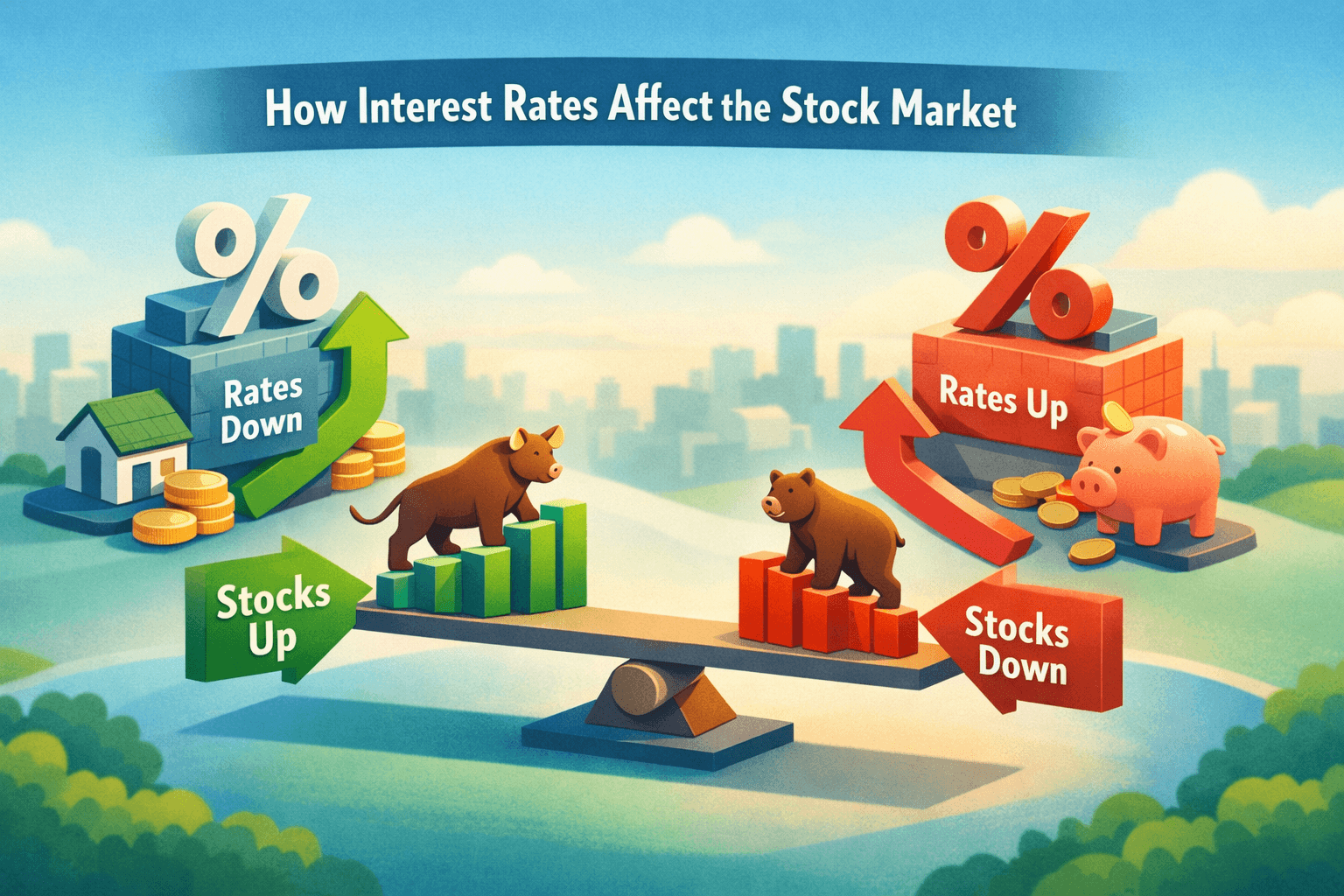
Interest rates are the price of money and a primary driver of asset prices; changes in rates ripple through discount rates, corporate borrowing costs, and investor behavior. For equity investors, understanding that relationship helps explain why markets rally on rate cuts and often sell off when rates rise.
This article breaks down the mechanics linking interest rates and stock valuations, shows how Federal Reserve actions and communication influence markets, and reviews which sectors tend to win or lose when rates move. You’ll get practical frameworks, numerical examples, and tactical considerations suitable for intermediate investors.
- Higher interest rates increase discount rates and borrowing costs, which can compress stock valuations, especially for long-duration, growth-oriented companies.
- Central bank actions matter both directly (policy rate changes) and indirectly (forward guidance and balance sheet moves) for market expectations and yields.
- Sectors respond differently: financials and energy often benefit from rising rates, while utilities, REITs, and high-growth techs are typically more sensitive to rate increases.
- Bond yields set a competing return and influence equity risk premia; a rising 10-year Treasury yield frequently forces P/E multiple compression across markets.
- Practical steps include monitoring the yield curve, duration exposure in portfolios, corporate leverage, and Fed communication rather than only headline rates.
How interest rates influence stock valuations
The core link between interest rates and equity prices is valuation: expected future cash flows from a company are discounted to present value using a discount rate that reflects risk-free rates plus a risk premium. When the risk-free rate rises, the discount rate rises and present values fall, all else equal.
Two valuation channels are most important: the cash-flow present value channel and the financing-cost channel. The first affects every company through valuation math; the second affects companies differently depending on leverage and capital intensity.
Discounting future cash flows, a simple example
Imagine a company expected to pay $10 of free cash flow next year and $10 each year thereafter forever (a perpetuity). Value ≈ Cash flow / discount rate.
If the discount rate is 4%, value ≈ 10 / 0.04 = $250. If the risk-free component rises and the discount rate moves to 6%, value ≈ 10 / 0.06 = $166.7, a 33% drop. This shows why long-duration cash flows (far future growth) are most vulnerable to rate increases.
Duration sensitivity and growth vs value
Duration in equities is the weighted average timing of cash flows. High-growth tech companies whose value depends heavily on profits 5, 10 years out have higher equity duration and are more rate-sensitive than value companies with near-term earnings like utilities or consumer staples.
For example, $NVDA and other AI-levered growth names are sensitive to rate expectations because much of their valuation is future-oriented. Conversely, $T (AT&T) or $VZ pay steady dividends and have lower duration, though high leverage can offset that benefit.
Federal Reserve policy, forward guidance, and market reactions
The Federal Reserve and other central banks influence short-term policy rates directly and long-term yields indirectly. Markets price both the current policy rate and expectations for future paths through futures, swaps, and the yield curve.
Three channels matter: the policy rate itself, forward guidance (what the Fed signals about future hikes or cuts), and balance-sheet actions (quantitative tightening or easing). Each channel changes expectations and therefore bond yields and equity valuations.
Policy surprise vs. communication
A surprise rate hike typically causes immediate volatility as markets reprice discount rates. Often, the reaction is larger when guidance or the dot plot changes because investors adjust the expected duration of higher rates rather than just the current rate.
Example: In 2022 the Fed moved from near-zero to 4.25, 4.50% by year-end. Markets reacted not only to the hikes but to guidance that rates would remain higher for longer. That expectation pushed 10-year Treasury yields from roughly 1.5% in early 2022 to about 3.8% mid-year, causing broad multiple compression across equities.
Quantitative tightening and term premium
When the Fed reduces its balance sheet (QT), it can increase the term premium investors demand for holding long-duration Treasuries, lifting long yields even if the policy rate is unchanged. That effect can be outsized during periods of high inflation or low liquidity.
Investors should watch both the fed funds futures curve and central bank announcements; sometimes the market reaction to communication is as important as the policy move itself.
Sector winners and losers when rates change
Interest-rate cycles have sectoral fingerprints. Understanding these typical responses helps investors manage exposure and expect rotating leadership across market environments.
Sectors that tend to underperform when rates rise
- Technology and high-growth stocks: Sensitive to higher discount rates. $NVDA, $TSLA, and many unprofitable growth companies often see wide price swings when yields climb.
- Utilities and REITs: High payout ratios and bond-like cash flows make them sensitive to yields; their dividend yields compete with safe Treasury rates.
- Consumer discretionary: Borrowing-sensitive businesses and stretched valuations can be vulnerable, especially if higher rates slow consumer credit growth.
Sectors that can benefit from rising rates
- Financials (banks, insurers): Net interest margins often widen when short-term rates rise faster than long-term rates; $JPM and $BAC are examples that historically benefit early in hiking cycles.
- Energy and commodities: Rising rates often align with improving economic activity or inflation, which can boost commodity prices and energy sector profits.
- Certain industrials: Companies with pricing power and low leverage can outpace peers when growth remains intact despite higher rates.
Note: Sector behavior depends on the pace of rate changes and the macro backdrop. An economy that slows into a recession while rates remain high tends to hurt cyclicals, including financials.
Practical strategies for investors
Intermediate investors can apply several practical steps to manage rate risk without market timing. The focus should be on risk management, position sizing, and informed sector rotation rather than short-term speculation.
- Assess duration exposure: Use a rules-of-thumb approach, long-duration growth stocks are more rate-sensitive. Consider trimming outsized positions in such names if you expect a sustained move higher in yields.
- Monitor leverage and cash flow timing: High-debt companies face higher interest costs; prefer firms with low refinancing needs in a rising-rate environment.
- Diversify across sectors and styles: Balance growth exposure with value, dividend payers, and defensive sectors to smooth volatility.
- Use bond allocation strategically: A higher allocation to short-maturity bonds reduces sensitivity to rising yields compared to long-duration bonds.
- Watch leading indicators: Break-evens, 10-year/2-year spread, and fed funds futures provide signals about inflation expectations and recession risk.
Real-world example: 2022 rate cycle and equity rotation
During 2022 the Fed increased rates aggressively. Growth-heavy indexes like the NASDAQ fell more than the broader S&P 500 as long-duration tech valuations compressed. Financial stocks initially outperformed as margins expanded, but that advantage faded when concerns about economic slowdown and bank stress emerged mid-cycle.
That episode highlights two lessons: first, initial sector winners can become losers if the macro shifts toward recession. Second, keeping an eye on corporate fundamentals (earnings, leverage, and cash flow) is essential alongside macro indicators.
Common Mistakes to Avoid
- Chasing the latest Fed prediction: Markets price expectations quickly; reacting to every Fed comment leads to overtrading. Instead, use a plan tied to valuations and fundamentals.
- Ignoring duration risk: Treating all equities the same overlooks the higher sensitivity of long-duration growth firms. Quantify exposure qualitatively by assessing where a company's earnings are produced in time.
- Assuming rising rates always hurt stocks: The context matters. Early hikes during strong growth can be benign or even positive for cyclicals and financials.
- Over-leveraging in a rising-rate environment: High corporate or personal leverage increases vulnerability to rate spikes. Focus on balance-sheet quality and interest coverage ratios.
FAQ
Q: How do higher interest rates directly reduce stock prices?
A: Higher rates raise the discount rate used to value future cash flows and increase borrowing costs for companies. Both effects reduce expected present value and can compress price-to-earnings multiples.
Q: Do central bank rate cuts always boost stocks?
A: Not always. Rate cuts may signal economic weakness; markets react positively when cuts boost growth expectations, but if cuts come because of recession risk, equities can still fall.
Q: Which market indicators should I monitor for rate-driven risk?
A: Watch the 10-year Treasury yield, the 10y, 2y yield curve, fed funds futures, CPI/PCE inflation data, and central bank statements for guidance on policy paths and term premiums.
Q: How should I position my portfolio when I expect rates to rise?
A: Consider reducing exposure to long-duration growth names, favoring financials and commodity-linked sectors, prioritizing companies with low leverage and strong near-term cash flows, and shortening bond maturities.
Bottom Line
Interest rates shape the discounting of future cash flows, borrowing costs, and investor opportunity sets. For investors, the key is to separate the mechanical valuation effects from the broader economic context: rising rates during strong growth present different risks and opportunities than rising rates tied to inflation shocks or quantitative tightening.
Actionable next steps: monitor yields and Fed signals, assess duration exposure in your holdings, stress-test high-debt positions for higher rates, and maintain diversification across sectors and bond maturities. Understanding these dynamics helps you respond rationally when rates move rather than reacting emotionally to headlines.