Key Takeaways
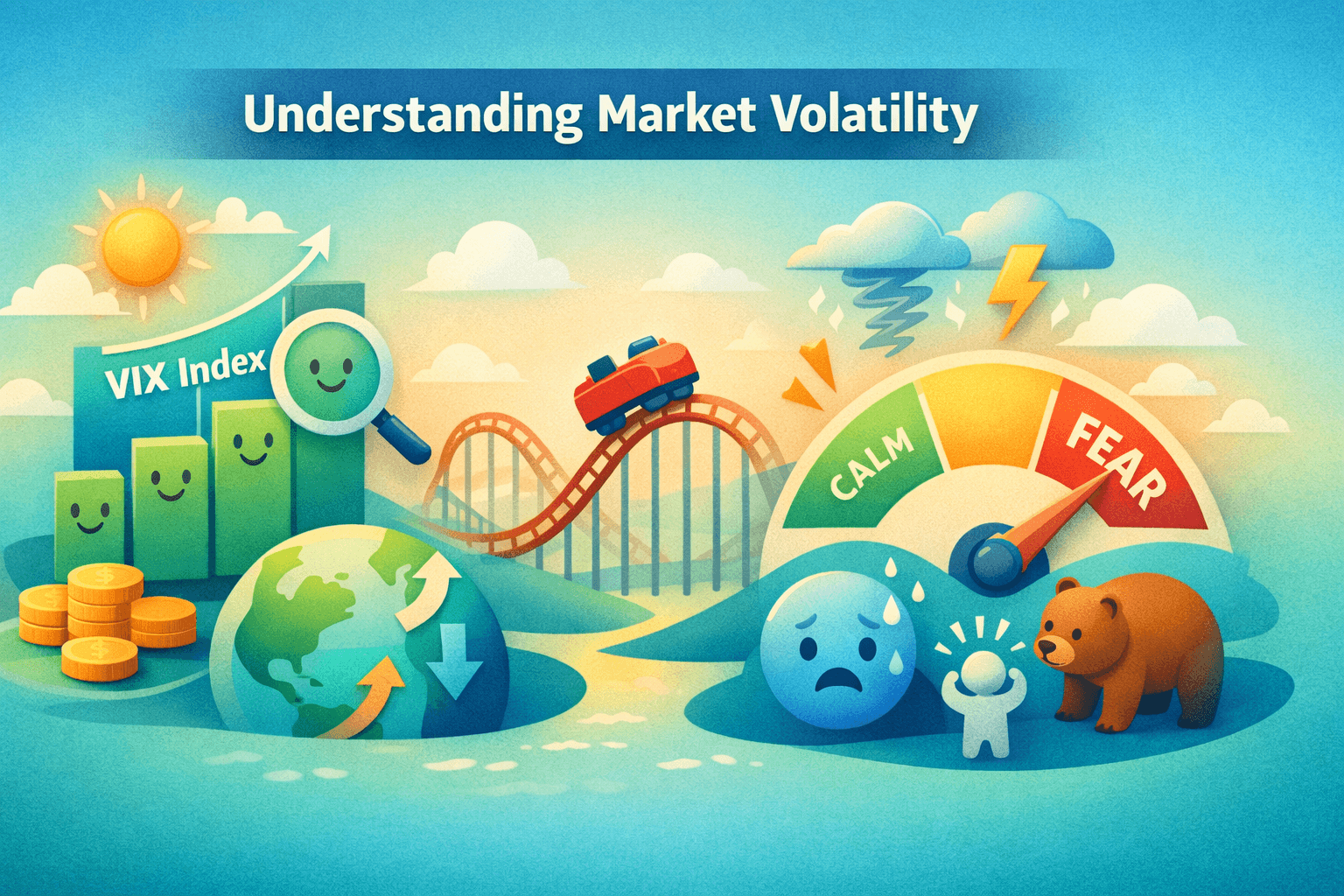
- The VIX measures implied 30-day volatility for the S&P 500 and is often called the "fear index" because it tends to spike when markets sell off.
- Volatility has multiple signals: implied volatility (VIX), realized volatility, term structure (contango/backwardation), put-call ratios, and credit spreads all add context.
- VIX-based ETFs and ETNs exist but most suffer from roll costs and are not long-term buy-and-hold tools; understand futures term structure before using them.
- Practical responses include volatility-aware position sizing, options hedges or collars, dynamic rebalancing, and liquidity planning, not just buying dips blindly.
- Avoid common mistakes: treating the VIX as a timing signal alone, misusing leveraged VIX products, ignoring cost of hedges, and confusing noise with regime shifts.
Introduction
Market volatility refers to the size and speed of price swings in financial markets. Investors use volatility measures to gauge risk, set position sizes, and design hedges.
For many participants the VIX, the CBOE Volatility Index, serves as the canonical fear signal, but it’s only one piece of the puzzle. Understanding how the VIX is constructed, when it spikes, and which other indicators to watch helps investors translate fear signals into practical actions.
This article explains the VIX, complementary volatility signals, real-world examples, tactical and portfolio-level responses, common mistakes, and a short FAQ to fill remaining gaps.
What is Market Volatility and Why It Matters
Volatility measures how much and how quickly prices move. Financial markets with higher volatility produce larger swings in returns; lower volatility implies smaller, steadier moves.
For investors, volatility matters because it affects risk management, expected drawdowns, option prices, and the cost of hedging. Volatility also influences investor behavior, fear can become self-reinforcing during large sell-offs.
Realized vs. Implied Volatility
Realized volatility is what has occurred: standard deviation of past returns over a chosen window (e.g., 30 days). Implied volatility is the market’s forward-looking expectation embedded in option prices.
VIX is an implied volatility metric; it represents the market’s expectation of 30-day volatility for the S&P 500 derived from option prices. When implied exceeds realized volatility, options are relatively expensive, and vice versa.
The VIX: How It Works and What It Signals
The VIX is calculated from a strip of S&P 500 option prices across strikes to estimate market-expected volatility over the next 30 days. It uses both calls and puts to capture symmetric expectations about future moves.
Because option demand rises in market sell-offs (investors buy protection), implied volatility and the VIX typically spike when equities fall. That is why the VIX is often called a "fear index."
Interpreting VIX Levels and Spikes
There is no magic cutoff, but some practical reference points help: a VIX in the low-teens implies a calm market, mid-to-high teens is normal, 20, 30 is elevated, and sustained readings above 30 reflect high fear. Historic spikes have exceeded 60, 80 in extreme stress.
Examples: In March 2020 the VIX rose above 80 during the COVID-19 panic; in the 2008 financial crisis it also reached very high levels. Short, sharp spikes (a few days to weeks) are common; prolonged high VIX is rarer and often signals a regime shift.
VIX Limitations
The VIX measures implied volatility for the S&P 500, not individual stocks or other asset classes. It can be elevated due to one-off risks (e.g., elections, earnings seasons) and sometimes moves without a major news catalyst.
Because the VIX is based on options, price distortions from liquidity squeezes or options market structure can affect readings. Use the VIX with confirmation from other indicators.
Other Fear & Volatility Indicators
Complementary indicators give context beyond the VIX. Combining signals reduces false alarms and helps distinguish noise from structural risk.
VIX Term Structure (Contango vs. Backwardation)
VIX futures have maturities; their relative prices form the term structure. When front-month futures are priced higher than later months, the market is in backwardation, a strong distress signal. Contango (later months higher) is typical in calm markets.
ETFs that track VIX futures (like $VXX or $UVXY) are affected heavily by the term structure and suffer roll costs in contango, which erodes returns for long-holders.
Put/Call Ratio and Skew
Put/call ratios (options volume of puts divided by calls) rise when investors buy downside protection. A high put/call ratio indicates rising demand for puts and growing downside fear.
Skew refers to higher implied volatility on out-of-the-money puts relative to calls. Elevated skew suggests investors are willing to pay more for crash protection, a subtle sign of tail-risk concern.
Credit Spreads, CDS, and Liquidity Indicators
Credit spreads (e.g., investment-grade vs. treasury yields) and credit default swap (CDS) prices widen when credit stress rises. Rising credit spreads often precede or accompany equity volatility in systemic events.
Liquidity measures, bid-ask spreads, market depth, and trading volumes, also matter. Volatility with thinning liquidity increases execution risk and can amplify moves.
Realized Volatility and Volume
Compare implied to realized volatility. If implied is much higher than realized, equities may be pricing in potential shocks that haven’t occurred. If realized moves above implied, markets are catching up to sudden events.
Volume spikes during a sell-off indicate conviction; low volume with large prices moves can indicate fragile liquidity and higher risk of continued volatility.
How Investors Can Respond to Volatility
Volatility is not inherently bad, it is an input to risk management. The right response depends on time horizon, goals, liquidity needs, and risk tolerance.
Short-Term Tactical Tools
- Options hedges: Buying puts or put spreads on $SPY (or key holdings like $AAPL) can limit downside for a defined cost. Consider collars to offset premium costs.
- Volatility ETFs/ETNs: Products such as $VXX or $UVXY provide exposure to short-term VIX futures, useful for short-duration tactical plays but generally poor as long-term hedges due to negative roll returns.
- Stop-loss and execution planning: Use limit orders, staggered exits, and pre-defined stop levels rather than emotional decisions during fast markets.
Portfolio-Level Approaches
At the portfolio level, consider volatility-aware position sizing and risk parity approaches that target a constant volatility allocation. Rebalancing buys weakness and sells strength, which can harness volatility to improve long-term returns.
Maintain a liquid cash buffer or low-volatility allocation (bonds, cash equivalents) to meet margin or cash needs without forced selling in spikes.
Hedging Costs and Trade-offs
Hedging reduces downside but costs money (option premiums, negative carry in hedging strategies). Evaluate hedging as insurance: decide your acceptable premium and time horizon rather than hedging reactively every spike.
Example: Purchasing a 3-month put on $SPY during elevated VIX might be costly; instead, a staggered ladder of expirations or a put spread can reduce cost while providing partial protection.
Real-World Examples
Concrete scenarios clarify how indicators and responses interact.
March 2020, Rapid Spike
In March 2020 the VIX jumped above 80 as COVID uncertainty exploded. Equity correlations rose, liquidity fell in some venues, and credit spreads widened dramatically. Short-term traders who used long volatility products profited, while long-term holders who rebalanced into weakness benefited over subsequent quarters.
An investor who had a pre-funded options hedge (a long put on $SPY) saw the hedge spike in value and could either lock gains or use proceeds to buy equities at depressed prices.
2018 February Volatility Spike
February 2018 saw a sharp move where a historically calm market experienced a sudden VIX surge toward the 40, 50 range. Leveraged volatility products surged intraday and then faded over weeks. Traders using leveraged long-VIX ETFs without an exit plan experienced outsized gains followed by rapid decays.
This event highlights that timing and strategy matter: hedges can explode in value during a crash, but carry costs and mean reversion can erode those gains if positions are not managed.
Common Mistakes to Avoid
- Treating the VIX as a precise timing tool, The VIX signals elevated fear but doesn’t predict direction or exact timing. Use it with other indicators and risk limits.
- Holding long VIX ETFs as a long-term hedge, Products like $VXX and $UVXY suffer decay from contango. They are typically short-duration tactical tools, not buy-and-hold hedges.
- Underestimating hedging costs, Continually buying puts can become expensive. Consider structured hedges (collars, put spreads) and budget hedging costs into portfolio return expectations.
- Ignoring liquidity, Volatility often coincides with lower liquidity, raising execution risk. Plan trades, use limit orders, and size positions appropriately.
- Confusing noise with regime change, Not every spike signals a long-term shift. Combine multiple indicators (term structure, credit spreads, volume) before revising long-term allocations.
FAQ
Q: What does a high VIX actually mean?
A: A high VIX means the options market expects large S&P 500 moves over the next 30 days. It signals elevated uncertainty or fear but does not specify direction. High VIX often accompanies market sell-offs because demand for downside protection increases.
Q: Can I hedge my whole portfolio with VIX ETFs?
A: VIX ETFs and ETNs track VIX futures, not the index directly, and often suffer from roll costs in contango. They can be used for short-term hedges but are generally unsuitable as long-term portfolio hedges due to decay and path dependency.
Q: Is implied volatility always higher than realized volatility?
A: Not always. Implied volatility can be higher if option buyers pay for protection (expensive options) or lower if options are cheap relative to realized moves. Comparing implied to realized volatility helps identify when options are over- or underpriced.
Q: How should I size hedges during volatile periods?
A: Hedge sizing depends on objectives and cost tolerance. Use scenario analysis: estimate potential drawdowns, decide acceptable insurance cost, and size hedges to cover the portion of drawdown you want to mitigate. Avoid over-hedging, which can be costly and reduce long-term returns.
Bottom Line
The VIX is a powerful, widely used gauge of market fear, but it’s most informative when combined with other volatility and credit indicators. Understanding implied vs. realized volatility, term structure, and liquidity conditions helps differentiate transient spikes from structural shifts.
Practical investor responses include pre-defined hedging plans, volatility-aware position sizing, rebalancing discipline, and careful use of volatility products. Avoid treating any single indicator as a crystal ball, use an ensemble of signals and sound risk management to navigate volatile markets.
Next steps: monitor VIX and term structure, add a simple hedging policy to your investment plan, and backtest volatility-aware allocation rules that match your time horizon and liquidity needs.