Introduction
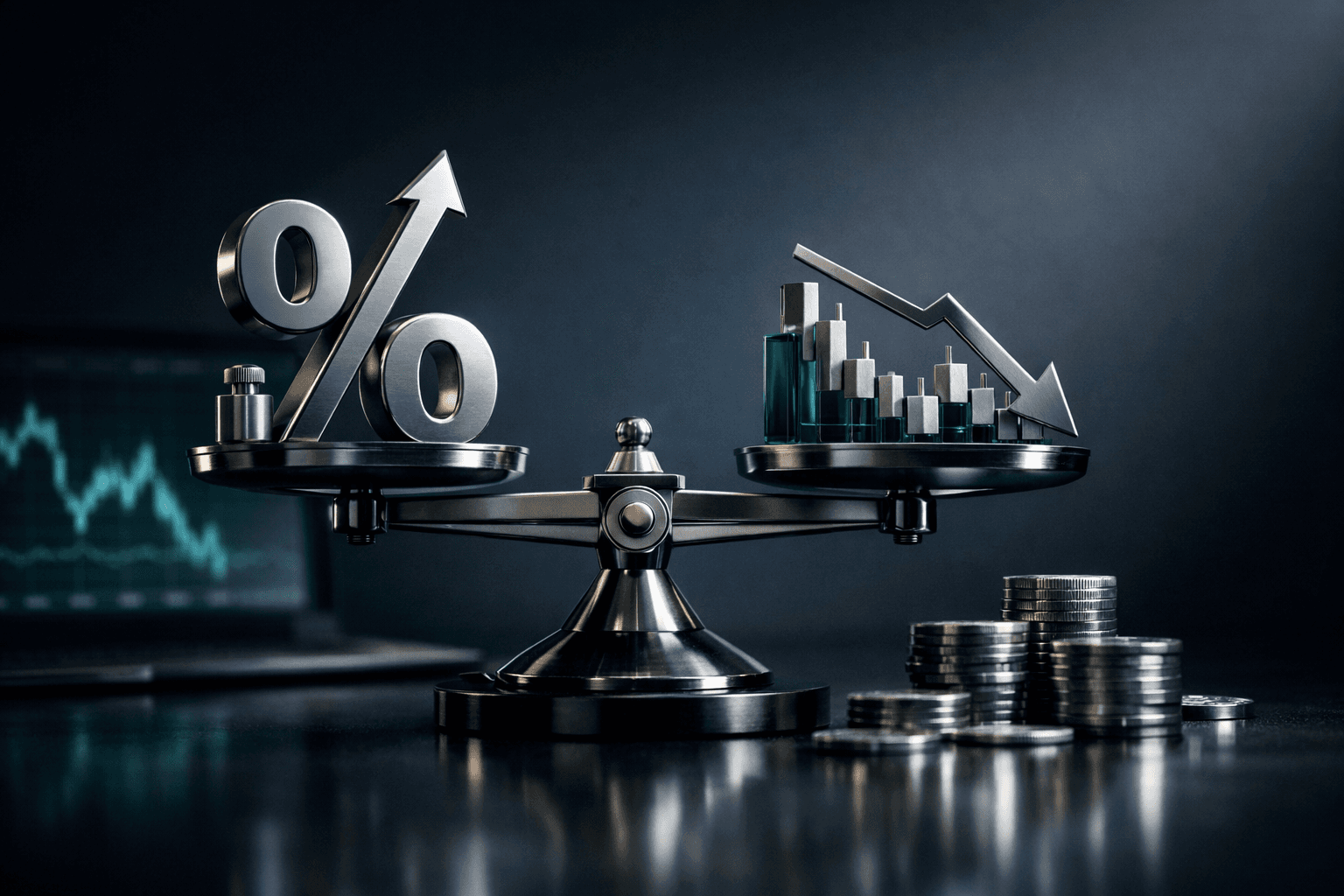
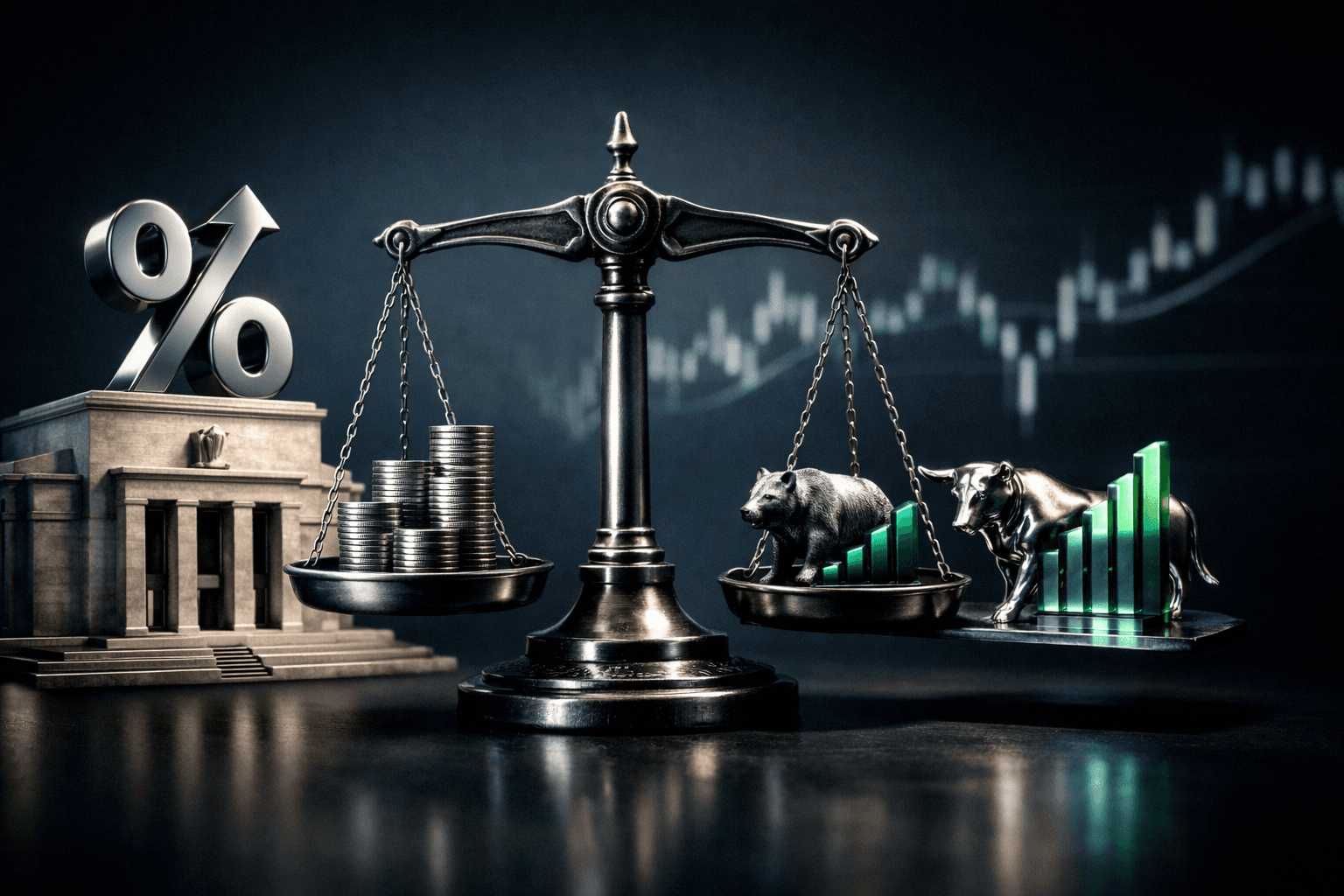
Interest rates are the price of money set in short-term by central banks and reflected across the economy. For investors, changes in those rates affect corporate borrowing costs, bond yields, investor preferences, and the present value of future earnings.
This article explains why rising rates often pressure stocks and why low rates can fuel rallies. You will learn the economic channels involved, which sectors tend to benefit or suffer, how to read Federal Reserve communications, and practical ways to interpret rate news for portfolio decisions.
- Higher interest rates raise borrowing costs and reduce corporate free cash flow, often pressuring earnings and valuations.
- Rising bond yields make fixed-income more attractive relative to stocks and increase discount rates used in valuation models.
- Sectors react differently: banks may benefit from wider net interest margins while growth/high-duration stocks (e.g., $NVDA, $TSLA) typically underperform when rates rise.
- The Fed influences markets through policy actions and forward guidance; markets price expectations, not only actual rate moves.
- Track real rates (nominal yield minus inflation) and the 2s/10s yield curve to assess growth and recession risks.
How Interest Rates Affect Valuations
One of the clearest links between rates and stocks is valuation. Most equity valuations rely on discounted cash flow logic: future earnings are worth less today when the discount rate increases. The discount rate typically rises with government bond yields and policy rates.
Higher discount rates reduce present values more for companies with earnings concentrated in the distant future. These "high-duration" or growth stocks, companies whose value depends on profits far ahead, are therefore more sensitive to rate increases.
Valuation example
Imagine a tech firm projecting $100 of free cash flow five years from now. At a 3% discount rate that future cash flow has a present value around $86. At a 6% discount rate it falls to about $74. The same expected cash flow stream can justify a lower stock price when rates rise.
Channels: Borrowing Costs, Bond Yields, and Allocation Effects
Interest rates affect stocks through multiple channels that operate concurrently. Three key channels are corporate borrowing costs, bond yields as alternative investments, and investor allocation behavior.
1) Borrowing costs: Many companies borrow to fund growth, buybacks, or capital expenditure. Rate hikes increase interest expense and can squeeze margins, especially for highly leveraged firms and cyclical businesses.
2) Bond yields and alternatives: When Treasury yields rise, bonds become more attractive relative to stocks. Rising yields reduce the risk premium investors demand to hold equities, pressuring equity valuations.
3) Allocation and risk appetite: Higher rates can reduce risk-taking. Lower rates encourage leverage, margin financing, and reallocation toward equities and risk assets. Conversely, tightening cycles often shift flows back into cash and fixed income.
Practical metric: real yields
Real yields (nominal yield minus inflation) matter more than nominal rates. Real yields capture the true opportunity cost of capital. For example, a 10-year Treasury yield of 4% with 2% inflation implies a 2% real yield, which sets a different valuation backdrop than a 4% nominal yield with 4% inflation (0% real).
Sector Winners and Losers
Rate moves don't affect all stocks the same way. Understanding sector sensitivity helps investors reinterpret market reactions to Fed decisions.
Winners: Financials (banks and insurance) often benefit initially from rising short-term rates because net interest margins can widen. Value sectors like energy and industrials may also fare better if rate hikes coincide with strong economic growth.
Losers: Growth and high-valuation tech stocks typically suffer when rates rise because their expected earnings lie further in the future. Utilities and REITs, which are bond proxies due to stable cash flows and dividends, often underperform as yields climb.
Real-world tickers
Consider $JPM (a large bank): in a rising-rate environment net interest income can increase, though loan demand and credit quality still matter. Contrast $NVDA or $TSLA, where valuation depends heavily on future growth expectations and therefore reacts strongly to higher discount rates.
Interpreting Federal Reserve Signals and Data
The Federal Reserve influences markets through rate decisions and forward guidance. Markets trade on expected future policy moves, so understanding Fed language and the data that drive decisions is essential.
Key data points: inflation measures (CPI, PCE), labor market indicators (nonfarm payrolls, unemployment rate), and growth metrics (GDP, ISM). The Fed weighs inflation and employment under its dual mandate; surprises on these data often move rate expectations.
Dot plot and forward guidance
The Fed's dot plot and statements provide probabilistic guidance on future rate paths. Investors should track revisions in Fed projections and the tone of Fed Chair comments. A hawkish shift (more tightening) typically pushes yields up and equities down, while a dovish shift can lower yields and lift risk assets.
Real-World Examples
Historical episodes illustrate the mechanics. The 2015, 2018 tightening cycle saw gradual hikes accompanied by solid growth, which benefited financials but pressured some long-duration tech names. The sharp Fed easing in 2020, 2021 (near-zero rates and QE) coincided with a broad stock market rally, especially for growth and speculative assets.
2022, 2023 offered a textbook reaction: aggressive Fed hikes to combat high inflation pushed the 10-year Treasury yield from around 1.5% to over 4% (peak), compressing valuations and rotating leadership from growth to value. Sectors like energy and financials outperformed, while many high-multiple tech stocks saw notable drawdowns.
Concrete numbers
Suppose the S&P 500's forward earnings yield was 4% and the 10-year Treasury yielded 1.5%, the equity risk premium was 2.5 percentage points. If the 10-year rises to 3.5%, holding earnings yield constant, the risk premium halves to 0.5 percentage points, meaning equities must either justify higher earnings or accept lower prices to equilibrate.
Practical Guidance: What Investors Can Do
Interpreting Fed moves doesn't mean timing markets perfectly; it means adjusting expectations and risk posture. Use rates to inform position sizing, sector exposures, and duration risk in portfolios.
- Review valuation sensitivity: Identify holdings with high duration (long-dated earnings) and quantify how a 100, 200 basis point rise in discount rates could affect fair value.
- Diversify across rate regimes: Combine cyclical/value exposure with defensive holdings and consider increasing cash or short-duration bonds if you expect further hikes.
- Use hedges selectively: Options or inverse instruments can protect concentrated exposure, but costs and timing matter.
- Monitor macro indicators: Track CPI/PCE, unemployment, and the 2s/10s yield curve for recession signals that could change the Fed's path.
Common Mistakes to Avoid
- Overreacting to a single Fed announcement: Markets price expectations; one data point rarely signals a regime shift. Avoid knee-jerk portfolio overhauls after a single meeting.
- Ignoring sector nuances: Treating the market as uniform leads to missed opportunities. Some sectors and stocks benefit from hikes, identify those instead of selling everything.
- Confusing nominal and real rates: Inflation erodes nominal yields' buying power. Focus on real yields to gauge true opportunity cost and valuation impact.
- Assuming causation from correlation: Rate hikes can coincide with stronger growth; poor stock performance may reflect slowing demand, not rates alone. Analyze both policy and fundamentals.
FAQ
Q: How quickly do stocks react to a Fed rate hike?
A: Stocks can react immediately as markets update expectations, but the full economic impact unfolds over months. The initial move reflects repricing of rates and expectations; earnings and credit effects appear later.
Q: Should I sell growth stocks when the Fed raises rates?
A: Not automatically. Evaluate why you hold each stock. If valuations are highly dependent on low rates and you expect persistent tightening, consider trimming or hedging. But fundamentals, competitive position, and growth prospects matter more than policy alone.
Q: What indicators tell me the Fed has finished hiking?
A: Look for sustained declines in inflation (PCE/CPI), weakening labor market data, and dovish Fed guidance. Markets also watch the fed funds futures curve and the dot plot for signals the tightening cycle has peaked.
Q: How do bond yields affect dividend-paying stocks and REITs?
A: Higher yields make fixed-income more attractive relative to dividend stocks and REITs, often causing price declines in those income-sensitive sectors as investors seek yield in lower-risk bonds.
Bottom Line
Interest rates are a central driver of equity valuations and investor behavior. Rising rates typically compress equity valuations through higher discount rates and by making bonds more attractive, while low rates support higher equity multiples and risk-taking.
Investors should focus on duration sensitivity, sector implications, and the Fed's communication rather than chasing headlines. Use rates as a framework for portfolio risk management: assess valuation sensitivity, diversify exposures across sectors, and monitor key macro indicators to anticipate regime shifts.
Next steps: quantify duration risk in your holdings, build a checklist of macro indicators you will monitor, and decide in advance how you will adjust allocations if the Fed's path changes.