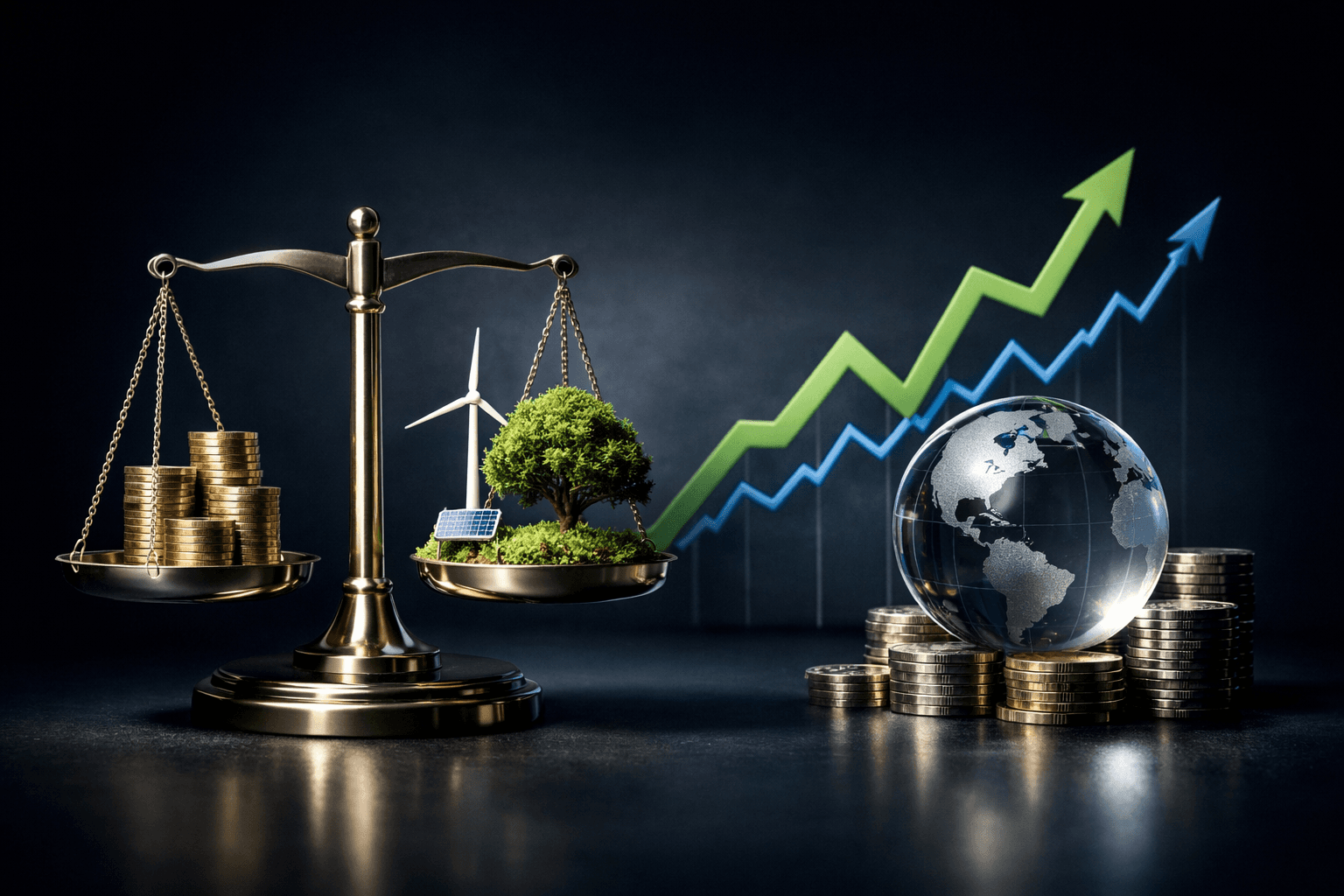
Key Takeaways
- Climate policy and corporate emissions targets are a material driver of sector returns and capital allocation.
- Investment opportunities include renewable-energy producers, EV and battery supply chains, energy-storage, and efficiency tech, each with different risk/reward profiles.
- Green ETFs and green bonds offer diversified access to climate themes, but label scrutiny and eligibility rules vary, do your due diligence.
- Regulations like carbon pricing and stricter emissions standards shift profitability across incumbents and disruptors; monitor policy timelines and transition risks.
- Manage portfolio exposure through staged allocations, active risk controls, and scenario analysis rather than binary bets on “green” vs “brown.”
Introduction
Green investing refers to allocating capital to companies, projects, and securities that benefit from or contribute to the mitigation of climate change and environmental degradation. This includes renewable energy generation, electric vehicles (EVs), energy efficiency technologies, green infrastructure, and fixed-income instruments labeled as green bonds.
For investors, climate initiatives matter because they are reshaping revenue streams, cost structures, and capital spending across entire industries. Policy targets, consumer preferences, and falling costs for clean technologies create both opportunities and risks for portfolios over multi-year horizons.
This article explains the market forces behind green investing, identifies investable vehicles (stocks, ETFs, bonds), outlines how regulations like carbon pricing influence valuations, presents concrete examples using well-known tickers, and gives practical steps to incorporate climate-aware allocations.
How Climate Initiatives Are Changing Market Dynamics
Climate initiatives combine policy action (e.g., emissions targets, subsidies, carbon pricing), technology progress (e.g., cheaper solar and batteries), and changing demand (corporate net-zero commitments and consumer preferences). Together, these elements reallocate capital from high-emission activities to lower-carbon alternatives.
Regulatory signals are particularly powerful because they change the long-term economics of industries. For example, a reliable carbon price increases operating costs for fossil-fuel-intensive firms, while production tax credits or subsidies improve the payback for renewable projects.
Key channels of market impact
- Cost competitiveness, Falling levelized costs of electricity (LCOE) for wind and solar make renewables preferred sources for new generation.
- Capital reallocation, Banks, insurers, and asset managers increasingly shift financing away from high-emission projects and toward green projects.
- Valuation adjustments, Anticipated future regulations or technology shifts are often priced into growth-oriented companies (e.g., EV manufacturers) while pressuring legacy players.
Investment Avenues: Stocks, ETFs, and Green Bonds
There are three broad ways to gain exposure to climate-related themes: individual equities, thematic ETFs, and fixed income labeled as green. Each has trade-offs in concentration, diversification, liquidity, and due diligence requirements.
Individual stocks
Equities offer targeted exposure and the potential for outsized returns but carry company-specific risks. Consider these examples:
- $NEE (NextEra Energy), A large utility with significant regulated and renewable generation assets; benefits from utility-scale wind and solar growth.
- $TSLA (Tesla), A major EV and battery manufacturer; strong demand growth but valuation is sensitive to margin and delivery execution.
- $FSLR (First Solar) and $ENPH (Enphase), Solar manufacturer and solar inverter systems provider, respectively, showing how vertical segments capture different parts of solar value chains.
When picking stocks, evaluate unit economics, order backlog, supply-chain risks (e.g., critical minerals for batteries), and potential policy tailwinds or headwinds.
Thematic and broad-market ETFs
Thematic ETFs provide diversified exposure to renewable energy, clean technology, and low-carbon indices. Common examples include $ICLN (global clean energy), $TAN (solar), and $QCLN (clean-tech growth). ETFs simplify access and reduce single-stock risk, but they can be concentrated in a few large holdings or sub-sectors.
Check an ETF's indexing rules: some are market-cap weighted, others tilt toward revenues from clean activities, and a few apply ESG screens. Turnover, expense ratio, and underlying holdings matter for long-term outcomes.
Green bonds and sustainable fixed income
Green bonds finance projects with environmental benefits, renewable energy plants, energy-efficiency retrofits, and sustainable transport. They are issued by sovereigns, municipalities, supranationals, and corporations.
Green bonds typically have the same credit features as issuer debt but tie proceeds to green projects. Investors should review green bond frameworks, use-of-proceeds reporting, and third-party verification to avoid greenwashing.
Regulatory Drivers: Carbon Pricing, Emissions Targets, and Subsidies
Policy tools shape sector economics and can be more deterministic than consumer taste changes. Three mechanisms to watch are carbon pricing, emissions standards, and subsidy programs.
Carbon pricing and cap-and-trade
Carbon pricing forces emitters to internalize CO2 emissions costs. The EU Emissions Trading System (EU ETS) is a leading example; carbon prices rose materially over the past decade, prompting fuel-switching and investment in abatement. A higher carbon price favors renewables, nuclear, and gas over coal.
Cap-and-trade regimes create market prices for emissions; predictable price corridors help investors evaluate project economics. Watch for policy announcements that expand coverage or tighten caps, these are catalysts for sector revaluation.
Emissions standards and product regulations
Vehicle emissions standards and clean-fuel mandates accelerate electrification of transport. If regulators phase out internal-combustion sales by a target year, automakers face a multi-year capex and product transition that benefits early EV adopters and suppliers in the battery supply chain.
Battery recycling rules and critical-minerals policies can also reshape supply-chain economics and create new investment niches.
Subsidies, tax credits, and procurement rules
Direct subsidies and tax incentives lower the effective cost for clean projects. For example, production and investment tax credits for solar, wind, or EVs change project returns. Government procurement (e.g., electrifying public fleets) creates reliable demand for certain technologies.
Risk, Valuation, and Portfolio Construction
Green investing entails familiar equity risks plus transition-specific considerations: technology obsolescence, policy reversal, commodity price swings, and greenwashing risk. A disciplined investment process reduces downside.
Valuation considerations
Many clean-tech names trade at premium multiples reflecting high expected growth. Validate assumptions: revenue growth rates, margin improvement paths, and required capital expenditure. Scenario analysis, base, bullish, and policy-shock cases, helps estimate value under different regulatory outcomes.
Risk management and diversification
Practical steps include limiting single-stock exposure, using ETFs for sector diversification, and blending growth-oriented allocations (e.g., EV manufacturers) with income-oriented green assets (e.g., utility-scale renewable owners or green bonds).
Time horizon and staging allocations
Climate transitions are multi-decade processes. Staged allocations, starting modestly and increasing exposure as technologies mature or as policy clarity improves, can balance opportunity and risk.
Real-World Examples: Numbers that Illustrate the Shift
Example 1, Solar cost trends: Over the last decade, module and system costs for utility-scale solar fell materially, improving project IRRs and enabling more capacity additions versus fossil fuel plants. A utility evaluating a 100 MW project can see payback timelines shortened when LCOE falls relative to gas peaker plants.
Example 2, EV adoption and supplier impacts: Assume an automaker targets 1 million EVs by 2030. That demand requires battery cells, power electronics, and charging infrastructure. Companies specializing in battery cells and battery management systems can see multi-year CAGR in revenue, but margins depend on scale and raw material costs.
Example 3, Carbon pricing and profitability swing: If an industrial plant emits 0.5 tons CO2 per MWh and a carbon price rises to $50/ton, the per-MWh cost increases by $25. For energy-intensive industries, that can turn thinly profitable plants into loss-making units, prompting investment in efficiency or fuel-switching.
Common Mistakes to Avoid
- Confusing “green” marketing with real impact, Verify frameworks and reporting to avoid greenwashed investments. Look for third-party verification and clear use-of-proceeds for green bonds.
- Overconcentration in high-growth names, Rapid-growth clean-tech stocks can be volatile; use position sizing and diversified ETFs to manage idiosyncratic risk.
- Ignoring transition risks for incumbents, Fossil-fuel companies may have stranded-asset exposure; stress-test portfolios for regulatory and demand shifts.
- Relying solely on headline policies, Implementation timelines, subsidy phase-outs, and local permitting can materially affect project economics; model realistic rollout scenarios.
- Neglecting supply-chain constraints, Critical minerals and manufacturing bottlenecks (e.g., semiconductor chips or battery precursor materials) can delay growth and raise costs.
FAQ
Q: How do green ETFs differ from traditional ESG funds?
A: Green ETFs typically target revenues or activities tied to environmental themes (renewables, clean energy), while ESG funds evaluate broader environmental, social, and governance criteria across portfolios. Check index methodology and holdings against your objective.
Q: Are green bonds safer than regular corporate bonds?
A: Green bonds have the same issuer credit risk as the underlying bond; their “green” label relates to how proceeds are used, not the debt’s credit quality. Assess issuer creditworthiness, framework transparency, and reporting.
Q: How sensitive are renewables to interest rates and inflation?
A: Renewables projects are capital intensive and sensitive to financing costs; higher interest rates raise project-level discount rates and can lengthen payback periods. Long-term power purchase agreements (PPAs) and fixed-rate debt can mitigate some exposure.
Q: What indicators should I monitor to track climate-driven market shifts?
A: Watch policy signals (carbon prices, targets), technology cost curves (LCOE, battery $/kWh), adoption metrics (EV penetration rates, renewable capacity additions), and corporate disclosures (Scope 1-3 emissions and capex plans).
Bottom Line
Climate change initiatives are reshaping markets by altering costs, demand patterns, and capital allocation. Investors can capture opportunities across equities, ETFs, and green fixed income, but must balance growth potential with policy, technology, and supply-chain risks.
Practical next steps: define your climate-investing objective (growth, income, diversification), choose the right mix of individual stocks and diversified ETFs, perform scenario-based valuation checks, and use green bond frameworks to add credit diversification. Regularly revisit exposures as policies and technologies evolve.
Green investing is not a single trade, it’s a thematic shift requiring ongoing diligence, staged allocations, and attention to both upside catalysts and transition risks. Treat it as a strategic allocation within a diversified portfolio rather than a speculative bet.