Key Takeaways
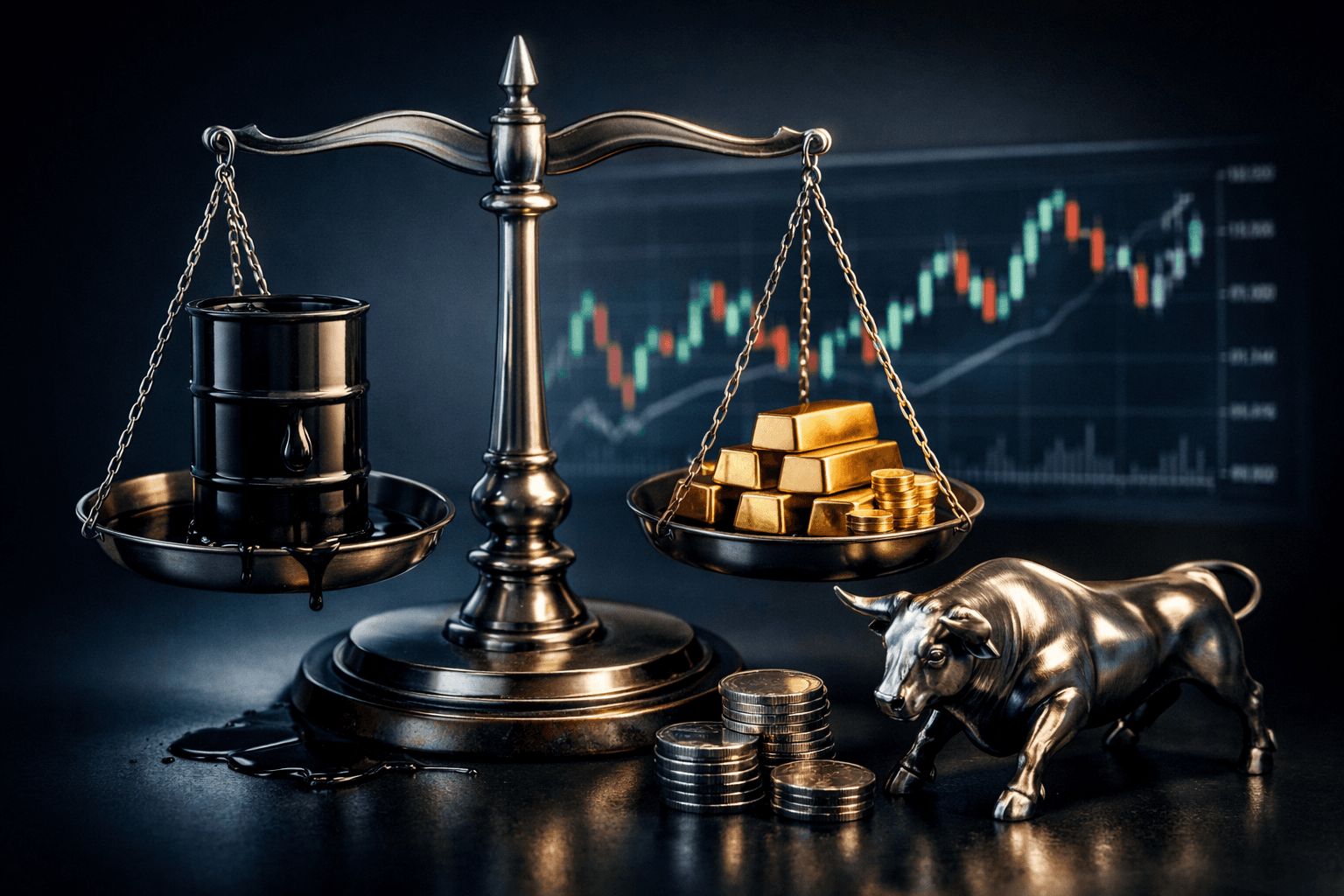
- Commodity prices are macro signals: oil influences costs and margins across sectors; gold signals risk appetite and real rates.
- Sectors respond differently, energy and materials tend to benefit from higher commodity prices, while airlines, autos and retail margins can suffer.
- Look beyond headline prices: forward curves (contango/backwardation), inventories, and real yields explain how commodity moves affect equities.
- Use commodity-linked equities and ETFs for targeted exposure, and consider hedging strategies if commodity risk is material to your portfolio.
- Avoid common mistakes such as treating commodity moves as permanent regime shifts or ignoring the lag between price moves and corporate earnings.
Introduction
Commodities, raw materials like crude oil, gold, copper and agricultural products, are fundamental inputs to the global economy. Their prices influence consumer prices, corporate costs, margins and investor sentiment, so they matter to stock investors even if you don't trade commodities directly.
This article explains the mechanics by which commodity moves transmit to equity markets, with a focus on oil and gold. You’ll learn sectoral effects, timing nuances, practical ways to translate commodity information into stock-level decisions, and how to avoid common investor errors.
What follows: a breakdown of the channels linking commodities to stocks, oil’s sectoral winners and losers, gold as a risk and real-rate indicator, other commodity influences, real-world examples using tickers, and actionable steps for investors.
How Commodity Prices Affect Stocks
Commodities affect equities through several channels: input costs, revenue drivers, macro inflation and real interest rates, and investor risk appetite. The net impact on a specific stock depends on that company’s exposure as a consumer, producer, or neutral party.
Key transmission channels include:
- Direct cost pass-through, higher oil raises fuel and transport costs for airlines, shipping, logistics and some consumer goods.
- Revenue boost for producers, oil or metal producers typically see revenues rise with commodity prices, improving margins and cash flow.
- Inflation and interest rates, broad commodity inflation can push central banks toward higher nominal rates, affecting discount rates used in equity valuations.
- Risk sentiment, safe-haven commodities like gold tend to rally when market confidence falls, often coinciding with equities selling off.
Timing and lags
Commodity changes are not always instantaneous in their impact. Companies often have hedges, long-term supplier contracts, inventory buffers, or pricing power that delay the effect on reported earnings by quarters. Investors should map expected lags, for example, fuel cost increases can show up quickly in airline margins, while consumer goods companies may only see margin pressure over a few quarters.
Oil: Which Sectors Win and Lose
Oil is the single most watched commodity because it is a large input for transportation and industry and because oil price swings can shift inflation and growth prospects. The first-order winners are producers; the losers are those with high fuel intensity and limited pricing power.
Winners: Energy, materials, and some emerging markets
Producers and integrated oil companies typically benefit from higher crude prices. For example, $XOM and $CVX saw revenue and cash-flow gains when crude traded above $100/barrel in past cycles. Commodity service companies and energy equipment names can also rally if higher prices sustain activity.
Losers: Airlines, shipping, autos, and low-margin retail
Airlines such as $DAL and $AAL are sensitive to jet fuel prices; fuel often represents 15, 30% of operating costs depending on the cycle and hedging. Higher oil can compress profit margins unless fares rise or hedges offset the move. Similarly, shipping and logistics companies face higher bunker fuel costs, and automakers may face mixed effects, higher oil can dent demand for gas-guzzling models but may benefit EV-related suppliers if policy responses accelerate electrification.
Sector rotation examples
Consider a simple rotation trade when oil rallies materially: overweight energy and materials, underweight airlines and certain consumer discretionary names. Use ETFs for tactical moves, $XLE (Energy Select Sector SPDR) for energy exposure or $USO (oil futures ETF) for direct crude price tracking, but be mindful of futures roll costs and ETF structure.
Gold: The Inverse Indicator of Confidence
Gold behaves differently from industrial commodities. It is a monetary and safe-haven asset that often moves inversely to risk appetite and real interest rates. When real rates fall (nominal rates minus expected inflation), gold usually becomes more attractive because its opportunity cost declines.
Gold and market risk
When equities enter risk-off episodes, investors frequently rotate into gold or gold ETFs like $GLD, while selling riskier equities. A rising gold price can signal increasing uncertainty about growth, inflation, or geopolitics, all of which can pressure equity multiples.
Gold vs. inflation and real yields
Gold is also sensitive to inflation expectations and central bank policy. If inflation expectations rise while central banks keep real rates low, gold typically rallies. Conversely, rising real yields (for instance, through faster growth or tighter policy) can weigh on gold and support equities if the economic picture brightens.
Other Commodities and Cross-Asset Signals
Beyond oil and gold, copper is often called an economic bellwether because of its industrial use. Rising copper prices can indicate stronger manufacturing activity and potentially support cyclically exposed stocks like industrials and materials.
Base metals, agriculture and supply shocks
Base metals (copper, aluminum) influence mining and industrial firms. Agricultural commodity moves (soybean, corn) affect food companies and supermarket margins. Supply shocks, like crop failures or mine strikes, can create sudden winners and losers among suppliers and end users.
Commodity curves and expectations
Forward curves (contango vs. backwardation) provide clues about short-term supply/demand balance. Persistent backwardation (futures prices below spot) suggests tight physical markets and can support producers' earnings. Contango can indicate oversupply and storage pressure, which may depress producer margins over time.
Real-World Examples and Worked Numbers
Example 1, Oil shock and airlines: Suppose jet fuel costs increase by $20/barrel equivalent and fuel accounts for 20% of an airline’s operating expenses. If an airline had $10 billion in total operating costs, a $20/barrel swing might raise fuel-related costs by roughly $400, 600 million over a year depending on consumption, a material amount that can turn modest profits into losses for marginal carriers. That’s why airlines hedge fuel and why oil spikes often hit airline stocks hard.
Example 2, Gold, real rates and mining equities: When geopolitical risk rose in 2019, 2020 and real yields fell, gold rallied and gold miners like $NEM outperformed broad benchmarks. Mining companies can provide leveraged exposure to rising bullion prices because a higher gold price lifts margins on existing production without commensurate increases in fixed costs.
Example 3, Copper and industrials: A sustained 10% rise in copper prices can signal stronger industrial demand, benefiting copper miners and equipment makers, while also increasing input costs for electronics manufacturers. Investors can monitor copper inventories and LME/Shanghai spreads as leading indicators for manufacturing cycles.
Practical Strategies for Equity Investors
Translate commodity insights into portfolio actions without overreacting to noise. Here are practical steps:
- Map exposures: For each holding, identify if the company is a commodity producer, consumer, or neutral. Estimate how a meaningful price move would affect margins and cash flow.
- Use hedges selectively: If a company or sector has outsized commodity exposure, consider hedges via options, commodity ETFs, or sector positioning to reduce short-term volatility.
- Monitor leading indicators: Follow inventories, forward curves, and real yields rather than headline price moves alone to gauge persistence.
- Prefer equities with pricing power or flexible cost structures if you expect prolonged commodity inflation.
Common Mistakes to Avoid
- Assuming all commodity moves are permanent: Many price spikes are transitory. Check inventories, seasonality, and forward curve structure before concluding a new regime.
- Ignoring company-specific hedges and contracts: Many firms lock in costs or revenues with hedges; headline commodity moves may not immediately affect earnings.
- Overconcentrating on commodity producers: Producer stocks can be volatile and sensitive to capital spending cycles, diversify within and outside the commodity theme.
- Using spot prices only: Spot prices can be noisy. Use futures curves and macro indicators (real yields, PMI, inventory data) to form a view on persistence.
- Failing to account for policy responses: Fiscal, monetary and regulatory shifts (e.g., energy transition policies) can change how commodities influence equities over multi-year horizons.
FAQ
Q: How quickly do commodity price changes affect corporate earnings?
A: It varies. Companies with immediate exposure (airlines) can see rapid effects within weeks or a quarter, while those with long supply chains or hedging programs may show changes over multiple quarters. Map company contracts and hedges to estimate timing.
Q: Should I buy energy stocks when oil rises?
A: Not automatically. Rising oil helps producers but consider valuations, capex plans, dividend sustainability and the difference between short-term price moves and structural demand trends. Use sector ETFs for tactical exposure and individual names for longer-term conviction after due diligence.
Q: Does gold always move opposite to stocks?
A: No. Gold often rises in risk-off environments, but it can also climb with inflation expectations even when equities do well. The crucial driver is real interest rates and risk sentiment, not a fixed inverse relationship to stocks.
Q: How can I use commodity information without trading futures?
A: You can act via commodity-linked equities, ETFs (e.g., $XLE for energy, $GLD for gold), or by adjusting sector weights. You can also use options on stocks to hedge commodity-driven risks without needing futures expertise.
Bottom Line
Commodities are a leading macro input for equity investors. Oil directly affects costs and sector performance, while gold provides signals about risk appetite and real rates. Other commodities like copper offer forward-looking insight into industrial activity.
Actionable steps: map exposures, monitor forward curves and inventories, consider selective hedging, and avoid treating every commodity move as a permanent regime shift. Using commodity knowledge thoughtfully can improve risk management and uncover tactical opportunities in equities.
Continue learning by tracking commodity-specific indicators (EIA reports, LME inventories, futures curves) alongside corporate earnings and central-bank commentary to see how real-world data drives the theory in practice.