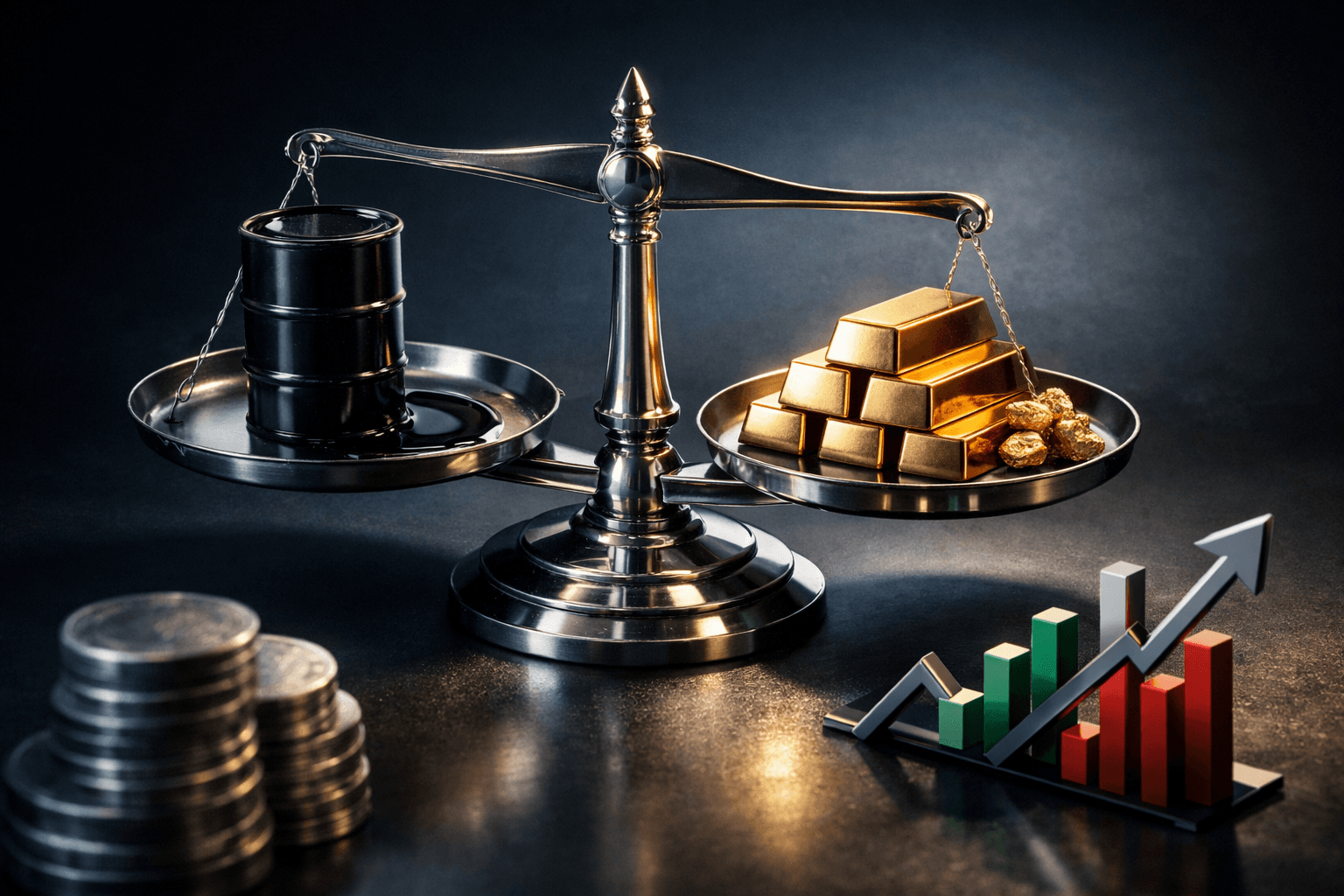
Commodities 101 explains how raw materials like oil, gold, copper, and wheat interact with equity markets and corporate profits. You will learn why commodity moves matter to different sectors, how commodity-driven costs and revenues flow into earnings, and what tools investors use to gain exposure.
Understanding commodities matters because price changes can reshape margins, consumer demand, inflation, and even central bank behavior, all of which affect stock prices across industries. What happens to airline margins when oil spikes? How does a rally in copper influence industrial names? These are the kinds of cause and effect you should be able to trace.
- Commodity prices influence stocks through cost channels, revenue channels, and macroeconomic effects.
- Oil moves have immediate sectoral winners and losers, for example energy producers versus airlines and trucking.
- Gold often acts as a safe haven when equities are under stress, but miners and ETFs behave differently.
- Industrial metals affect manufacturing, construction, and miners, while agricultural swings hit food processors and consumer staples.
- You can get exposure via futures, ETFs, commodity-producing stocks like $XOM or $FCX, and commodity-linked mutual funds, each with distinct risks.
- Monitor inventory data, PMI surveys, and inflation reports to interpret commodity signals and adjust your stock analysis accordingly.
How commodities connect to the stock market
Commodities influence stocks through three main channels: input costs, revenue for producers, and macroeconomic feedback loops. Input costs mean higher commodity prices raise expenses for firms that use raw materials. Revenue for producers means commodity price rallies boost earnings for resource companies.
Macro feedback loops happen when commodity price moves feed into inflation, consumer spending, or monetary policy. For example, broad commodity inflation can pressure central banks to tighten policy, which translates into higher rates and lower valuations for growth stocks. You should watch both sector-specific impacts and the broader economic signals.
Transmission channels
- Cost push, where higher commodity prices squeeze margins for users like airlines or food processors.
- Revenue boost, where higher prices lift profits for producers such as oil companies or miners.
- Inflationary signaling, where commodity-driven price rises influence CPI and monetary policy expectations.
- Sentiment and safe haven flows, where investors move between risk assets and safe assets such as gold.
Oil: the economy's lubricant and a market mover
Oil is the single most consequential commodity for many economies because it is a major input for transportation and manufacturing. When crude prices rise, costs climb for airlines, shipping, and road freight, while energy producers see a boost to revenues and free cash flow.
Who wins and who loses depends on direct exposure. Integrated oil majors like $XOM and $CVX generally benefit from higher crude because their upstream operations earn more. Airlines such as $DAL and freight firms face higher fuel bills that often cannot be fully passed to consumers in the short run.
Real-world example: oil shock impacts
Imagine Brent crude jumps 30 percent over three months because of a supply disruption. Energy producer margins widen, lifting profits for $XOM. At the same time, airline unit costs climb, pressuring ticket margins and potentially forcing capacity cuts. If the oil shock feeds into headline inflation, central banks may pivot to tighter policy, which tends to reduce equity multiples, especially for high-growth sectors.
Gold: safe haven, inflation hedge, and investment nuance
Gold behaves differently from industrial commodities. Investors often buy gold to preserve purchasing power or as a hedge against geopolitical risk. In risk-off episodes you frequently see gold prices rise as investors shift money out of equities and into perceived stores of value.
Gold miners do not move in lockstep with bullion. Stocks like $NEM and $GOLD provide leveraged exposure to gold prices but face operational costs, mine depletion, and company-specific risks. ETFs such as $GLD track bullion more directly and avoid corporate risks.
Gold's signals for equity markets
When gold rallies because of growth concerns rather than pure inflation, it signals risk aversion. That matters to you because equity sectors that rely on stable economic growth, such as industrials and consumer discretionary, often underperform during those periods. At the end of the day, gold tells you more about investor sentiment than it does about miners' balance sheets.
Industrial metals and the global growth barometer
Metals such as copper, aluminum, and nickel are critical for construction, electronics, and transportation. Copper is often called the bellwether metal because its demand tracks industrial activity closely. Rising copper prices usually indicate healthy manufacturing and construction demand, which tends to lift stocks in related sectors.
Producers like $FCX will benefit when metals rally. Manufacturers face higher input costs, which can compress margins unless they pass costs to customers. Metals can also be volatile because supply is concentrated and new mines take years to come online, creating asymmetric responses to demand shocks.
Example: copper and manufacturers
If copper climbs 20 percent over six months due to infrastructure spending, miners gain revenue and construction firms may see increased contract prices. But electronics manufacturers could face higher component costs, squeezing gross margins if product pricing is sticky. Investors should watch order books and input-cost guidance in earnings calls.
Agricultural commodities: food costs and consumer staples
Crops such as corn, soybeans, and wheat influence food processors, beverage makers, and restaurants. Weather shocks, crop disease, and trade policies can cause volatile swings in agricultural prices. Companies that process commodities, like $ADM or $BG, face direct cost pressures when crop prices rise.
For consumer-facing firms, the ability to pass higher raw material costs to consumers varies. Packaged food companies often have stronger pricing power than restaurants, but persistent food inflation can erode discretionary spending and hurt retailers and casual dining stocks.
Practical example: drought and grocery prices
Consider a drought that reduces corn yields, pushing corn prices up 40 percent season over season. Beverage companies using high-fructose corn syrup face rising ingredients costs. Grocery inflation picks up, and consumers may shift to cheaper brands, impacting growth rates for premium food names. You can track USDA crop reports and inventory data to anticipate these moves.
How investors can get commodity exposure
There are multiple ways to invest in commodities, each with trade-offs in liquidity, cost, and risk. You can buy futures, ETFs that track futures or physical commodities, and equities of commodity producers. Each approach has its own drivers and sensitivities.
- Futures contracts provide direct exposure but carry roll yield risk and require margin. They are best suited to experienced traders.
- Physical-backed ETFs, like $GLD for gold, offer nearer direct exposure for some commodities but are not available for all resources.
- Commodity futures ETFs, such as $USO for oil, are easy to trade but can diverge from spot prices due to contango and carry costs.
- Equity exposure, through producers like $XOM, $FCX, $NEM, comes with company-specific risk and leverage to commodity prices.
When you choose a vehicle, think about time horizon. Futures and commodity ETFs can be volatile and are not ideal for long-term buy-and-hold unless you understand roll dynamics. Producer equities may be more suitable for longer-term exposure but bring operational and capital allocation risks.
Indicators and data points to watch
To make commodity-informed stock decisions, monitor both market-specific and macro indicators. Supply data, inventory reports, and PMI surveys can signal demand or supply stress. For oil, weekly inventory figures are useful. For agriculture, USDA reports matter. For metals, exchange inventories and construction data are helpful.
- Inventory reports like EIA oil stockpiles and LME warehouse data.
- PMI and manufacturing output to read industrial demand for metals.
- Weather and crop progress reports for agricultural forecasts.
- Inflation reports and central bank commentary for macro effects.
Real-world scenario: integrating commodity signals into stock strategy
Suppose you follow copper prices and see a sustained rally driven by renewed infrastructure spending and improving PMI indexes globally. That suggests stronger demand for industrial metals, which could benefit miners like $FCX and equipment suppliers. At the same time, you might reweight away from high-multiple consumer growth stocks if the rally raises inflation expectations and long-term rates.
Conversely, if oil spikes due to a supply shock, you could expect energy producers to post better quarterly earnings, while airlines and shipping companies may issue cautious guidance. You would look at operating leverage, fuel hedges, and the ability to pass costs on before adjusting positions. Asking these questions helps you translate commodity moves into stock-level implications.
Common mistakes to avoid
- Ignoring the difference between commodity prices and producer profits. Explanation: Producers' earnings depend on volume, costs, taxes, and hedging, not just spot prices. How to avoid: Read company guidance and margin drivers, and compare spot moves to realized price averages reported by firms.
- Using a single data point to make big decisions. Explanation: Commodities are volatile and often mean revert after shocks. How to avoid: Use a series of indicators such as inventories, PMI, and earnings revisions before changing allocations.
- Overlooking roll yield and contango when using futures ETFs. Explanation: ETFs that track futures can underperform spot during contango. How to avoid: Understand the ETF's structure and check historical tracking error.
- Failing to account for currency effects. Explanation: Commodities are priced in dollars, so currency moves affect local-currency returns and corporate costs. How to avoid: Factor USD strength or weakness into your analysis, especially for multinational firms.
- Treating gold miners as identical to bullion. Explanation: Miners face operational risks and balance sheet constraints. How to avoid: Separate bullion exposure via ETFs like $GLD from miner equities like $GOLD or $NEM when forming a view.
FAQ
Q: How quickly do commodity price moves affect corporate earnings?
A: That depends on the industry and hedging. Energy producers may see near-immediate revenue changes. For manufacturers and food processors, effects can appear over one to several quarters as input contracts roll and companies pass costs to customers.
Q: Can commodities move independently of stocks?
A: Yes, commodities can decouple from equities, especially when driven by supply shocks or weather. However, prolonged commodity moves often translate into broader market effects through inflation and growth channels.
Q: Is buying commodity ETFs the same as buying commodity stocks?
A: No, ETFs that track spot prices behave differently from producer equities. ETFs avoid company risk but may have roll or storage costs. Producer stocks add operational leverage and corporate governance factors.
Q: How should you use commodity signals in portfolio management?
A: Use commodity trends as one input among many. Monitor key indicators, assess sector exposures, and align your time horizon with the investment vehicle. Rebalance and hedge where appropriate rather than reacting to every headline.
Bottom line
Commodities are powerful drivers of sector performance and macro outcomes, but their effects vary by channel and timing. By tracking input-cost channels, producer revenues, and macro indicators, you can translate commodity moves into more informed stock-level judgments.
Start by choosing exposure that fits your time horizon and risk tolerance, and then incorporate inventory data, PMI, and company guidance into your analysis. With a structured approach you will better interpret commodity headlines and adjust your stock strategy when trends shift.
Keep learning by following supply and demand reports, and by reviewing earnings commentary from both commodity users and producers. The more you connect commodity dynamics to corporate fundamentals, the clearer the investment implications will become.