
 Alpha Breaking
JetBlue Stock Under $1B: Jet Fuel, Assets & a Bad Comms
Share this article
Spread the word on social media
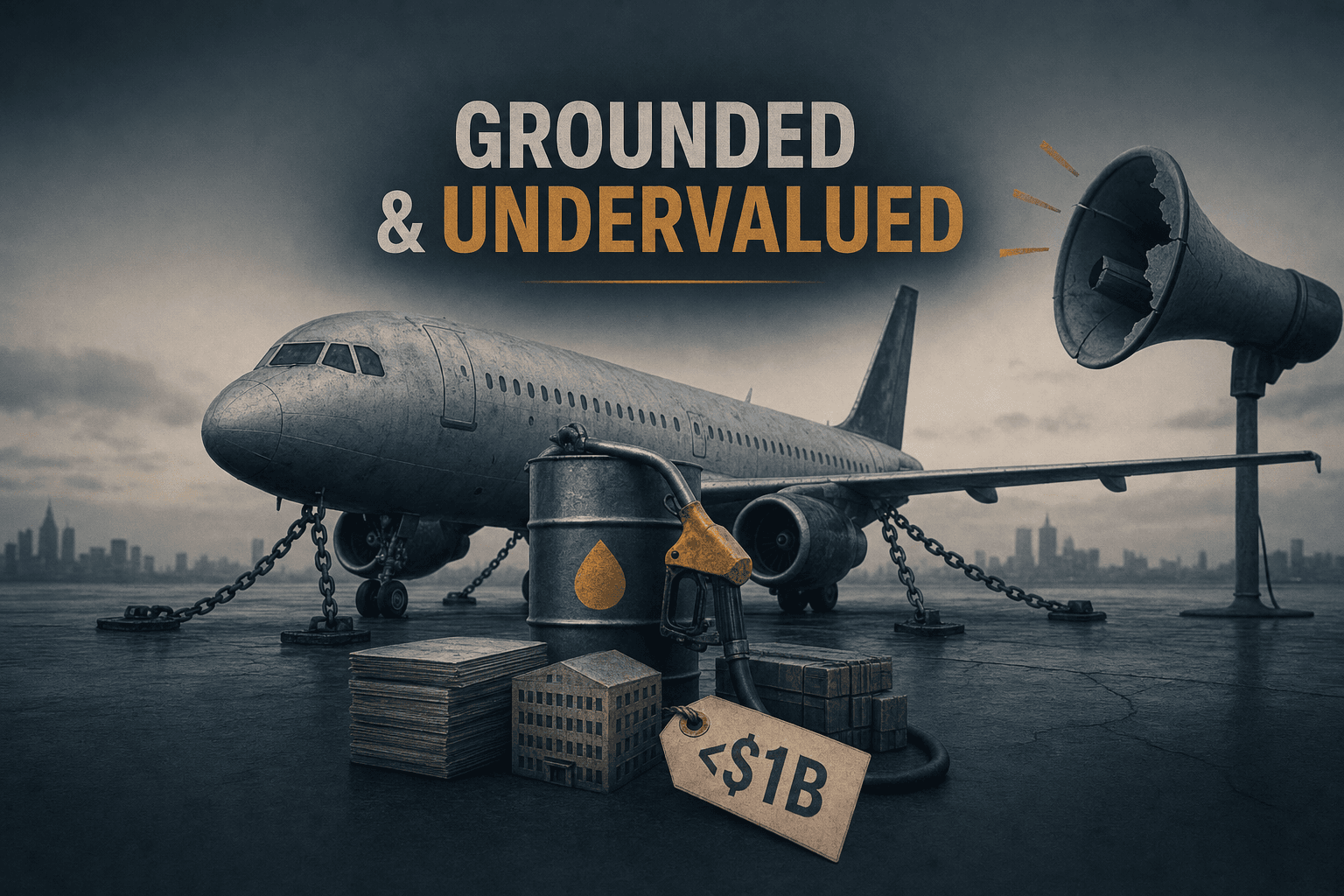
JetBlue closed Friday at $2.63. Monday it printed $2.20. That's a 296-plane airline, New York's hometown carrier, the biggest airline in Fort Lauderdale, with a market cap you could lose in the couch cushions of the Mag 7. Under $1 billion. Its $2 billion of senior bonds, the ones backed by the TrueBlue loyalty program, traded at 42 cents on the dollar Thursday. A month ago they were 80. The bondholders have hired PJT Partners & the law firm Akin, which is what you do right before you ask for the keys. Q3 earnings land Tuesday morning. You can likely guess where we're going with this. The number that matters Tuesday isn't earnings. It's cash.
How we got here
Start with the asteroid. When the Strait of Hormuz went from shipping lane to war zone this year, crude did what crude does & jet fuel did something worse. We wrote about the bond side of that story Hormuz Lit the Fuse. Jet fuel isn't crude. It's crude plus a refining margin called the crack spread, and when supply gets scared the crack blows out on top of the barrel. Gulf Coast jet fuel hit $4.34 a gallon on October 8. A year earlier it was $2.19. Delta, which owns its own refinery, still guided December-quarter fuel to about $4.25 a gallon, and that number already includes 40 cents of refinery benefit.
JetBlue has no refinery. It also has no hedges. The airline stopped using forward contracts for fuel, so it takes every penny of the move at the pump. Here's the arithmetic. JetBlue burns about 215 million gallons a quarter, call it 870 million a year. Every $1 a gallon is roughly $870 million of annual cost. The whole market cap is $830 million. Read those two numbers again.
In the second quarter JetBlue paid $4.23 a gallon, up 76% from a year ago, and its fuel bill went from $504 million to $911 million. Revenue was a record. RASM, the industry's unit-revenue yardstick, rose 10.9%. Didn't matter. The quarter lost $247 million. Management said it recaptured nearly half the fuel increase through fares. That's the best case. The other half goes straight through the P&L, & an airline running a negative 5% margin doesn't have a half to spare.
Then summer happened. Weather & air traffic control cancellations nearly doubled across the Northeast in July & August. On September 10 JetBlue raised its Q3 cost guidance ex-fuel to up 6% to 8%, cut capacity, raised its fuel assumption to $3.96 from $3.49, & raised revenue guidance too, because demand is the one thing that isn't broken. Consensus for Tuesday is a loss of 52 to 54 cents a share on $2.8 billion of revenue. Record sales. Wider loss. That's the airline business at $4 fuel.
What $830 million buys
On paper, a lot. 296 Airbus aircraft, 286 of them owned outright: 129 A320s, 102 A321s & 65 A220s, average age 12 years. $10.8 billion of flight equipment net of depreciation. $2.2 billion of cash & investments at June 30. Slots at JFK, LaGuardia & Washington National. Terminal 5 at JFK. A 9% piece of the TWA Hotel. A venture portfolio. And TrueBlue, which sold $463 million of points in the first half of the year alone.
Now the other side of the ledger, because the market can read a balance sheet. $8.5 billion of debt & finance leases. $2.7 billion of tickets & points already sold but not yet flown. $900 million of lease obligations. Add the payables & you get $14.8 billion of liabilities under $16.4 billion of assets. Book equity is the $1.6 billion sliver at the bottom, & the stock says that sliver is worth $830 million.
Here's the part the shareholders missed & the bondholders didn't. $8.1 billion of those aircraft, engines & facilities are already pledged to lenders. TrueBlue is pledged to the 2031 notes & a $742 million term loan. What's left unpledged is about $3 billion of book value, & JetBlue has been working that pile. In April it borrowed $500 million against owned A321s, A320s & A220s, with $250 million more available on the same terms. That accordion is the most visible lever left.
When the most senior paper in the building, secured by the best asset in the building, trades at 42 cents, the market is saying the collateral doesn't cover the claim. If the senior secured bonds take a haircut, the unsecured government loans, the converts & the common take the rest. Spirit's shareholders got zero in 2024. Spirit itself got zero in May. That's the comp.
So the $830 million isn't an airline. It's a call option on jet fuel going back to $3, with a creditor committee sitting across the table. A $1 drop in fuel adds $870 million of annual earnings power to a company worth $830 million, and the stock doubles or triples. Fuel stays here & the lenders take the keys. A 10% move in enterprise value is an 85% move in the stock. That's why 30% of the float is short, & why the bonds, not the EPS line, decide Tuesday. For the framework on why a 5% world punishes debt-funded balance sheets first, see Valuing AI Stocks in a 5% World With $112 Oil: Cash vs Debt.
What we're watching Tuesday
First, the September 30 cash number. A print near $1.8 billion keeps the $750 million liquidity covenant theoretical; a number starting with 1.5 makes it the conversation. Second, the Q4 fuel assumption. Anything north of $4.50 a gallon turns the full-year margin guide into a cut. Third, new money. A Barclays pre-purchase of TrueBlue points, sale-leasebacks or Airbus deferrals would move the bonds first & the stock second. Fourth, a direct answer on the creditor group. Silence gets read as confirmation. Fifth, 2027 capacity. An airline at this margin has to shrink, & shrinking into a fixed cost base is how the spiral starts.
The communication problem
Now the part we actually want to talk about, because this is our business. Thursday, October 22, at 1:04 in the afternoon, with the stock down 10% to its lowest print since the 2002 IPO & the loyalty-backed bonds trading at 40 cents, JetBlue put out a press release. Not about liquidity. Not about the bonds. A release expanding Mosaic, its elite status program, for 2027: free BlueFirst upgrades for every Mosaic tier, bigger point bonuses, the ability to gift status to a friend. Think about what the collateral is here. TrueBlue backs $2.7 billion of senior debt. The market spent that exact afternoon marking that collateral to 40 cents, & management's answer was to publicly give away more of it. Within 24 hours the Wall Street Journal reported the bondholders had hired restructuring advisers. The release was almost certainly scheduled weeks earlier, & it doesn't matter. The calendar doesn't outrank the tape. On a day the credit is talking, a company has two moves. Say nothing until the print, or put out a 7 a.m. 8-K with the September 30 cash balance & one sentence confirming covenant compliance. The new Investor Relations manager (according to its website) is Koosh Patel who came from Boeing but not in the investor relations capacity. His job was focusing on sales & growth for converted freighters and aircraft leasing. Before that Deutsche bank (face palm). This is what happens when you have just stick anyone into a role where the market is listening intently. Delta cut its guidance two weeks ago and the stock lived, because Delta talked to the market about the thing the market was scared of. JetBlue talked about upgrades. Anyone who reads loyalty press releases as a bankruptcy tell, & there are more of them than you'd think, read that one the way it was always going to be read: an airline reassuring its frequent flyers that their status is safe, three months before anyone asked. Promising February perks when the question is whether you get to February unrestructured isn't communication. It's a confession with a marketing budget.
Subscribe to StockAlpha for the Tuesday scorecard and everything that follows it.
Disclosure
Jefferson AI and StockAlpha holds a small position in $JBLU in stock plus 2028 options and has no business relationship with JetBlue Airways. Figures are from JetBlue's SEC filings, company releases and public reporting as of October 26, 2026. Nothing here is investment advice.