
 Alpha Breaking
Hormuz Lit the Fuse. Bonds Now Run AI Data Center Stocks
Share this article
Spread the word on social media
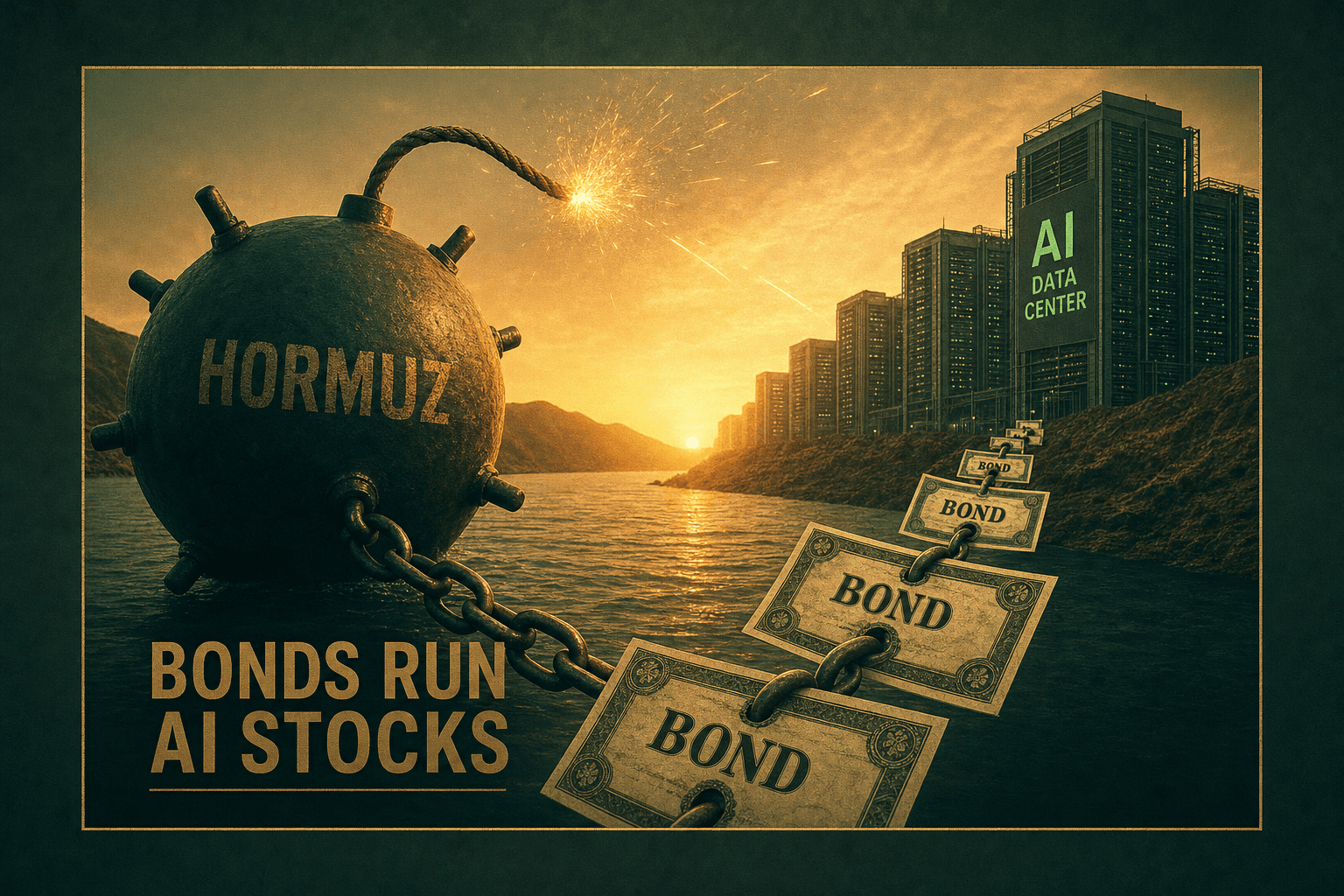
The AI data center trade used to be a pleasant chip story with unicorns & rainbows, but this month it’s a bond horror story. The 10-year Treasury is trading with a 5-handle and printed its highest yield since 2002 this month. The 30-year printed 5.73% on Wednesday before two decent auctions pulled it back. September CPI came in hot at 3.7%. And the four biggest hyperscalers have guided to roughly $730 billion of 2026 capex, a growing share of which the bond market is being asked to fund. A Seeking Alpha piece this morning written by Michael Kramer called the bond market the AI trade’s biggest challenge yet. We agree, and we think the damage runs deeper than the $XLK chart it was written around. So we mapped the whole complex against a 5% risk-free rate, hyperscalers at the top, small-cap photonics at the bottom, and factored in the variables in between.
How we got here: an asteroid in the Strait of Hormuz
Every story has its beginning, middle and end, with protagonists, heroes and antagonists. Chips and data centers was the fairytale filled with unicorns & rainbows and has devolved into Nightmare on Bond street. How this one got written is no different, but how we got here needs to be understood, because it was the catalyst that shaped this whole mess. You can likely guess where we’re going with this: the war in Iran that never needed to happen, a region under siege, and the Middle East countries that have funded much of the AI data center buildout getting hurt because of it. The war wasn’t a pebble thrown into a still pond. It was an asteroid hitting the Strait of Hormuz, where the supply chains ran through, as did 20% of the world’s oil and gas. Moving at 25,000 miles per hour.
The dates matter. The U.S. and Israel hit Iran on Feb. 28. Iran shut the strait within days. Before the war, about 125 big ships a day and roughly a fifth of the world’s crude and LNG moved through it. A ceasefire in April bought three months and fell apart in July. The Navy now shepherds Gulf tankers out along Oman’s coast while traders do ship-to-ship transfers to stay out of missile range. It almost worked. Gulf exports clawed back to more than 80% of pre-war levels in September. Then the IRGC went after the shuttle. Ten tankers were hit in one week at the turn of the month, 15 more attacks followed through Oct. 14, and flows through the strait went from 20.8 million barrels on Oct. 8 to 2.9 million on Oct. 11. Brent sits just under $100 against $72 before the war, after a $109 spike in early September. At least 24 sailors are dead and 100 commercial ships have been attacked, by the IMO’s count.
Now the money. A big chunk of the checks behind the AI buildout get written in Riyadh, Abu Dhabi and Doha. PIF, QIA, Mubadala and its AI arm MGX manage something like $5 to $6 trillion between them, and Middle East funds led the world in sovereign AI investing last year. MGX is a strategic partner in Stargate, holds pieces of OpenAI, xAI and Anthropic, and closed a $40 billion buyout of Aligned Data Centers with BlackRock in July. Saudi’s Humain is building 1.9 gigawatts of AI capacity at home. Those funds get refilled by oil and gas, and oil and gas go through Hormuz. Iran knows it. That’s why it hit Gulf energy infrastructure early and why 47% of the ships it has struck belong to Gulf Arab energy fleets, per Windward. The checkbook isn’t closed, Aligned proves that. But Saudi FDI is falling, net foreign buying across the GCC was down 83% in the first half, and the pledges are reportedly under review. When the people funding the buildout are watching their own export revenue get shot at, the buildout’s cost of capital goes up. That’s the beginning of the story.
Then the inflation. Oil at $100 is a tax on everything that moves, and it shows up in CPI with a lag. Headline inflation is 3.7% now, up from 3.4% in August, and the September monthly print was 0.6%. Harris Financial’s Jamie Cox put it bluntly on CPI day: inflation is cooking with gas, and two wars have to end before anyone gets relief. The Fed hiked in September into a supply shock. The bond market did the rest. That’s the middle of the story, and it’s where the AI trade walked in carrying a $730 billion shopping list.
What the bond market just did
Wednesday’s CPI was the trigger. Headline ran 3.7% from a year ago against a 3.6% forecast. Core came in at 2.6%, a tenth above consensus. The 10-year touched 5.365% and the 30-year 5.733%, both 24-year highs, before the auctions came in well bid. The Nasdaq and the Russell 2000 each dropped about 2% after the print. Nobody rang a bell. They didn’t need to.
That number lands two weeks before the Fed meets on Oct. 27-28. Fed funds sits at 3.75% to 4.00% after September’s hike. Before the CPI, futures already put the odds of at least one more hike by December above 80%. October itself was priced somewhere between a long shot and a coin flip, depending on the venue. After the print those odds went up, not down. We wrote the game theory on a hiking Fed back in September. The branches haven’t changed. The hawkish one just got more likely, and the 2-year at 4.86% is telling you so.
The money got borrowed
Capex at this scale doesn’t come out of free cash flow anymore. It comes out of the bond market, and the bond market just raised its price. Microsoft $MSFT, Alphabet $GOOGL, Amazon $AMZN and Meta $META guided to about $730 billion of combined 2026 capex at the July prints, up from roughly $410 billion last year. Add Oracle $ORCL and you’re pushing $800 billion. UBS figures the three big cloud operators will spend about 102% of their cloud revenue on capex this year. Read that again. The gap gets borrowed.
So the bond market is getting fed, pun intended. U.S. corporate issuance crossed $1 trillion by September, led by tech, media and telecom. Oracle did $18 billion in one shot last September. Meta followed a month later with $30 billion of bonds plus a $27 billion off-balance-sheet vehicle for its Hyperion site. Alphabet and Amazon have each been back to the window more than once since. Fidelity’s institutional desk puts hyperscaler and AI paper at about 6.2% of the Bloomberg U.S. Corporate index, and says its duration-times-spread contribution, a measure of credit risk, now exceeds that of the six largest banks. Six banks. In mid-September Apollo’s Torsten Slok flagged widening credit default swaps on hyperscaler bonds while bank spreads held steady. His read: the market is repricing hyperscaler credit, not credit in general.
Then there’s Nvidia $NVDA, which quietly became a financier. In August it signed memorandums with Apollo, BlackRock, Blackstone, Brookfield, Goldman Sachs and KKR to raise more than $500 billion of third-party capital for AI factories. Jensen Huang said Nvidia could backstop up to $125 billion of it. JonesTrading’s Mike O’Rourke called it in September: Nvidia is repositioning itself to finance the buildout, and rate hikes would put pressure on the whole trade. He wasn’t sure the hikes were coming. We got one anyway.
One more wrinkle from the Seeking Alpha piece. By the author’s count, the CPI index for computers and related devices is up 9.7% from a year ago. That’s a category that fell about 11% a year on average since 1997. AI demand for the same parts flipped it. So the buildout isn’t just borrowing at higher rates. It’s helping cause the inflation that keeps the rates high. The snake is eating its tail.
Who gets hit, and in what order
Picture the shockwave from the strait rolling through the complex. It doesn’t hit everyone the same way.
The hyperscalers feel it as a coupon. They borrow, but they also have the cash flows, so their equity reprices on multiples, not survival. Oracle is the one the credit desks look at first because it borrows the most relative to what it earns.
The chip layer feels it as demand. Nvidia, AMD $AMD, Broadcom $AVGO, TSMC $TSM and Micron $MU get paid out of that capex. HBM is still tight enough that Micron is the one name enjoying the scarcity. Nvidia is the odd one out, carrying a $125 billion backstop on top of a chip business. A financier trades like a financier when rates go up.
Optical and power feel it as a discount rate, and that’s the cruel part. Coherent $COHR, Lumentum $LITE, Credo $CRDO, Marvell $MRVL and Applied Opto $AAOI get paid by the box builders, who get paid by the hyperscalers, two steps from the checkbook. Vistra $VST, Constellation $CEG and GE Vernova $GEV sell multi-year capacity against project debt, so the long end hits them twice. We covered how the photonics trade repriced on Nvidia’s last quarter. It reprices on bond days too, and harder, because nobody in that group has coupons to blame. It’s all multiple.
And then the small caps, POET $POET, Lightwave Logic $LWLG, Aeva $AEVA, at the bottom of the shockwave. No bonds to reprice. But their equity is a claim on cash flows years out, and the 30-year is the rate those get discounted at. They also raise money in the equity market, so a tape like Wednesday’s makes every raise harder and more dilutive. In a 5% world, the further your cash flows sit from today, the more the bond market owns your multiple. That’s not a theory. Look at the Russell on CPI day.
$XLK says the tape agrees
$XLK broke support this week. The Seeking Alpha author’s read is that the uptrend that started July 29 is gone, and a close below the 50-day opens a move toward $175. We’d add that the small caps bled first, which is what a discount-rate shock looks like. The Russell fell as much as the Nasdaq on CPI day. Beta rolled down the stack in exactly the order above.
Six things we’re watching into the Oct. 28 Fed
1. Hormuz, every morning. Tanker strikes and the Brent print. A $100 handle keeps headline CPI hot, and hot CPI is the whole reason we’re here.
2. Oct. 28 itself. Hike or hold matters less than the statement’s language on December. A hold that keeps December live is still a hiking Fed.
3. The hyperscaler prints, expected the same week. Meta and Alphabet are penciled in around Oct. 28 and Amazon around Oct. 29. The number is 2027 capex guidance. “Spend more” into a hiking Fed is a different trade than “spend more” was in July.
4. Hyperscaler CDS and new-issue concessions. If the next $20 billion deal needs more coupon to clear, the capex-to-cash-flow math gets uglier for every layer below.
5. The 2-year above 4.85% against the 30-year near 5.6%. Front end for the Fed path, long end for the multiple.
6. Nov. 10, October CPI. The last inflation print before the Dec. 8-9 meeting.
The hero of this story is boring. It’s cash.
Every story needs a hero, and in a bond horror story the hero is boring. POET $POET is the pure-play at the bottom of this stack. It designs optical interconnect engines for the AI data center market. Volume shipments into that market are expected, not yet underway. What makes it interesting in a 5% world is the one line the bond market can’t reprice. POET finished June with $796.3 million of cash and short-term investments against about 173 million basic shares, 264 million fully diluted. Run the arithmetic at any price under $7 and cash covers roughly two-thirds of the market cap. No coupons. No refinancing window. No sovereign fund to call for the next round. That’s the opposite of the hyperscaler balance sheet right now, and it’s the opposite of what the asteroid hit.
The other side of it is duration. Revenue has grown sequentially for six straight quarters, off a small base, with a $50 million initial purchase order from Lumilens inside a framework that can run to $500 million. Those cash flows are years out, which is exactly why the stock trades like a yo-yo on bond days. It’s the highest-beta expression of the whole complex. Q3 results are due in November. Until then the war sets the bond market, the bond market sets the tape, and the names with cash and no coupon get to wait it out. The names with coupons don’t.
Subscribe to StockAlpha.ai for the next read on the AI data center complex.