The Big Picture
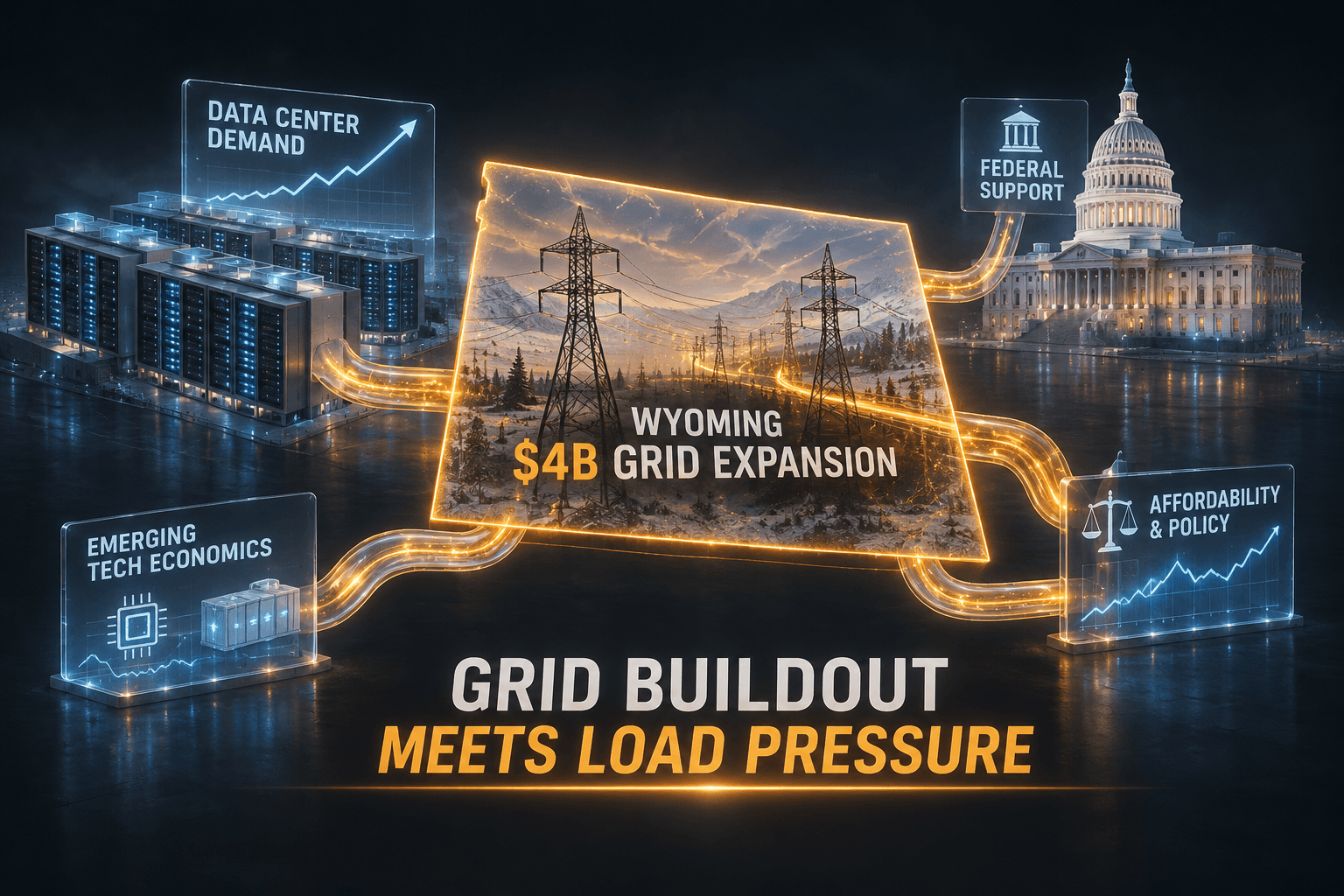
A federally supported $4 billion transmission project and a multigigawatt data center pipeline point to the same urgent question for utilities: how will the grid keep up with new demand? The U.S. Department of Energy is backing Grid United’s proposed Wyoming intertie to connect eastern and western electricity grids, while Cheyenne Light is working through major data center opportunities.
That buildout could bring new investment and customers, but it also raises questions about costs, reliability, and who pays for expanded infrastructure. Utilities are emphasizing affordability and a broader mix of load-growth sources as they navigate election-related uncertainty. What should you take from the latest headlines? The sector has meaningful growth drivers, but execution and cost management will matter.
Market Highlights
The clearest infrastructure headline is the federal support for Grid United’s planned intertie. The project is valued at $4 billion and is expected to save $39 billion over 30 years, according to the report. Those figures point to the potential long-term value of moving power between regions, although the story does not provide a construction schedule or details on how the projected savings would be distributed.
- Grid United’s Wyoming transmission project: $4 billion in estimated project cost, with $39 billion in expected savings over 30 years.
- Cheyenne Light: a record peak load of 439 megawatts, alongside a 3-gigawatt near-term data center pipeline and 2.5 gigawatts of emerging opportunities.
- Otovo: more than 1,000 inverter replacements completed using Tigo Energy technology to repower existing residential and commercial solar systems.
There were no utility stock price changes or percentage moves reported in the supplied stories. For today’s open U.S. market, that means the news offers operating and policy context, not a reported share-price catalyst. You’ll want to distinguish confirmed project support and company-reported pipelines from future development opportunities that may still depend on contracts, infrastructure, and approvals.
Key Developments
Transmission investment meets a surge in power demand
The Department of Energy’s support for the Wyoming intertie puts transmission capacity back in focus. Connecting eastern and western grids could help move electricity across regions, while the reported $39 billion in expected savings over 30 years suggests a substantial potential benefit relative to the project’s $4 billion price tag. The news does not specify the project’s final approvals, financing structure, or delivery timeline, so those details remain important to track.
At the same time, utilities are fielding new demand from data centers. Cheyenne Light’s 3-gigawatt near-term pipeline, plus 2.5 gigawatts of emerging opportunities, is large compared with its reported 439-megawatt peak load record. A pipeline isn’t the same as contracted or connected load, but it shows why utilities are planning for potentially significant changes in electricity needs. The wider discussion about factories competing with data centers for power adds a further question: how will utilities balance competing customers and maintain affordable service?
Utilities stress affordability and flexibility
In its Q3 earnings roundup, Utility Dive reports that executives are reassuring investors amid election fallout. Leaders discussed data center pipelines but also highlighted diverse sources of load growth, affordability, and the importance of working with incoming officials. For you, the message is that demand growth alone may not tell the full story. Policy relationships and the ability to serve customers without placing undue pressure on bills are also central to the sector’s outlook.
Those priorities connect with the European Parliament’s move toward a proposed Competitiveness Fund, expected to become active from 2028. The fund is framed as a way to coordinate investment, strengthen industry, and support climate objectives. It is a longer-term policy development rather than an immediate operating change for U.S. utilities, but it reflects the broader competition to fund clean-energy and industrial infrastructure.
New technologies offer potential, with hurdles still in view
Bidirectional EV charging could let vehicles send electricity back to the grid, but experts cited by Utility Dive say costs remain high and technical solutions are incomplete. Carefully designed utility programs and newer charging systems could eventually create value for both customers and the grid, though the report points to work still needed before that potential can be broadly realized.
On the solar side, Otovo’s more than 1,000 inverter replacements show one practical way to extend the usefulness of existing systems that have been left without adequate support. Separately, a first space-solar power purchase agreement has been signed: Virtus Solis is set to supply orbital solar power to data center infrastructure operated by Brae Systems under a 20-year PPA. That is a notable contract, but the article focuses on the challenge of pricing and underwriting the technology. It is an early-stage development, not evidence of established utility-scale supply.
Climate-related reporting also included a study of travel influencers’ flying habits and airline social-media promotion. It is not a direct utility earnings story, but the debate underscores the competing pressures around emissions and consumer behavior that shape the wider energy transition conversation.
What to Watch
For the rest of today and in the coming weeks, focus on specifics that can turn demand forecasts into investable operating plans. Track updates on the Wyoming intertie’s approvals, financing, route, and construction schedule, along with any explanation of how its projected savings are calculated. These details will help clarify whether the proposed benefits can be realized and when.
Also watch whether Cheyenne Light’s data center prospects progress from pipeline to signed agreements, and how utilities describe the cost of serving large new customers. Q3 commentary points to affordability and policy as active concerns, so rate treatment, infrastructure spending, and engagement with incoming officials remain relevant. On emerging technologies, look for concrete program designs and cost reductions in bidirectional EV charging, as well as credible financing and delivery milestones for orbital solar. The supplied reports don’t identify a specific upcoming earnings date or regulatory decision.
Bottom Line
- Federal support for a $4 billion intertie highlights the value utilities and policymakers place on transmission, with $39 billion in expected savings over 30 years.
- Cheyenne Light’s data center pipeline signals possible load growth, but pipeline figures are not the same as connected demand.
- Affordability, reliable service, and election-related policy uncertainty remain key factors in utility planning.
- EV-to-grid charging and orbital solar are developing concepts with meaningful cost, technical, and underwriting questions still to resolve.
- Use reported milestones and company disclosures to assess progress; this summary is informational and isn’t personalized investment advice.
FAQ
Q: What is the Wyoming grid intertie? A: It is a proposed $4 billion electricity transmission project backed by the U.S. Department of Energy to connect eastern and western grids.
Q: How large is Cheyenne Light’s data center pipeline? A: Company officials cited a 3-gigawatt near-term pipeline and another 2.5 gigawatts in emerging opportunities.
Q: Can electric vehicles already supply power back to the grid at scale? A: The reports say costs remain high and technical solutions are incomplete, though utility program design and newer charging systems could help.