The Big Picture
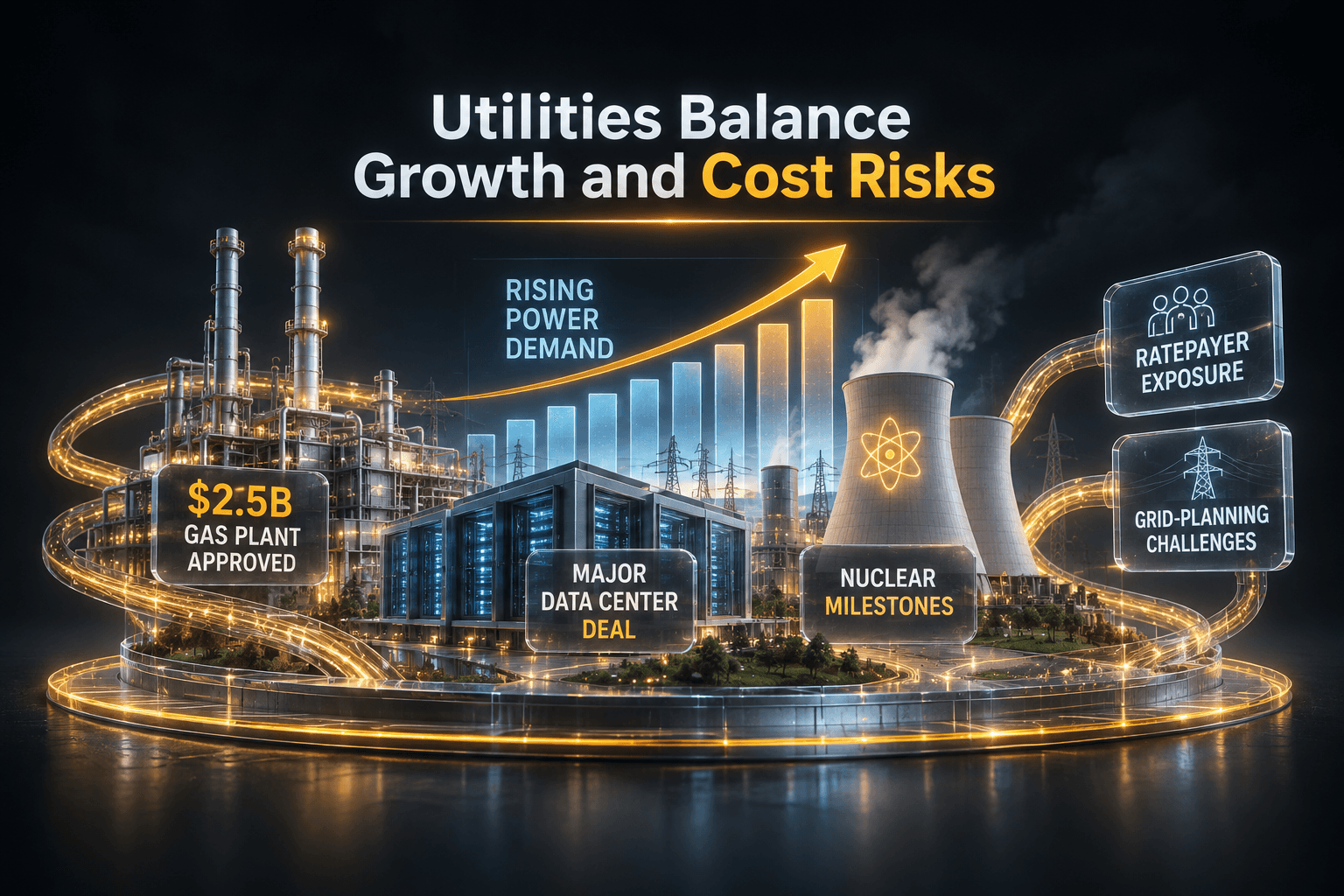
U.S. utilities are facing a fast-changing investment equation: new demand from data centers is driving large infrastructure plans, but the cost and allocation of those investments remain contested. Today’s developments include approval of a $2.5 billion gas plant in West Virginia and a $1.7 billion data center deal touted by the Tennessee Valley Authority, alongside significant progress for advanced nuclear projects.
Those announcements point to possible growth in electricity demand and new generation, not guaranteed returns for utility shareholders. Consumer advocates, environmental groups and transmission critics are raising concerns about who bears the cost. For you, the key question is whether utilities can add capacity and serve new customers without putting disproportionate costs or risks on existing ratepayers.
Market Highlights
The clearest near-term developments involve generation and large-load customers. FirstEnergy’s utilities received approval for a gas plant, while TVA highlighted a data center agreement under a new tariff. The reported coverage did not provide share-price moves or percentage changes for utilities stocks, so there are no verified stock movements to cite here.
- FirstEnergy (FE) utilities received approval for a proposed $2.5 billion gas plant in West Virginia. The project faced opposition over demand forecasts and potential ratepayer risk.
- TVA touted a $1.7 billion data center deal under its new large-load tariff. The utility has also received an NRC construction permit for a BWRX-300 small modular reactor at Clinch River, but has not decided whether to build it.
- The NRC issued a construction permit for four X-energy Xe-100 reactors intended to provide power and process steam to Dow (DOW) operations on the Texas Gulf Coast. The permit was issued Nov. 9, after nearly eight years of development.
Other reports point to longer-term pressures and possibilities rather than immediate financial results. An analysis of commercial electricity demand argues that traditional grid-planning assumptions are being tested, while a CalWave-SKF agreement opens discussions about deploying submerged wave-energy systems. Neither report includes a near-term utility earnings estimate or a quantified change in power supply.
Key Developments
New capacity meets ratepayer scrutiny
Approval of FirstEnergy’s proposed gas plant gives the project a regulatory milestone, but it doesn’t resolve the disagreement over whether projected load growth justifies the investment. Consumer advocates and environmental groups have questioned both the forecasts and the possibility that customers could absorb project risks. That debate matters because approval alone doesn’t establish the plant’s final cost to customers or its effect on utility earnings.
TVA’s data center agreement highlights the commercial opportunity in serving large electricity users, with a tariff designed for large loads. The structure of such tariffs is worth watching: the terms can affect how much of the cost of new service falls on the customer versus other ratepayers. If you’re assessing utilities’ growth plans, look beyond headline deal values to cost recovery, customer commitments and infrastructure needs.
Nuclear projects advance, but construction is not operation
The NRC permit for Dow’s four Xe-100 reactors marks a notable step for high-temperature gas-cooled reactor technology. The planned facility is intended to serve industrial operations with electricity and high-temperature steam, linking nuclear development to both power supply and manufacturing needs. A construction permit is not a completion date or a guarantee of commercial performance, so execution and project economics remain important unknowns.
TVA’s separate BWRX-300 permit is also a regulatory milestone, but the utility says it hasn’t decided whether to proceed with construction. These projects signal continued interest in advanced nuclear options, while making clear that a permit and a final investment decision are distinct events. What will determine whether they become durable supply additions? Utilities’ decisions, project costs and delivery timelines will be central.
Grid pressure and energy-transition signals
A POWER Magazine analysis says the traditional relationship between population growth, economic activity and electricity demand is being challenged as commercial loads take a larger role. That concern connects directly to data center deals and generation approvals: large, concentrated demand can require utilities to revisit forecasts, transmission plans and who pays for added capacity.
In transmission, a Utility Dive opinion piece argues that the Southwest Power Pool is using a reliability exemption to favor incumbent utilities over competition, and calls for FERC action to protect ratepayers from higher costs. That is an advocacy position, not a reported FERC finding, but it draws attention to a material policy question: how transmission projects are selected and funded. Separately, CalWave and SKF signed a memorandum of understanding to explore a commercial relationship for submerged wave-energy systems. The announcement indicates early-stage collaboration, not a confirmed commercial rollout.
Two other CleanTechnica reports are less directly tied to regulated utilities. One describes a possible Tesla (TSLA)-SpaceX merger, while noting that the expectation has rested on limited evidence; the other reports Chinese automakers overtaking Japanese competitors in six more markets. Neither supplies a confirmed utility-sector transaction or quantified effect on electricity demand. A report on in-port emissions describes health and climate costs and argues that existing European shore-power rules leave significant harms unaddressed, adding another policy and infrastructure issue for ports and power providers.
What to Watch
During today’s U.S. trading session, watch for company or regulatory updates that clarify project timelines, cost recovery and customer protections. The stories provided do not include verified premarket share moves, new earnings guidance or scheduled announcements for today, so avoid treating the project headlines as immediate stock catalysts.
For the coming weeks and months, monitor FirstEnergy’s next steps on the West Virginia plant, TVA’s decisions on its data center tariff and Clinch River reactor, and the development path for Dow’s permitted reactors. FERC action or further debate over SPP transmission planning could also affect how new grid investments are allocated. For your assessment of the sector, compare demand commitments with planned capacity and transmission spending, and note whether large customers are bearing the costs associated with their service.
Bottom Line
- Utilities have visible growth opportunities from data centers and industrial power demand, but project value depends on cost recovery and execution.
- FirstEnergy’s plant approval is a milestone, not a resolution of concerns about forecasts or ratepayer exposure.
- NRC permits move advanced nuclear projects forward, but they don’t mean construction is complete or that every permitted project will be built.
- Transmission competition, grid planning and customer cost allocation remain key policy risks to monitor.
- No stock-price or percentage moves were included in the supplied reports, so today’s market reaction should be checked against current trading data.
FAQ
Q: What is the biggest utilities development today? A: The news points to both rising electricity demand and new infrastructure plans, especially FirstEnergy’s $2.5 billion plant approval and TVA’s data center deal.
Q: Does the NRC permit mean Dow’s reactors are operating? A: No. It authorizes construction of four planned Xe-100 reactors, but it doesn’t mean they are built or generating power.
Q: What is the main risk for utility customers and investors? A: A central concern is whether new generation and transmission costs are fairly allocated, particularly when demand forecasts and large-load commitments remain under scrutiny.