The Big Picture
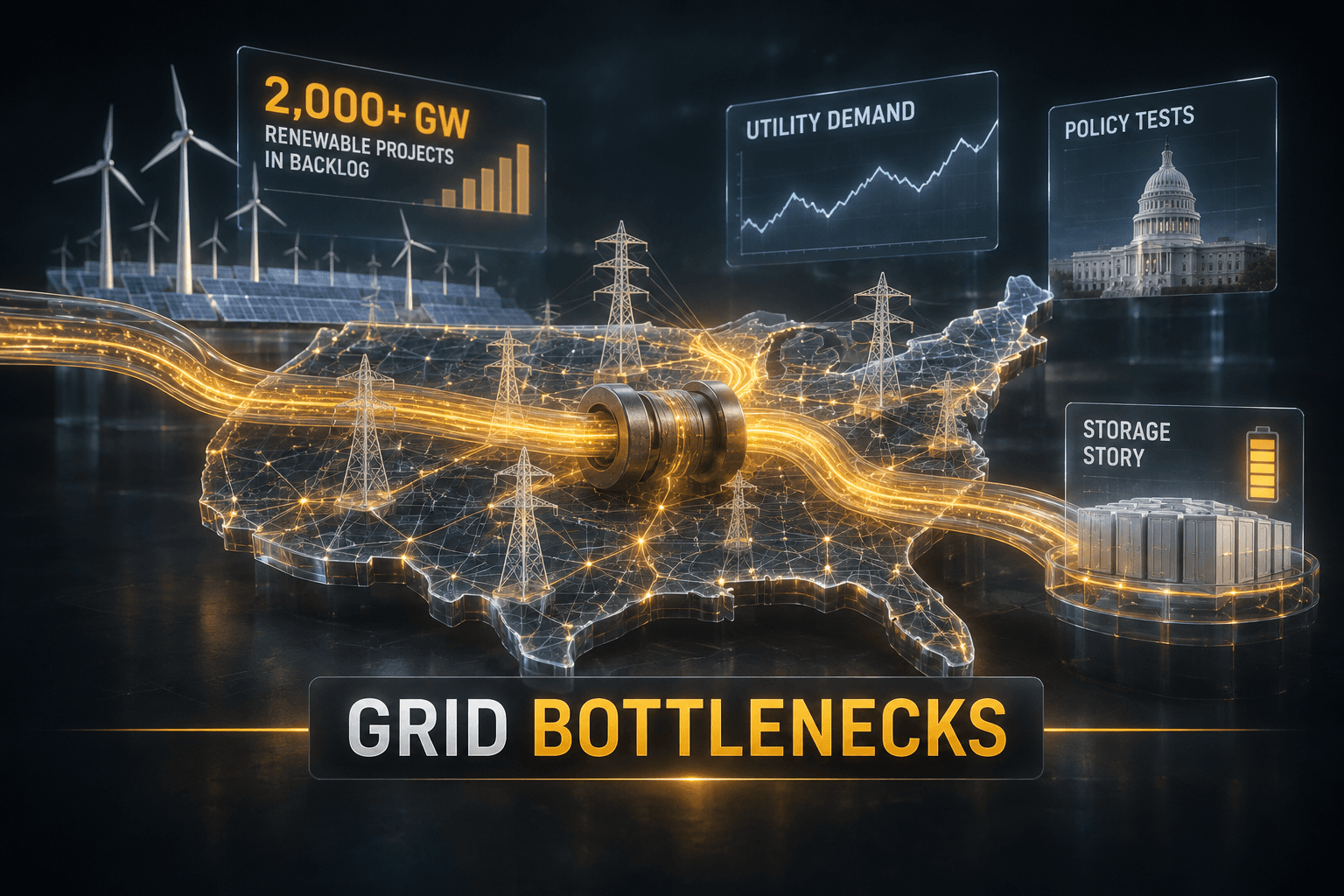
Grid capacity is emerging as a central constraint for utilities and the wider energy transition: industry leaders at COP31 say more than 2,000 GW of renewable projects are waiting for grid connections. That queue shifts attention from the cost of generating clean power to the infrastructure needed to deliver it.
Other developments offer a mixed picture, from a federal antitrust probe closing for NextEra and Dominion to unsettled policy debates and large-scale storage plans. As U.S. markets open today, the reports don’t provide stock-price moves or new earnings data, so what can you take from the headlines? The clearest signal is that execution, regulation and customer costs remain key issues.
Market Highlights
These are the notable figures and developments in the morning’s news. The coverage provides no percentage changes or current share prices for the companies mentioned.
- More than 2,000 GW of renewable projects are awaiting grid connections, according to industry leaders cited by Power Engineering.
- Snowy 2.0’s final cost estimate is A$22 billion to A$25 billion, with completion expected in late 2029, according to the Australian National University.
- CalWave and SKF signed a memorandum of understanding to explore a commercial relationship for fully submerged wave-energy systems. The agreement is exploratory, not a confirmed deployment contract.
- New Jersey utilities have less than a year to implement virtual power plants under the state’s current timeline.
For U.S. utility names, the Department of Justice’s decision to close its antitrust probe involving NextEra Energy (NEE) and Dominion Energy (D) removes one federal investigative hurdle. State-level scrutiny continues, however, and the reports don’t indicate a resulting share-price reaction.
Key Developments
Grid limits and demand shape the growth outlook
The renewable-project connection queue highlights a practical challenge for utilities: projects can be developed, but still wait for transmission and grid access. That makes grid investment, permitting and interconnection processes important to the pace at which new generation can serve customers. The report doesn’t specify when the queued capacity could connect.
On demand, Mitsubishi Heavy Industries CEO Eisaku Ito argued that data centers’ off-grid power costs could push them back toward utility supply. He also said the effect on utilities would be limited if some projected data-center demand doesn’t materialize, and that electricity growth doesn’t depend on data centers alone. That’s an executive’s outlook, not a guarantee of future load or earnings growth.
Policy and regulatory questions remain open
The DOJ ended its antitrust investigation into NextEra and Dominion after the utilities agreed to let ISO-NE’s internal market monitor examine proposed plant retirements. That closes the federal probe, but hearings in Virginia are continuing, with executives questioned about how customer benefits will be quantified and secured. For you, the distinction matters: one review has ended, while state-level questions remain.
Solar policy is also contested. The solar industry supports the Bipartisan American Affordability and Jobs Act, or BAAJA, following its passage in the Senate, while environmental organizations oppose it. The available report doesn’t lay out the full provisions or the next legislative steps, so the practical effect on solar developers and utilities is not yet clear.
Another policy question is the supply chain behind “American-made” solar. A Renewable Energy World podcast discussion reported that solar cell and wafer production remains largely tied to China. Separately, COP31 ended without agreement on language calling for a transition away from fossil fuels, while the conference’s carbon-capture focus drew criticism from the CleanTechnica report. Together, these stories point to continued disagreement over energy policy and the technologies that should receive support.
Storage and distributed energy offer different paths
Australia’s Snowy 2.0 illustrates the scale and cost of long-duration pumped storage. The A$22 billion to A$25 billion estimate and late-2029 completion target are substantial, although the Australian National University’s assessment, as described in the report, says the project would be much cheaper than relying on batteries for storage. The figures are estimates, and the comparison shouldn’t be read as a like-for-like cost assessment without further detail.
In New Jersey, regulators say data from the two-year interim PowerUp NJ program will inform a longer-term, open-access virtual power plant tariff. Virtual power plants can coordinate distributed energy resources, but the immediate watchpoint is implementation: utilities have less than a year under the reported schedule. CalWave and SKF’s MoU offers a separate early-stage signal for ocean energy, but it establishes interest in a commercial relationship rather than a confirmed project.
What to Watch
During today’s session, check company disclosures and reliable market data for any price moves or updates tied to the headlines. The supplied reports contain no pre-market quotes, so they don’t establish whether $NEE, $D or other utility shares are moving in response.
Keep an eye on the next steps for BAAJA, details from Virginia’s hearings, and whether ISO-NE’s market monitor review changes the discussion around plant retirements. In New Jersey, implementation progress and the design of the long-term virtual power plant tariff may clarify how distributed resources could be incorporated into utility planning.
For the sector more broadly, grid connection delays, transmission investment and storage costs are worth tracking alongside demand forecasts, including data-center load. Project timelines and estimates also matter: Snowy 2.0 is years from expected completion, while CalWave and SKF have only announced exploratory cooperation. These are important distinctions when you assess how quickly a headline could translate into operating results.
Bottom Line
- Grid connections are a major bottleneck, with more than 2,000 GW of renewable projects reported to be waiting.
- The DOJ’s NextEra-Dominion probe is closed, but state hearings and market-monitor review continue.
- Data-center demand may support utility growth, though the MHI CEO says utilities aren’t reliant on that demand alone.
- Storage and virtual power plants present potential system tools, but costs, implementation and timelines remain central questions.
- Policy and supply-chain debates cloud the outlook for solar; today’s reports provide no company-specific share moves or financial results.
FAQ
Q: What is the main utility-sector issue in today’s news? A: Grid capacity and connections stand out, with more than 2,000 GW of renewable projects reportedly awaiting grid access.
Q: Has the DOJ investigation involving NextEra and Dominion ended? A: The DOJ closed its antitrust probe after the utilities agreed to allow ISO-NE’s market monitor to investigate proposed plant retirements. State hearings continue.
Q: Does the CalWave-SKF agreement confirm a wave-energy project? A: No. The companies signed an MoU to explore a commercial relationship; the report does not announce a deployment commitment.