The Big Picture
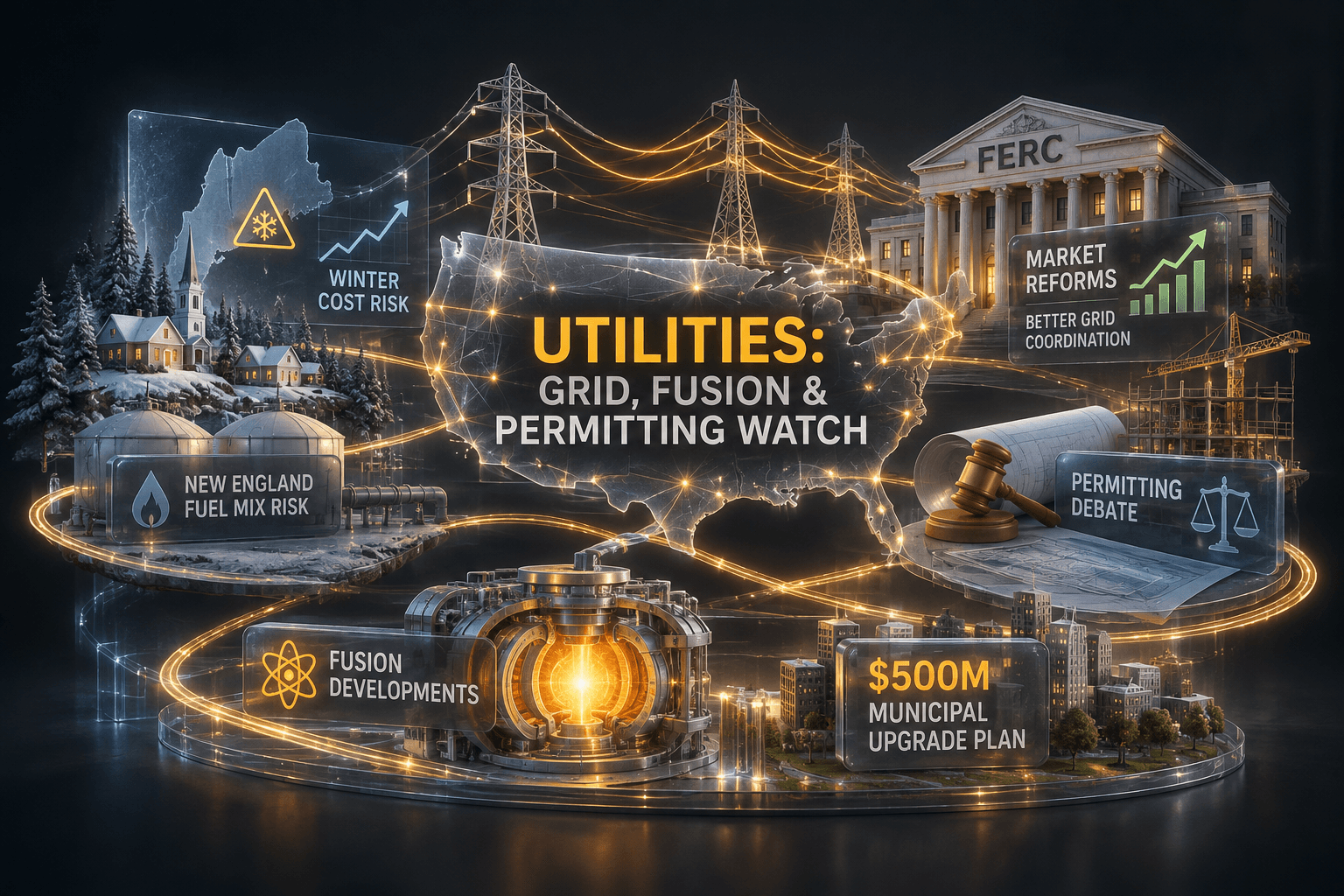
Utilities enter the new week with a mixed set of signals: federal regulators see market reforms improving grid coordination, but drought-related hydropower constraints in the West and oil dependence in New England keep reliability in focus. The Federal Energy Regulatory Commission’s winter report frames the reforms as a possible help to costs, not a guarantee of lower bills.
For investors, the broader story is about how quickly the grid can adapt to new demand and new energy sources. A House permitting debate, a $500 million municipal efficiency program and a regulatory step for a fusion developer each touch that transition, though none alone changes utility earnings outlooks overnight. U.S. stock markets are closed Sunday, so utility shares last traded Friday, November 20.
Market Highlights
There are no reported utility share moves or new company earnings figures in these reports. The developments are mainly policy, infrastructure and technology updates, so you’ll want to distinguish long-range sector themes from immediate financial results.
- FERC says improved coordination in the West could help offset lower hydropower output tied to historically low water levels in the Colorado River basin. Its report also flags New England’s risk of relying too heavily on oil.
- Energy-as-a-service provider Budderfly plans to invest $500 million in municipal energy upgrades, recouping costs from savings over the contracts’ life.
- AMPERA and Berto Acquisition Corp. have agreed to a business combination that implies a roughly $900 million pre-money equity value for AMPERA.
- New Mexico approved Pacific Fusion’s radioactive materials license, allowing the company to possess and use tritium fuel for a fusion machine.
- China’s October EV share reached a reported 68%, while the overall vehicle market fell 27% year over year to about 1.6 million sales. Ford also began producing LFP batteries for its own vehicles using CATL-licensed technology.
These EV developments are not utility results, but they offer context for changing electricity demand and storage technology. The reports don’t quantify any near-term effect on U.S. utility load, rates or capital spending.
Key Developments
Winter reliability depends on regional grid conditions
FERC’s winter market and reliability report points to both a potential benefit and a clear constraint. Better coordination among Western power markets may help balance the effects of diminished hydropower, while low water levels in the Colorado River basin remain a concern for available generation.
New England faces a different challenge: the report warns about overreliance on oil. Fuel availability, weather and regional market operations can all affect reliability and costs, so the national picture shouldn’t obscure local differences. If you follow utilities with substantial exposure to either region, these conditions are worth monitoring alongside company-specific updates.
Permitting debate creates a policy test
A permitting reform bill has passed the Senate and is heading to the House, but Democratic divisions persist over its provisions. Some lawmakers object to changes they believe could weaken environmental protections or state and tribal authority. Others argue that the current political environment may leave little room for a different agreement.
For utilities and developers, permitting timelines matter because major transmission and generation projects require approvals and construction. The bill’s path and final terms remain uncertain, however, and the reports don’t establish what projects would benefit or how quickly. What should you watch? Whether House negotiations preserve a workable permitting framework without deepening opposition from key stakeholders.
Investment and innovation span efficiency, fusion and electrification
Budderfly’s $500 million commitment would finance and operate energy upgrades for municipalities, with repayment tied to savings over each contract’s term. This energy-as-a-service model can help public entities undertake projects without funding the full upfront cost themselves. For investors, the important questions include execution, contract duration and whether projected savings are sufficient to repay investment; those details weren’t provided in the summary.
Separately, the New Mexico license is a step toward Pacific Fusion operating a fusion machine, not evidence that commercial fusion power is already available. AMPERA’s proposed combination with Berto, at an implied $900 million pre-money equity value, likewise signals investor interest in scalable power solutions for data centers, defense, industrial and maritime uses. Both developments remain early-stage from the perspective of utility-scale supply.
EV and solar news adds useful background, but it should be kept in proportion. Ford’s start of LFP battery production could build its own battery supply capability, while China’s record EV share came as its total auto market contracted sharply. Solar industry explainers on panel specifications and the difference between AC and DC offer practical context for system design, but they report no new project awards or utility contracts. Together, the items underline the importance of storage, electrification and technical integration without establishing a near-term change in regulated utility revenues.
What to Watch
Monday, November 23 is the next U.S. trading day. Before then, there is no new market session to interpret from these reports, and none provides Friday closing prices or percentage moves for utility stocks. As trading resumes, watch for company disclosures that connect these sector-wide themes to capital plans, customer bills, project schedules or earnings guidance.
Policy and operating conditions are the nearer-term catalysts. Track the House’s consideration of the permitting bill, any further detail on Budderfly’s municipal contracts, and updates on Western hydropower and New England fuel planning. You can also monitor whether the Pacific Fusion license is followed by operational milestones, while keeping in mind that commercialization remains a longer-term question.
Risks include persistent drought, fuel supply constraints, delays or changes to permitting legislation, and execution risk in projects that rely on future energy savings or emerging technology. The China EV figures and Ford battery production may inform longer-term demand and storage discussions, but they aren’t direct measures of U.S. utility demand.
Bottom Line
- FERC sees improved Western coordination as a possible winter support, but drought-related hydropower limits remain a risk.
- New England’s potential overreliance on oil highlights that reliability challenges vary by region.
- The permitting bill’s House path matters for infrastructure timelines, but political divisions leave its outcome unsettled.
- Budderfly’s $500 million plan and Pacific Fusion’s license are notable developments, not proof of realized savings or commercial fusion power.
- EV and solar stories point to energy-transition trends, while the reports provide no immediate utility stock performance data.
FAQ
Q: Did utility stocks move on Sunday, November 22? A: No U.S. stock trading took place Sunday. The last trading day was Friday, November 20, and the next session is Monday, November 23.
Q: Could FERC’s market reforms lower winter energy costs? A: FERC says improved Western coordination may help offset reduced hydropower and could support lower costs, but it isn’t a guarantee. The report also identifies regional reliability concerns.
Q: Does Pacific Fusion’s license mean fusion power is commercially available? A: No. The license authorizes the company to possess and use tritium fuel for a fusion machine in New Mexico. It is a regulatory step, not confirmation of commercial power generation.