The Big Picture
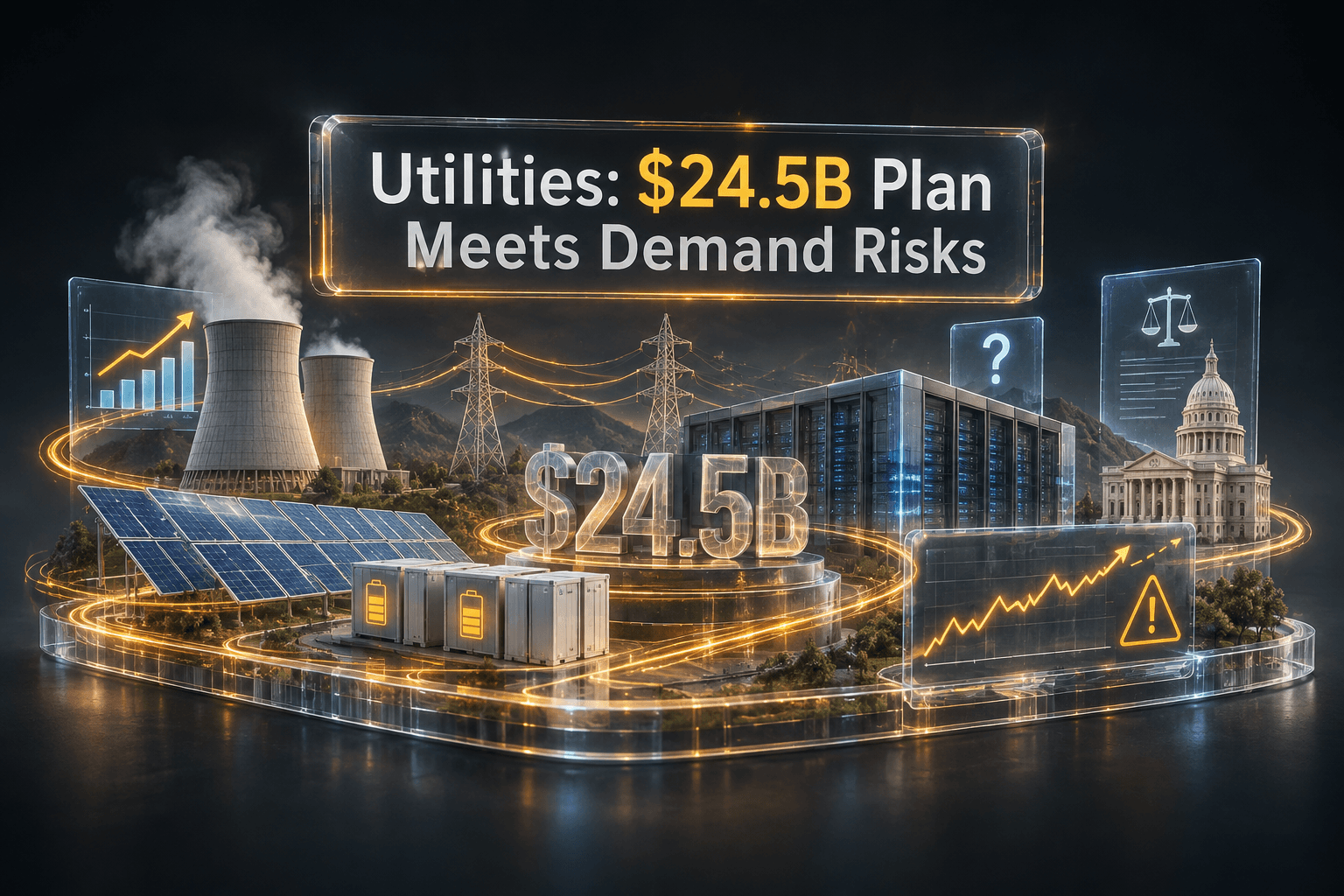
A nearly $25 billion Appalachian Power investment plan is the morning’s biggest utility-sector headline, but the broader picture is more complicated than a straightforward growth story. The plan pairs new natural-gas generation with coal-plant upgrades, while solar and storage projects point to continued investment across different parts of the power system.
At the same time, a report flags potential exposure to 191 GW of planned data-center capacity if those projects slow or fail to materialize. For you, the key distinction is between announced investment and demand that actually arrives. The sector has visible infrastructure plans, but their value will depend on construction, regulation and the customers utilities ultimately serve.
Market Highlights
Today’s reports span conventional generation, renewables, storage and grid operations. They offer evidence of active investment, but they don’t include share-price changes, earnings updates or new financial guidance for the companies mentioned. With U.S. markets open, investors can watch for trading updates separately rather than infer a stock reaction from these headlines alone.
Several figures help frame the scale and timing of the developments:
- Appalachian Power plans $17 billion for new natural-gas generation and $7.5 billion for coal-plant upgrades in West Virginia, a combined $24.5 billion. The state announcement projects 2,150 jobs by 2031. Appalachian Power is part of American Electric Power, which trades as American Electric Power (AEP).
- Crown City Solar in Cortlandville, New York, is planned as a three-phase, 22.5 MW DC floating community-solar complex. Its first two phases are under construction, with full operation expected in 2027.
- The U.S. energy-storage industry installed 14.3 GWh of capacity in the third quarter, bringing cumulative installations above 200 GWh, according to the reported industry figures.
- SolarEdge Technologies, traded as $SEDG, introduced a U.S.-made commercial and industrial optimizer designed to use 50% fewer optimizer units. Nextnova’s new Oklahoma City solar-cell plant is expected to create about 300 jobs.
Key Developments
Appalachian Power’s investment plan raises execution questions
The West Virginia proposal would direct $17 billion to new natural-gas generation and $7.5 billion to coal-plant upgrades. The reported job estimate adds a regional economic dimension, while the combination of new gas capacity and coal improvements reflects a generation strategy spanning both newer and existing assets.
For utility investors, the announcement is a substantial capital plan, not a completed project or a guarantee of returns. You’ll want to follow project approvals, financing, construction timelines and how the spending is reflected in customer rates. The reporting doesn’t specify those details or provide a projected effect on American Electric Power’s earnings.
Solar and storage projects add to grid options
Crown City Solar would bring a floating community-solar format to New York, with its 22.5 MW DC project expected to be fully operational in 2027. The reported construction of its first two phases gives the project a more concrete near-term status than a proposal alone, though the final phase and operating timeline remain milestones to watch.
Storage growth offers another important signal: more than 200 GWh has now been installed in the United States, with 14.3 GWh added in the third quarter. The industry report says storage growth is helping stabilize electricity prices and strengthen grid reliability, and it calls for permitting reform to accelerate deployment. Those are industry-level claims, not a guarantee that every project will improve reliability or reduce costs. Operators’ ability to monitor conditions and coordinate response matters too. A separate practical checklist highlights escalation pathways, telemetry and situational-awareness tools as ways storage operators can support the grid when conditions require it.
Manufacturing and demand risks point in different directions
SolarEdge’s new optimizer is aimed at simplifying commercial and industrial installations with fewer units, independent module-level tracking and enhanced safety features. Nextnova’s Oklahoma City facility adds domestic solar-cell manufacturing capacity and is expected to create about 300 jobs. OMCO Solar also introduced a tracker-control option powered by solar energy, intended to operate without AC power at the site. These product and factory developments suggest ongoing efforts to improve installation logistics and strengthen domestic supply chains, but the reports don’t quantify their expected revenue or market share.
That investment activity sits beside a material demand uncertainty. An Orennia report cited by Utility Dive estimates that 191 GW of planned data-center capacity is at risk, with exposure concentrated in Texas, Ohio and Georgia. If projects are delayed or scaled back, utilities counting on that load could face a mismatch between planned infrastructure and realized demand. Separately, a community-power advocacy group says most states fall short of its policy criteria for virtual power plants and local energy control. Its grades reflect the group’s policy framework, so they shouldn’t be read as a uniform regulatory assessment.
Zoox’s newly live partnership with Uber in Las Vegas, with Los Angeles expected to follow, is less directly tied to utility investment. Wider use of autonomous mobility could eventually intersect with electricity demand, but the announcement provides no power-consumption estimates or utility contracts. Treat it as a mobility development, not a near-term utility demand forecast.
What to Watch
For the next few sessions, separate near-term stock catalysts from longer-dated infrastructure plans. Watch for additional details on Appalachian Power’s approvals, project schedule, funding and rate treatment. For Crown City Solar and Nextnova, construction progress and commissioning timelines will help show whether announced capacity and jobs turn into operating assets.
Storage’s reported growth makes deployment and operations worth tracking, including whether permitting changes gain traction and how effectively operators use monitoring and response procedures. On the demand side, follow updates on data-center projects in Texas, Ohio and Georgia. If you’re assessing utility exposure, compare expected customer demand with the timing of planned investment, rather than assuming proposed capacity will be built.
Company-specific trading data wasn’t included in these reports, so today’s share-price moves, if any, need to be checked against live market information. Regulatory decisions, project costs and changes in customer demand remain important risks across the sector.
Bottom Line
- Appalachian Power’s $24.5 billion plan is the largest disclosed investment, but approvals, financing and rate recovery details remain key.
- U.S. storage installations have passed 200 GWh, while operating coordination and permitting remain relevant to further deployment.
- Solar projects and domestic manufacturing are advancing, with Crown City Solar targeting 2027 operations and Nextnova expecting about 300 jobs.
- The estimated 191 GW of at-risk planned data-center capacity is a notable demand-side risk, especially in Texas, Ohio and Georgia.
- These headlines are mixed signals, not a basis for a security recommendation. This summary is for informational purposes only, not personalized investment advice.
FAQ Section
Q: What is the largest utility investment announced today? A: Appalachian Power plans $17 billion for new natural-gas generation and $7.5 billion for coal-plant upgrades in West Virginia.
Q: How much energy storage has the U.S. installed? A: The reported total now exceeds 200 GWh, after 14.3 GWh of new capacity was installed in the third quarter.
Q: Why are data centers a risk for utilities? A: A report estimates 191 GW of planned capacity faces risk. If projects slow, utilities may see less demand than expected for planned infrastructure.