The Big Picture
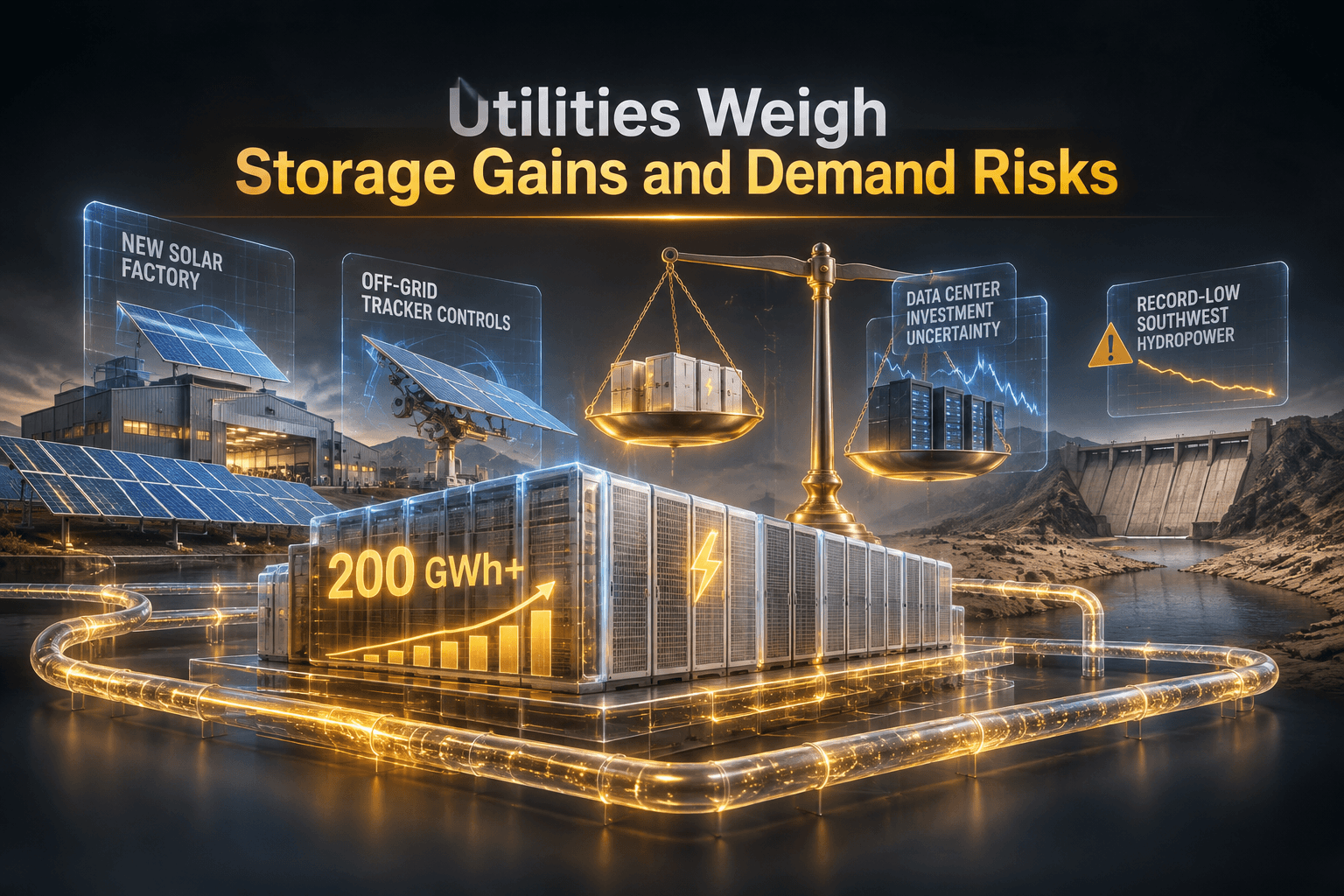
Utilities face a two-sided outlook tonight: energy storage and domestic solar manufacturing are expanding, but the scale and reliability of future power demand remain uncertain. A report flags 191 GW of planned data center capacity as exposed to potential slowdown, while drought pushed Southwest hydropower to a record low this summer.
That mix matters because utilities must plan generation and grid investment years ahead. What should you take from today’s news? Growth opportunities are real, but demand forecasts, weather and policy will shape how much of that investment pays off.
Market Highlights
Today’s reports offered new evidence of clean-energy deployment, alongside warnings about project and operating risks. U.S. storage capacity has crossed a notable threshold, while manufacturing and control-system announcements point to continued industry development.
- U.S. installed energy storage topped 200 GWh. SEIA and Benchmark Mineral Intelligence reported 14.3 GWh of new capacity in the third quarter.
- Nextnova opened a solar-cell factory in Oklahoma City expected to create about 300 jobs.
- Southwestern hydropower production hit a summer record low, down 19% from the prior year, according to the U.S. Energy Information Administration.
- Battery-electric heavy trucks reached 49.8% of new registrations in China in September, according to the report.
The news package did not include daily share-price changes or closing prices for utilities, so there’s no reported sector stock move to quantify here. These are developments affecting operating conditions and longer-term planning, rather than a clear read-through to today’s trading.
Key Developments
Storage and solar manufacturing build out
Crossing 200 GWh of installed U.S. energy storage reflects a growing resource for balancing electricity supply and demand. The 14.3 GWh added in the third quarter gives investors a concrete measure of recent deployment, though storage’s value to utilities depends on where projects are located, how they’re operated and the grid services they provide.
Nextnova’s Oklahoma City facility adds a domestic manufacturing milestone and is expected to support about 300 jobs. Separately, OMCO Solar introduced a version of its tracker control system powered entirely by solar energy, using battery packs charged by the panels. It’s designed for OMCO trackers and can operate without AC power at the site, a feature that may be relevant where grid connections are limited.
Data center demand brings planning uncertainty
Orennia’s report identifies 191 GW of planned data center capacity as newly exposed to risk after the midterm elections, with exposure concentrated in Texas, Ohio and Georgia. The report points to uncertainty around whether proposed projects will proceed as expected. For utilities, a slowdown could leave planned generation, transmission or other infrastructure investments facing a different demand outlook.
A Sierra Club report separately warns that U.S. data center growth could reverse 15 years of climate progress without safeguards. The group’s assessment emphasizes emissions and policy concerns, while the Orennia analysis highlights investment exposure. Together, they show why you’ll want to track both project commitments and the rules governing how new power demand is served.
Reliability, local power and environmental pressures
Hydropower’s 19% annual decline in the Southwest illustrates how drought can constrain a source utilities may rely on for generation and flexibility. That raises the importance of diverse resources and careful operating plans. At the same time, the report on storage operations highlights telemetry, escalation procedures and coordination as tools for responding when grid conditions require support.
Policy frameworks are another variable: the Institute for Local Self-Reliance gave state grades based on support for virtual power plants and local control of energy systems, saying most states fell short of its community-power test. Those grades reflect an advocacy group’s criteria, not a uniform measure of utility performance. Broader environmental reporting also cited seven of nine planetary boundaries as crossed and a 73% average decline in wildlife populations, context that may inform future debate over infrastructure and land use. In China, electric heavy trucks’ 49.8% share of new registrations signals a transport shift, but the report also stresses that charging access and route design matter for freight economics.
What to Watch
In the days ahead, monitor utility updates on data center contracts, project timelines and expected load growth, especially in Texas, Ohio and Georgia. Those details can help clarify whether the 191 GW of planned capacity translates into firm demand or remains a pipeline estimate. Policy decisions affecting emissions, grid connections and virtual power plants may also influence how utilities meet new loads.
Storage deployment is another useful indicator, but total capacity alone won’t show whether assets can support the grid when needed. Watch for updates on operating performance, project economics and regional deployment. For Southwest utilities, drought conditions and hydropower availability remain risks to generation planning. No specific earnings release or policy decision was identified in today’s reports as an immediate next-day catalyst, so the near-term focus is on further company and regulatory disclosures.
Bottom Line
- U.S. storage passed 200 GWh, with 14.3 GWh installed in the third quarter, a notable deployment milestone.
- Nextnova’s new factory and OMCO Solar’s solar-powered controls show continued activity across domestic manufacturing and project technology.
- Data center investment uncertainty could complicate utility load and infrastructure forecasts, particularly in Texas, Ohio and Georgia.
- Record-low Southwest hydropower highlights weather-related supply risk; storage and operational readiness remain important to reliability.
- Today’s reports contain no specific utility share-price reactions. Treat the news as mixed sector context, not a trading signal.
FAQ
Q: What was the biggest energy storage update today? A: U.S. installed capacity topped 200 GWh, with 14.3 GWh added in the third quarter, according to SEIA and Benchmark Mineral Intelligence.
Q: Why could data center plans matter to utilities? A: Large projects can affect forecasts for electricity demand and infrastructure needs, but the reported 191 GW of planned capacity faces uncertainty about whether projects proceed.
Q: What is the main hydropower concern for the Southwest? A: Drought drove summer production to a record low, 19% below the prior year, adding a weather-related challenge to regional supply planning.
This article is for informational purposes only and does not provide personalized investment advice or recommend any security.