The Big Picture
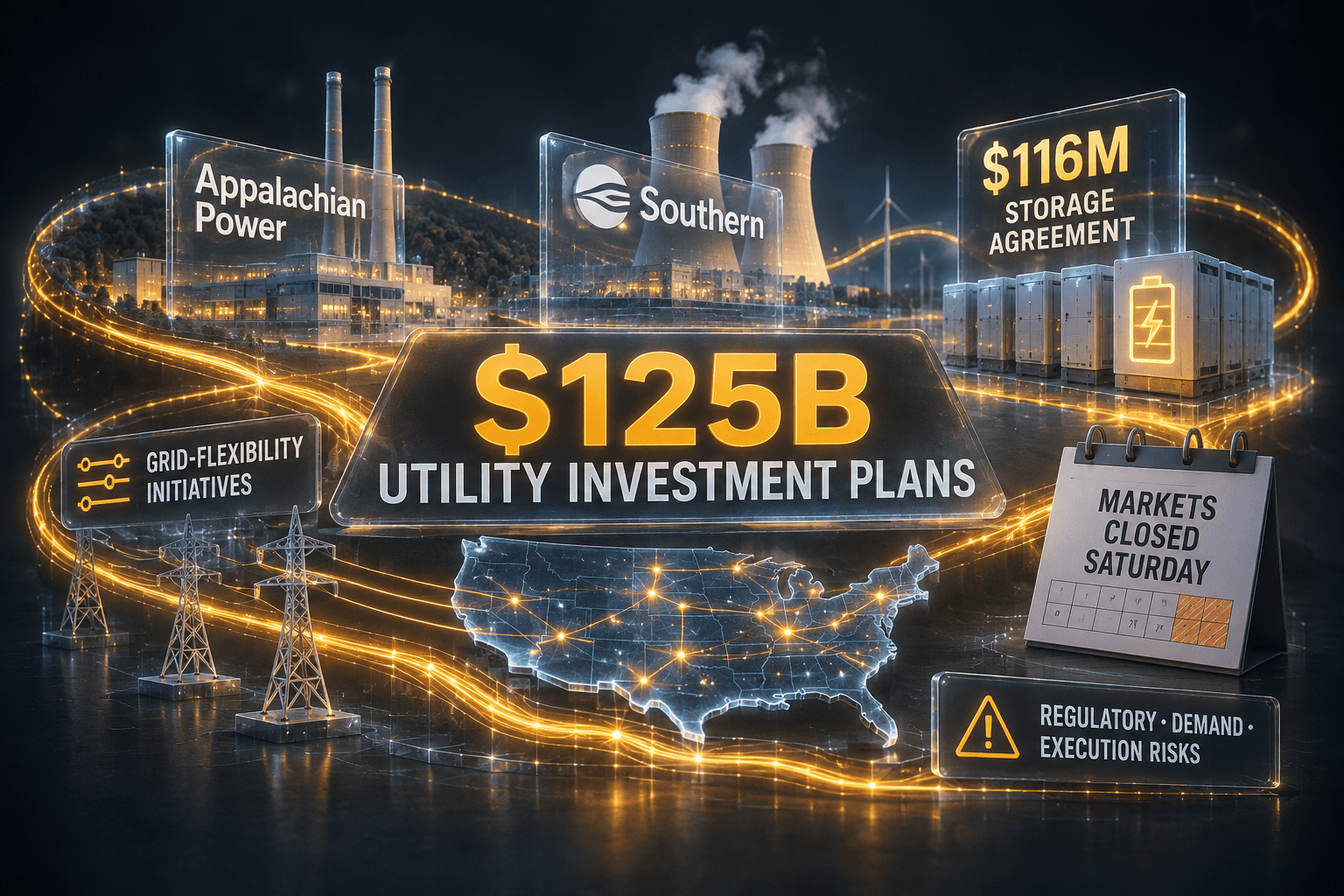
Utilities are preparing for a major buildout, but the path to meeting future electricity needs remains unsettled. Appalachian Power outlined nearly $25 billion in proposed investment in West Virginia generation, and Southern described a potential $100 billion spending plan spanning natural gas, nuclear and other investments. Those plans sit alongside efforts to use existing grid infrastructure more efficiently and bring energy storage online.
For investors, the contrast matters: capital spending may support utility growth, but it also raises questions about project execution, costs, resource choices and customer demand. U.S. stock markets were closed Saturday, November 14, so there was no trading reaction today. The next session is Monday, November 16, with utility shares last trading on Friday, November 13.
Market Highlights
The largest announced commitments center on generation investment, while grid flexibility and storage offer different ways to address changing electricity needs. These are reported plans and agreements, not evidence that all projects are approved, financed or already under construction.
- Appalachian Power announced $17 billion for new natural gas plants and a separate $7.5 billion commitment to upgrade existing coal plants in West Virginia, a combined $24.5 billion.
- Southern outlined a potential $100 billion spending plan involving natural gas, nuclear and other investments. CEO Chris Womack said on the company’s third-quarter earnings call that he felt confident in the existing strategy.
- NeoVolta’s majority-owned subsidiary signed a $116 million master purchase agreement to supply battery energy storage systems, with deliveries scheduled for 2027.
- Electric cooperatives are beginning to map out distribution energy resource management systems, while utility and technology officials also discussed grid-enhancing tools and specialized AI models to increase grid utilization.
Because markets were closed, there are no Saturday utility stock percentage changes or closing prices to report. For reference, American Electric Power (AEP), the parent of Appalachian Power, and Southern (SO), Southern Company, last traded Friday, November 13; this roundup does not infer a price response from the news.
Key Developments
Generation plans put capital spending in focus
Appalachian Power’s proposed investment is weighted toward natural gas construction and upgrades to coal-fired plants. Southern’s broader plan includes gas and nuclear, among other investments. Together, the announcements underscore how utilities are weighing reliability and projected electricity needs against the cost and policy implications of different generation sources.
Large plans can create opportunities for regulated utilities to expand their asset base, but the investment case depends on details that are not yet established here, including project timing, approvals, financing and how costs may be recovered. You’ll want to distinguish an announced commitment from completed construction or a final spending schedule.
Storage and grid flexibility offer another route
NeoVolta Power’s $116 million agreement calls for FEOC-compliant battery systems, with deliveries expected in 2027. The agreement is a concrete commercial milestone for storage, although the summary does not identify the buyer or provide further delivery terms. Storage can support a more flexible electricity system, but the scale and timing of its contribution depend on deployment and integration.
Separate coverage of cooperative DERMS implementation and a BNEF Houston Summit discussion points to a parallel priority: making better use of the grid already in place. Demand-side resources, grid-enhancing technologies and specialized AI tools could help utilities manage available capacity. What’s the practical test? Whether projects move from discussion and early implementation into measurable improvements in operating flexibility.
Climate rules and data-center demand remain unsettled
A Ninth Circuit split decision allowed Scope 1 and Scope 2 emissions reporting under California’s SB 253 to proceed, while halting enforcement of Scope 3 reporting and SB 261. That distinction leaves part of the reporting framework moving forward and part on hold. Utilities and other affected companies will need to follow further legal and regulatory developments rather than assume the dispute is resolved.
Data-center growth adds another layer of uncertainty. Reporting on local opposition describes technology companies adjusting how they communicate with communities, while a separate article questions whether AI businesses are financially sustainable. The coverage doesn’t establish a change in electricity demand, but it highlights why you shouldn’t treat projected AI expansion as a guarantee of durable load growth. A study identifying states with the steepest warming trends since 1980 also reinforces the longer-term need to consider local adaptation and infrastructure resilience.
One engineering development could eventually be relevant to infrastructure costs: MIT engineers cast a concrete beam using a sewn fabric mold with one-third the concrete and half the steel of a conventional beam. The technique uses topology optimization to design material-efficient shapes. It is an engineering result, not evidence of widespread utility adoption, but it points to potential material savings if the method proves practical at scale.
What to Watch
As trading resumes Monday, November 16, monitor company disclosures and market coverage for any response to Friday’s announcements. The next useful details will be project-level: approval milestones, construction schedules, financing plans and clarity on how proposed utility spending could affect customer costs and returns. The supplied reports do not specify a near-term earnings or regulatory date tied to these plans.
Also watch for evidence that battery deliveries scheduled for 2027 remain on track, and whether cooperatives move from initial DERMS planning to implementation. In California, court and regulatory updates could clarify reporting obligations. Meanwhile, local reactions to data-center development, the financial sustainability of AI businesses and regional warming trends all bear on how reliable demand forecasts and resilience planning prove to be.
For Monday’s session, the central issue is not simply how much utilities plan to spend. It’s whether those plans translate into reliable service and investment outcomes while managing policy, cost and execution risks.
Bottom Line
- Appalachian Power’s $24.5 billion commitment and Southern’s potential $100 billion plan signal a sizable generation investment pipeline, not completed projects.
- NeoVolta’s $116 million storage agreement adds a defined commercial order, with deliveries scheduled for 2027.
- DERMS and grid-enhancing technologies could help utilities increase utilization, but implementation and results remain key questions.
- California climate-law litigation and community resistance to data centers leave regulatory and demand assumptions in flux.
- U.S. markets were closed Saturday. Utility shares last traded Friday, and the next session is Monday, November 16.
FAQ
Q: Why are utilities announcing large investment plans? A: The reported plans cover generation and other investments, but the stories do not establish a single driver or provide final project schedules.
Q: What does the NeoVolta agreement mean for energy storage? A: It is a $116 million supply agreement for FEOC-compliant battery systems, with deliveries scheduled for 2027. Deployment and execution will determine its eventual impact.
Q: Did utility stocks trade on November 14? A: No. Saturday was not a U.S. stock-market trading day. Utility shares last traded Friday, November 13, and the next session is Monday, November 16.