The Big Picture
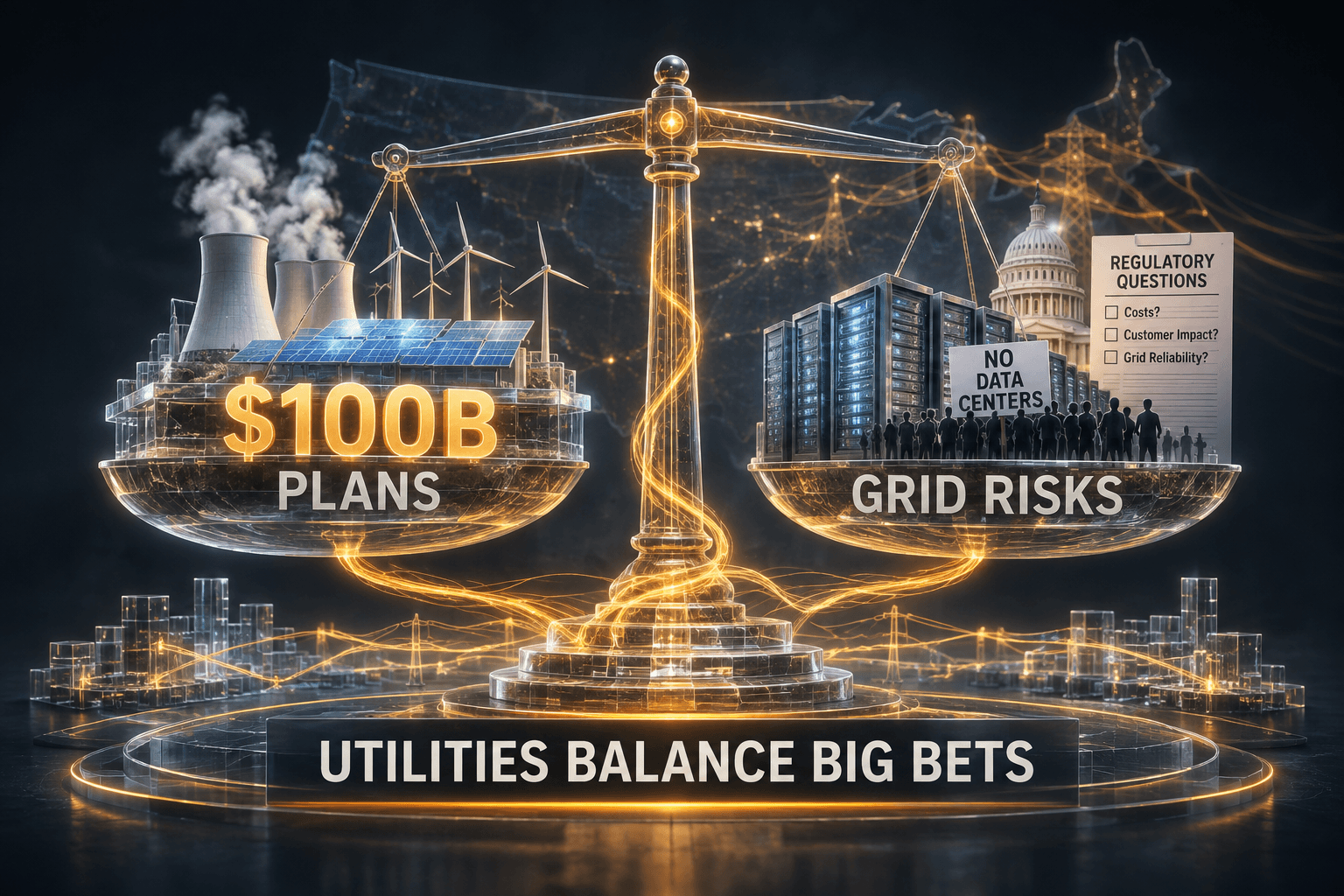
Utilities are signaling a major buildout, but the path from announced spending to reliable returns remains uncertain. Southern Co. is eyeing a $100 billion investment plan, while Appalachian Power has outlined nearly $25 billion for new gas generation and coal-plant upgrades in West Virginia.
Those plans arrive alongside efforts to use existing grid capacity more efficiently, including demand-side management and grid-enhancing technologies. What matters for you is not only how much utilities plan to spend, but whether projects can win approvals, meet local needs and manage costs. U.S. stock markets are closed Saturday, November 14; the last trading session was Friday, November 13, and the next is Monday, November 16.
Market Highlights
Friday’s utility news centered on long-term capital needs, grid capacity and the changing policy landscape. The reports did not provide stock-price changes or percentage moves, so there’s no basis here to describe specific share performance heading into the long weekend.
- Southern Co. (Southern (SO)) is considering a $100 billion spending plan spanning natural gas, nuclear and other investments.
- Appalachian Power, part of American Electric Power (AEP), was reported to have commitments of $17 billion for new natural gas plants and $7.5 billion to upgrade existing coal plants in West Virginia.
- NeoVolta announced a $116 million master purchase agreement for battery energy storage systems, with deliveries scheduled for 2027.
- A Ninth Circuit ruling allows Scope 1 and Scope 2 emissions reporting under California’s SB 253 to move forward, while halting enforcement of Scope 3 reporting and SB 261.
Separately, utilities and technology officials discussed better use of grid assets, with specialized AI models and grid-enhancing technologies among the tools under consideration. These are industry-level opportunities, not evidence that a particular utility has already secured savings or improved returns.
Key Developments
Large investment plans raise questions about execution
Southern Co.’s proposed plan and Appalachian Power’s announcements highlight the scale of investment under consideration as utilities address electricity needs and generation portfolios. Appalachian Power’s reported commitments include both new gas-fired capacity and upgrades to coal facilities, while Southern’s broad plan includes gas, nuclear and other spending. The mix illustrates that companies are pursuing multiple generation paths rather than a single transition strategy.
For shareholders, large capital programs can support growth if projects are approved, completed on schedule and incorporated into rates or otherwise earn adequate returns. They can also increase financing needs and expose customers and companies to construction, fuel and policy risks. The announcements are plans and commitments, not proof of completed projects or guaranteed financial outcomes.
Grid flexibility and storage offer a different route
Electric cooperatives are beginning to outline practical steps for implementing distribution energy resource management systems, or DERMS. These platforms can help coordinate flexible resources on the distribution network. At the BNEF Houston Summit, utility and technology officials also pointed to AI models and grid-enhancing technologies as ways to increase utilization of existing infrastructure.
That focus matters as utilities face pressure to serve changing demand without relying only on new power plants and wires. NeoVolta’s $116 million agreement adds a concrete storage-related announcement, though deliveries are not scheduled until 2027. You’ll want to distinguish announced contract value from near-term revenue, and track implementation details as they emerge.
Policy, communities and resilience remain part of the equation
The California appeals court decision narrows the immediate reporting obligations in dispute: Scope 1 and Scope 2 reporting under SB 253 can proceed, while enforcement of Scope 3 reporting and SB 261 is halted. The split decision leaves companies and investors with a changing compliance picture rather than a final resolution of every climate-law question.
Local acceptance is another constraint. A report on data centers describes big tech changing its approach amid community pushback, a relevant issue for utilities planning to serve large new loads. Other CleanTechnica reports address climate-related health risks and the costs of curbside organics programs. Those topics are not direct utility earnings updates, but they underline how resilience, municipal infrastructure and public priorities can shape energy planning. Tesla’s Cybercab launch at a stated starting price of $29,900 is also an adjacent electrification development; the report flags qualifications around availability, and it doesn’t establish a direct near-term effect on utility demand.
What to Watch
On Monday, November 16, market participants can assess how utility shares respond to Friday’s news and whether analysts or company representatives provide further detail. Watch for updates on Southern Co.’s spending timeline and funding, the scope and approval process for Appalachian Power’s projects, and whether grid-flexibility programs move from planning into deployment.
Other useful checkpoints include NeoVolta’s customer, delivery and execution updates; developments in California litigation or guidance; and signs that data-center developers are addressing local concerns. Climate-related extreme weather also remains a planning and reliability risk for utilities, while changing load forecasts can affect the need for generation and transmission. No specific upcoming earnings date or policy event was included in the supplied reports, so avoid treating these headlines as a dated catalyst.
Bottom Line
- Utilities face a substantial investment cycle, but announced spending is not the same as completed construction or assured returns.
- Grid-management tools and battery storage could complement new generation, with execution and delivery schedules worth monitoring.
- California’s split court ruling changes the near-term reporting picture but leaves policy uncertainty in play.
- Data-center opposition, climate resilience and customer costs may influence project timelines and local approvals.
- Markets are closed Saturday; use Friday’s close as the latest U.S. equity reference and watch for new information ahead of Monday’s session.
FAQ
Q: What is the main utilities-sector theme in these reports? A: The sector is balancing large generation investment plans with efforts to improve grid utilization and add storage.
Q: Did the reports include utility stock price changes? A: No. They provide company and industry news, but no share-price or percentage-change data.
Q: What does the California court ruling mean for emissions reporting? A: Scope 1 and Scope 2 reporting under SB 253 can move forward, while enforcement of Scope 3 reporting and SB 261 is halted under the reported decision.