The Big Picture
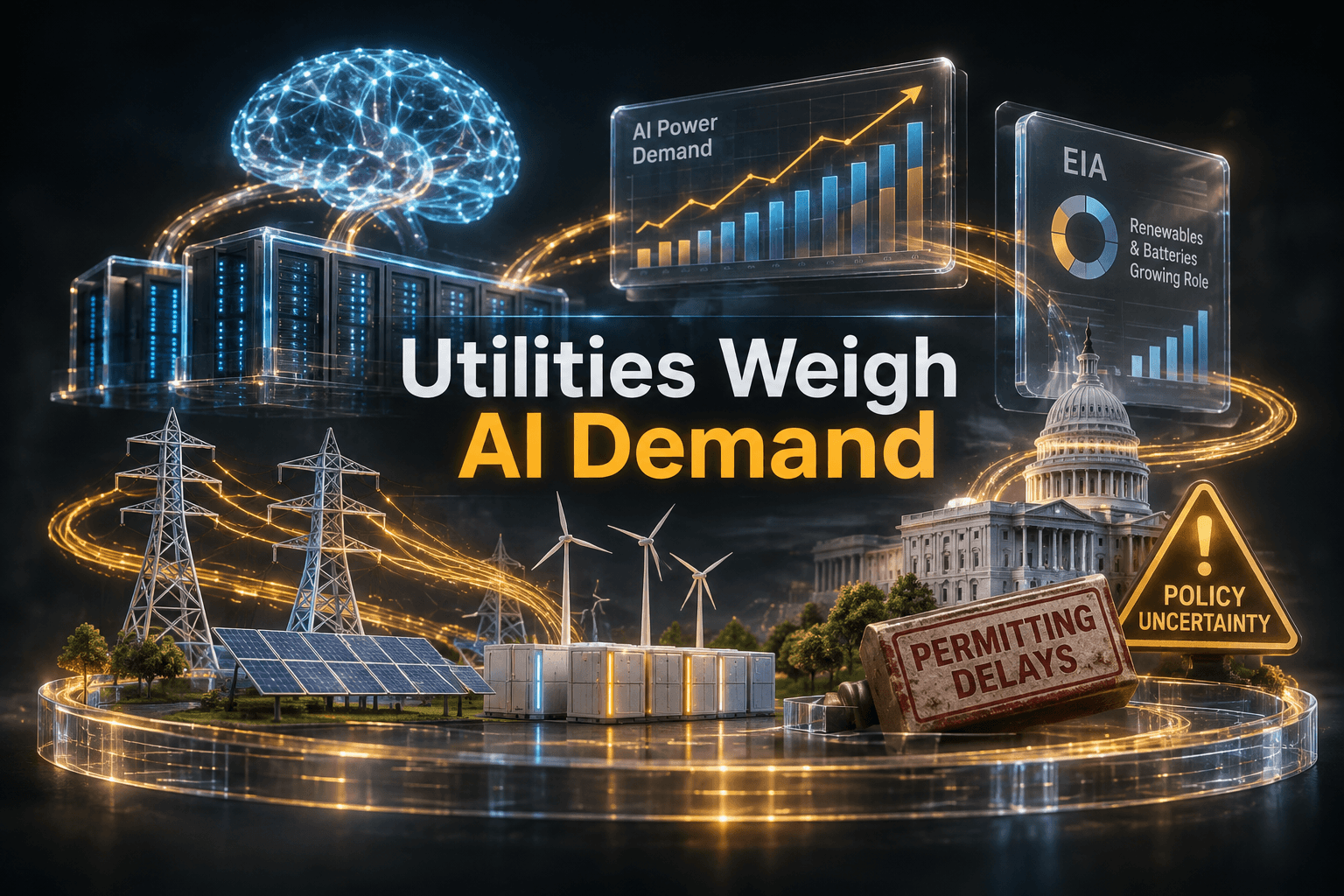
Utilities are being asked to plan for rising electricity demand just as the path to adding new generation remains uneven. Data-center expansion tied to artificial intelligence is raising concerns about power bills and community impacts, while the EIA expects renewables and battery storage to help meet growing demand.
At the same time, stalled wind reviews and uncertainty around federal policy complicate project planning. For you, the key question is whether utilities can secure enough reliable capacity while managing costs and meeting environmental requirements.
Market Highlights
The morning’s reports point to a sector balancing investment opportunities against execution and regulatory risks. The EIA forecast offers a notable buildout figure, but the news provides no current utility stock prices or percentage moves to assess ahead of today’s open session.
- The EIA says the power sector could install more than 26 GW of battery storage next year. Renewables are expected to supply almost a quarter of electricity consumption in 2027 as coal generation declines.
- Con Edison, Consolidated Edison (ED), is among utilities asking New York to loosen restrictions on utility-owned generation. It also wants regulators to expand options for storage connected to distribution and transmission networks.
- Rowan Digital Infrastructure announced more than $1.5 billion in additional capital capacity for its hyperscale data-center platform, including a $600 million term-loan upsize and a new $590 million revolving credit facility.
- A federal court heard that around 400 onshore wind projects are awaiting Department of Defense action, with an official citing limited staffing for permit reviews.
Other project announcements illustrate the range of technologies being deployed. Wärtsilä will supply a 43-MW gas-engine plant in Finland with a six-year service agreement, while a Virginia elementary school is set to receive a 313-kW solar array through a 25-year power purchase agreement at no cost to the school district.
Key Developments
AI demand raises the stakes for grid planning
Data centers are expanding to support AI and other digital services, according to a CleanTechnica report, but their growing electricity needs can have consequences beyond generation capacity. The report highlights potential effects on electricity bills, public health, local communities and the environment. It doesn’t provide a quantified demand forecast in the summary, so the scale and timing of those impacts remain important details to verify.
Rowan’s financing adds capital capacity to a developer focused on hyperscale data-center campuses. That is a signal of continued development activity, not proof that every proposed campus will secure power or proceed on schedule. Utilities may see additional demand and investment needs, while customers and regulators will be watching how infrastructure costs are allocated. What happens when load growth meets constraints on new generation and transmission? That tension is central to the sector’s outlook.
Renewables and storage gain ground, but permitting is a hurdle
The EIA’s outlook points to a changing generation mix: coal use is expected to decline, while renewable resources are forecast to provide almost one-quarter of 2027 consumption. The prospect of more than 26 GW of battery installations could help balance variable renewable output, though actual deployment will depend on project execution and grid needs.
Permitting remains a counterweight. The reported backlog of about 400 onshore wind projects awaiting Defense Department action, alongside the official’s staffing explanation and a coalition’s claim that the review process has ground to a halt, underscores the uncertainty facing developers. CleanTechnica’s offshore-wind report also describes policy headwinds and calls for adaptive management by regulators. For developers and utilities, approval timelines can affect project schedules and resource planning.
Utilities seek flexibility as local projects move ahead
Con Edison says changes to New York’s restrictions on owning generation could support renewable development, resource adequacy and environmental compliance. Its request to expand storage options reflects another planning priority: adding flexibility to the grid as demand and the generation mix change. The requests are not approvals, and the next step rests with regulators.
Smaller distributed-energy projects show how that flexibility might develop. SOLRITE and sonnen plan to combine sonnenHub with ADAPT Energy’s virtual power plant smart-breaker technology to manage household loads and participate in grid events. Separately, the Roanoke school solar project uses a long-term power purchase agreement, while Wärtsilä’s Finnish gas-engine project is designed to provide fast-reacting balancing power. Together, the announcements show different approaches to reliability, but they don’t establish that one technology will dominate.
What to Watch
Watch for details on how the EIA’s storage and renewable expectations translate into actual projects, interconnection approvals and utility investment plans. For you, the distinction between announced capacity and operating capacity matters: timing, siting and grid connections can determine whether new resources help meet demand when needed.
New York regulators’ response to Con Edison’s requests is a near-term policy catalyst, as are developments in the federal review of wind projects and the congressional process around the Bipartisan American Affordability and Jobs Act of 2026. The available report describes debate over the bill but doesn’t specify its final provisions or effects, so avoid drawing conclusions before the legislation advances. Also monitor whether data-center expansion is reflected in utility load forecasts, rate cases or plans for new transmission and generation. No company-specific market moves were included in the reports, so today’s trading response will need to be checked against live market data.
Bottom Line
- AI-related data-center demand puts power availability, grid investment and customer costs in focus.
- The EIA’s forecast for more than 26 GW of battery additions and a larger renewable share supports a changing generation mix, but forecasts are not completed projects.
- Wind permitting delays and policy uncertainty could affect project timing and resource plans.
- Con Edison’s regulatory requests and the announced solar, virtual power plant and balancing-power projects offer concrete developments to track.
FAQ Section
Q: What is the main demand issue for utilities? A: Data-center growth tied to AI is increasing attention on electricity supply, grid capacity and the potential effects on customer bills and communities.
Q: How much battery storage could be installed next year? A: The EIA says the electric power sector could add more than 26 GW in 2027.
Q: Are wind projects facing permitting delays? A: Yes. An official told a federal court that around 400 onshore wind projects await Defense Department action, citing limited review staff.