The Big Picture
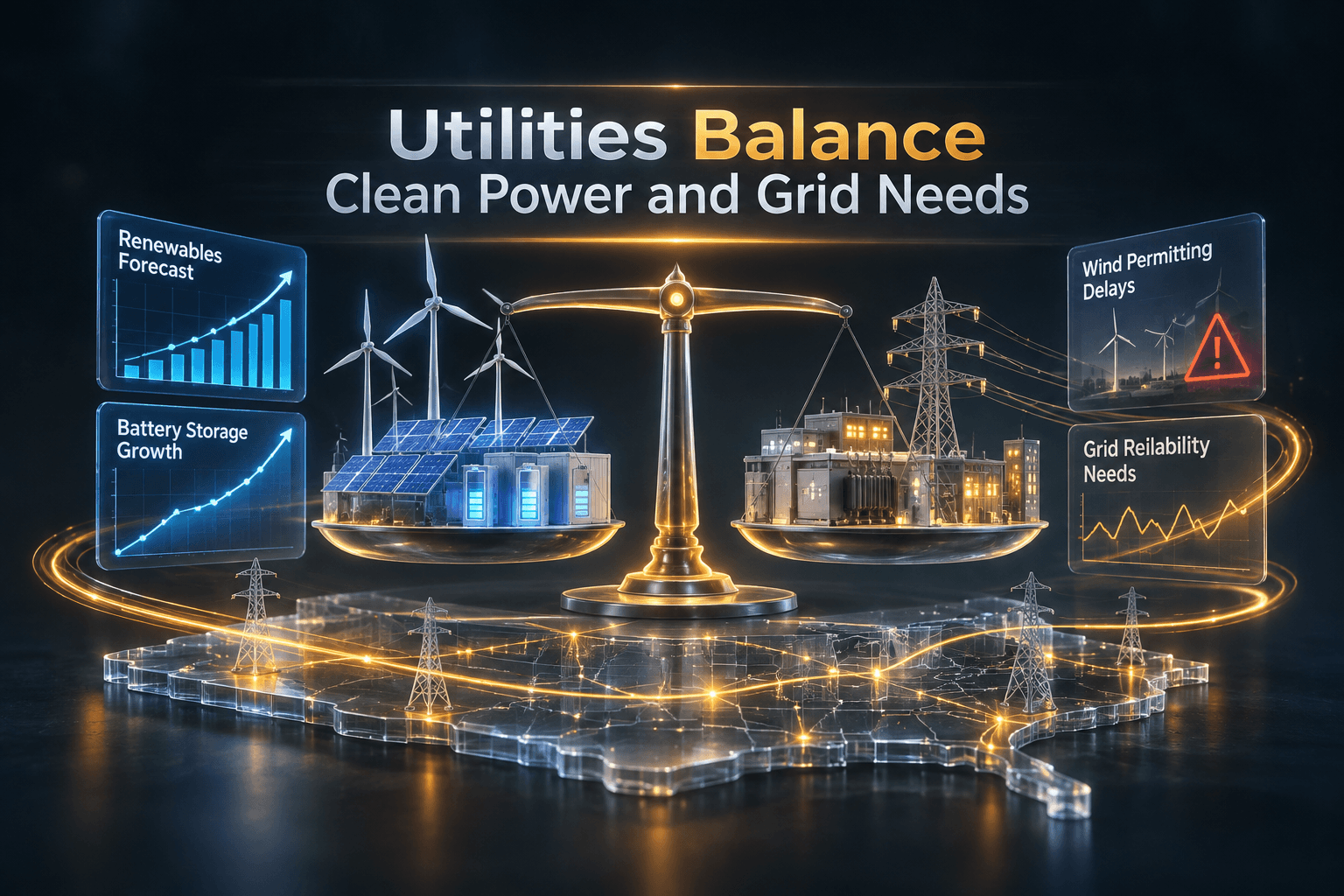
Utilities are preparing for rising electricity demand with a mix of renewables, battery storage and flexible generation, while permitting delays show that new supply can’t be built on demand. The Energy Information Administration expects more than 26 GW of battery storage installations next year, with renewables forecast to provide almost a quarter of U.S. electricity consumption in 2027.
That outlook is constructive for clean-energy development, but the day’s headlines also underscore execution risks, from stalled wind reviews to the cost and infrastructure barriers facing hydrogen power. What does that mean for you? The sector’s direction will depend not just on demand and technology, but on whether projects can clear regulatory and grid hurdles.
Market Highlights
Today’s stories ranged from utility planning and power-system flexibility to new financing and distributed energy projects. The reports did not include share-price movements or percentage changes for listed utilities, so this wrap focuses on operational and industry signals rather than a market-performance recap.
- The EIA sees more than 26 GW of battery storage additions next year and renewables supplying nearly one-quarter of U.S. electricity consumption in 2027 as coal generation declines.
- Con Edison (Consolidated Edison (ED)) is asking New York regulators to ease restrictions on utility ownership of generation and expand options for storage connected to distribution and transmission systems.
- About 400 onshore wind projects are awaiting Department of Defense action, according to testimony in a federal court case.
- Wärtsilä will supply a 43-MW gas-engine plant in Finland, while GE Vernova ($GEV) validated hydrogen capability for two turbine platforms, with fuel and infrastructure constraints still unresolved.
- Rowan Digital Infrastructure announced more than $1.5 billion in additional capital capacity. Separately, a 313-kW solar array is planned for a Virginia elementary school through a 25-year power purchase agreement.
Other developments included a virtual power plant collaboration between SOLRITE and sonnen, and QuantumScape’s ($QS) early-stage Osprey all-solid-state battery platform. These are not direct measures of utility earnings, but they illustrate how storage, flexible loads and electrification could shape future power needs.
Key Developments
Storage and renewables move further into the forecast
The EIA outlook places battery storage at the center of the effort to accommodate rising demand as coal generation declines. More than 26 GW of potential additions in 2027 would give grid operators another tool to manage variability and shift electricity across periods of supply and demand. Renewables are expected to cover almost a quarter of U.S. consumption that year, though the report summary provided no further breakdown by technology.
Several projects and partnerships show how that transition can take shape locally. Secure Solar Futures plans to install a 313-kW array at Preston Park Elementary School in Roanoke, Virginia, with construction expected to start later this year and no upfront cost to the school under a 25-year power purchase agreement. SOLRITE and sonnen are also integrating smart breakers with a virtual power plant system, allowing major household loads to be managed and potentially participate in grid events. For utilities, these examples point to more varied sources of supply and flexibility, alongside the need to coordinate them reliably.
Regulation and reliability remain decisive
Con Edison says changes to New York’s restrictions on utility ownership of generation could support resource adequacy and environmental compliance. The company has also asked regulators to expand storage options connected to both distribution and transmission networks. The requests put a practical question before regulators: how much flexibility should utilities have to build or own resources as their system needs change?
Meanwhile, roughly 400 onshore wind projects are waiting for Pentagon reviews, with a Defense Department official telling a court that the agency lacks enough staff to process permits. A coalition suing the department says the process has ground to a halt. That backlog could slow prospective wind development, even as the EIA projects a larger renewable contribution. In the other side of the coin, Wärtsilä’s 43-MW Finnish gas-engine project illustrates continuing demand for fast-reacting generation to balance variable supply. The project includes a six-year service agreement, but it is outside the U.S. and should be read as an industry example, not a direct indicator of domestic utility results.
New technologies offer potential, with adoption still uncertain
QuantumScape announced Osprey, a platform pairing its ceramic separator and anode-free lithium-metal design with a solid cathode. The company says the platform is intended to support developers of sulfide-based all-solid-state batteries, and it has shared performance data including 1,000 full charge cycles with about 80% capacity retention under stated test conditions. Cathode work remains in early validation, so the announcement is a technology milestone rather than evidence of commercial-scale production. Its relevance to utilities is indirect, through the longer-term possibility of changes in electrification and energy storage.
GE Vernova validated hydrogen combustion capability for its LM2500XPRESS and LM6000 turbines. However, limited hydrogen supplies, inadequate pipeline infrastructure and high costs remain substantial barriers to widespread power generation using the fuel. Rowan’s new financing capacity, announced at more than $1.5 billion, also highlights the growing capital needs of hyperscale data-center development, a sector that can contribute to electricity demand. These stories reinforce that future grid planning must account for both new supply technologies and potentially expanding loads.
What to Watch
Tomorrow and in coming sessions, monitor utility announcements and regulatory filings for evidence that storage and generation plans are moving from proposals into approved projects. For Con Edison, the response from New York regulators will matter for its options around generation and storage ownership. For wind developers, the pace of Defense Department permit reviews is a near-term execution risk, while the EIA’s 2027 outlook provides a broader benchmark for tracking additions and generation mix.
Also watch how utilities address power demand associated with new data-center development, and whether battery projects can be connected and operated at scale. Hydrogen turbine validation is a technical advance, but fuel availability, pipeline access and cost will determine whether it becomes a practical generation option. QuantumScape’s Osprey results remain early-stage, so follow-up validation and commercial milestones will matter more than headline performance figures alone.
No utility stock price data was included in the supplied reports. If you’re assessing the day’s market reaction, check current quotes and company disclosures separately rather than inferring trading moves from these operational headlines. Mixed signals make project execution, rate and regulatory outcomes, and reliability planning especially important to follow.
Bottom Line
- The EIA’s outlook supports a growing role for batteries and renewables, but forecasts are not a substitute for completed, connected projects.
- Con Edison’s New York proposals could affect its future planning flexibility, subject to regulatory decisions.
- Delays affecting around 400 onshore wind projects highlight permitting as a material constraint on new supply.
- Flexible gas generation remains part of reliability planning, while hydrogen and solid-state battery developments are not yet proof of broad commercial adoption.
- Today’s reports supplied no stock-price performance data. Treat the sector read-through as operational context, not a trading signal.
FAQ Section
Q: What is the main utilities-sector takeaway today? A: Storage and renewable forecasts are positive for clean-energy growth, while permitting delays and reliability needs show that execution remains challenging.
Q: Why is Con Edison seeking changes in New York? A: The company says easing restrictions on utility ownership of generation and expanding storage options could support resource adequacy and environmental compliance.
Q: Did the reports show how utility stocks performed today? A: No. The supplied stories did not include share-price or percentage-change data.