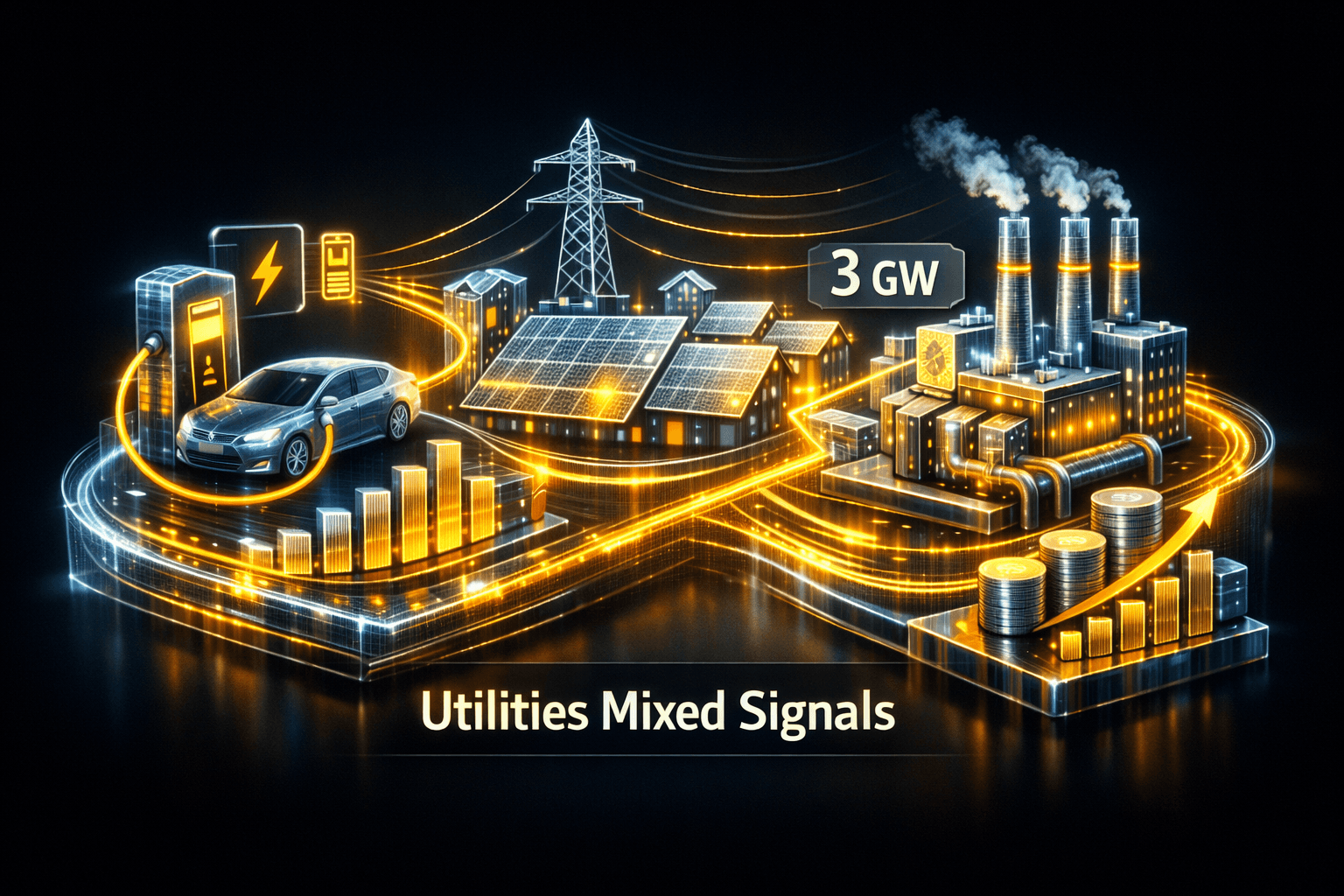
The Big Picture
Utilities headlines this morning paint a mixed bag for investors, with clear momentum in clean-energy deployments set against cost pressure and local resistance to new fossil-fuel projects. You can see momentum in EV charging awards, rooftop and community solar activations, and even a large proposed nuclear campus, but you should also note rising solar PPA prices and political or legal friction that could slow some projects.
These developments matter because they affect how utilities allocate capital, the pace of new capacity additions, and near-term project economics. You may want to follow permitting, tariff impacts, and power fuel inventories, because those factors will shape returns and risk across the sector.
Market Highlights
Quick facts and key numbers to skim before the market settles in.
- EV charging funding: Texas awarded $226 million to build 321 NEVI-funded charging stations, and advocacy groups are urging Congress to reauthorize the NEVI program.
- Solar rollouts: Gaylord National Resort activated a 3.5-acre rooftop array with 4,696 panels, estimated to supply up to 20% of peak load and offset as much as 50% of convention center electricity needs.
- Community solar: A 3.5-MWac project in Sandwich, Illinois, was completed as part of a 34.5-MWac portfolio under Illinois Shines.
- Major approvals and proposals: Virginia supervisors approved a 3,000-MW gas-fired plant proposed by $D, while The Nuclear Company unveiled a 6.6-GW AP1000 nuclear campus proposal in Kentucky.
- Costs and supply risks: LevelTen reports solar PPA prices rose about 5% in Q3, driven mainly by new tariffs. In India, officials say 96 coal-fired units are running critically low on fuel.
- Leasing and land: A Nevada geothermal lease sale netted $4.8 million for roughly 187,000 acres, though proceeds were lower per acre than a similar 2025 sale, and some parcels overlap a proposed $NEE solar site.
No major single-stock price moves were reported in the headlines this morning, and market reactions were muted as investors parsed project-level details and policy signals.
Key Developments
EV Charging and Federal Funding Momentum
States are translating federal NEVI funding into concrete projects, led by Texas, which awarded $226 million for 321 charging stations. The Sierra Club is urging Congress to reauthorize the NEVI program in upcoming funding negotiations, which would sustain deployment momentum. For you, that means more predictable long-term demand for grid upgrades and site-host revenues tied to charging stations.
Solar Expansion vs Higher PPA Costs
Solar deployment continues at multiple scales. The Gaylord National Resort rooftop project activated a 4,696-panel array, and a 3.5-MWac community solar project went live in Illinois as part of a 34.5-MWac portfolio. At the same time, LevelTen data shows solar PPA prices rose roughly 5% in Q3, citing new trade tariffs as the main driver. How will higher PPA prices change project finance models? You should be watching margin pressure on merchant and contracted projects, and whether developers can pass costs through to offtakers.
Fossil and Nuclear Moves Trigger Local and Regulatory Frictions
Not all capacity news points the same way. Cumberland County supervisors in Virginia backed a 3,000-MW gas-fired plant proposed by $D, a major addition of dispatchable capacity. In contrast, Linn County, Iowa supervisors unanimously denied a rezoning request for Alliant Energy's $LNT Morgan Valley gas plant. Environmental groups also filed a lawsuit aiming to restore stronger ESA protections, a case that could affect project permitting timelines. These stories show you that permitting and local politics will remain decisive for gas and other large projects.
What to Watch
Focus on catalysts and risks that will drive sector performance over the next weeks and quarters.
- NEVI reauthorization: Watch congressional budget negotiations and any language on EV charging funding, because federal support will shape state rollouts and grid upgrade budgets.
- Tariffs and PPA pricing: Monitor Treasury, Commerce, and trade rulings, and LevelTen or similar index updates. Rising solar PPA prices can change project returns and developer pipelines.
- Permitting heat map: Track county-level votes and lawsuits, especially for large gas plants and proposed nuclear sites. How many projects will face delays or denials?
- Fuel inventories and reliability signals: India’s low coal stockpiles and other fuel constraints could influence global commodity prices and policy responses that affect utilities with international exposure.
- Project finance and offtake demand: Keep an eye on announcements from major developers and utilities about financing terms for solar, geothermal, and nuclear projects, because that will show you whether higher costs are being absorbed or passed to customers.
Which of these risks matters most to your portfolio? That depends on your exposure to merchant projects, regulated utilities, and developers, so stay selective.
Bottom Line
- Clean-energy deployment is moving forward at multiple scales, from EV charging and rooftop arrays to community solar and geothermal leases.
- Cost pressures are real, with solar PPA prices up about 5% in Q3, largely due to new trade tariffs, and some geothermal lease receipts falling versus 2025 levels.
- Big capacity swings continue, illustrated by a 3,000-MW gas approval in Virginia and a proposed 6.6-GW nuclear campus in Kentucky, while local opposition and litigation can still derail projects.
- Reliability risks, highlighted by low coal inventories in India, add a macro layer of uncertainty that can affect commodity prices and near-term utility operations.
- Stay focused on permitting, tariff outcomes, and federal funding signals, because those will set the pace of deployment and the economics you care about.
FAQ Section
Q: How will NEVI reauthorization affect utilities? A: Reauthorizing NEVI would sustain federal funding for EV charging, encouraging grid upgrades and new site-host agreements, which may boost demand for certain utility services and infrastructure projects.
Q: Should I worry about the 5% rise in solar PPA prices? A: A 5% quarterly rise increases project costs and may compress developer margins, but impact varies by contract duration, geographic market, and ability to pass costs to offtakers.
Q: Do local zoning denials signal a broader halt to gas projects? A: Zoning denials, like the Alliant $LNT case, signal heightened local scrutiny, but they do not uniformly stop all gas builds. You should expect project-by-project outcomes based on politics and permitting.