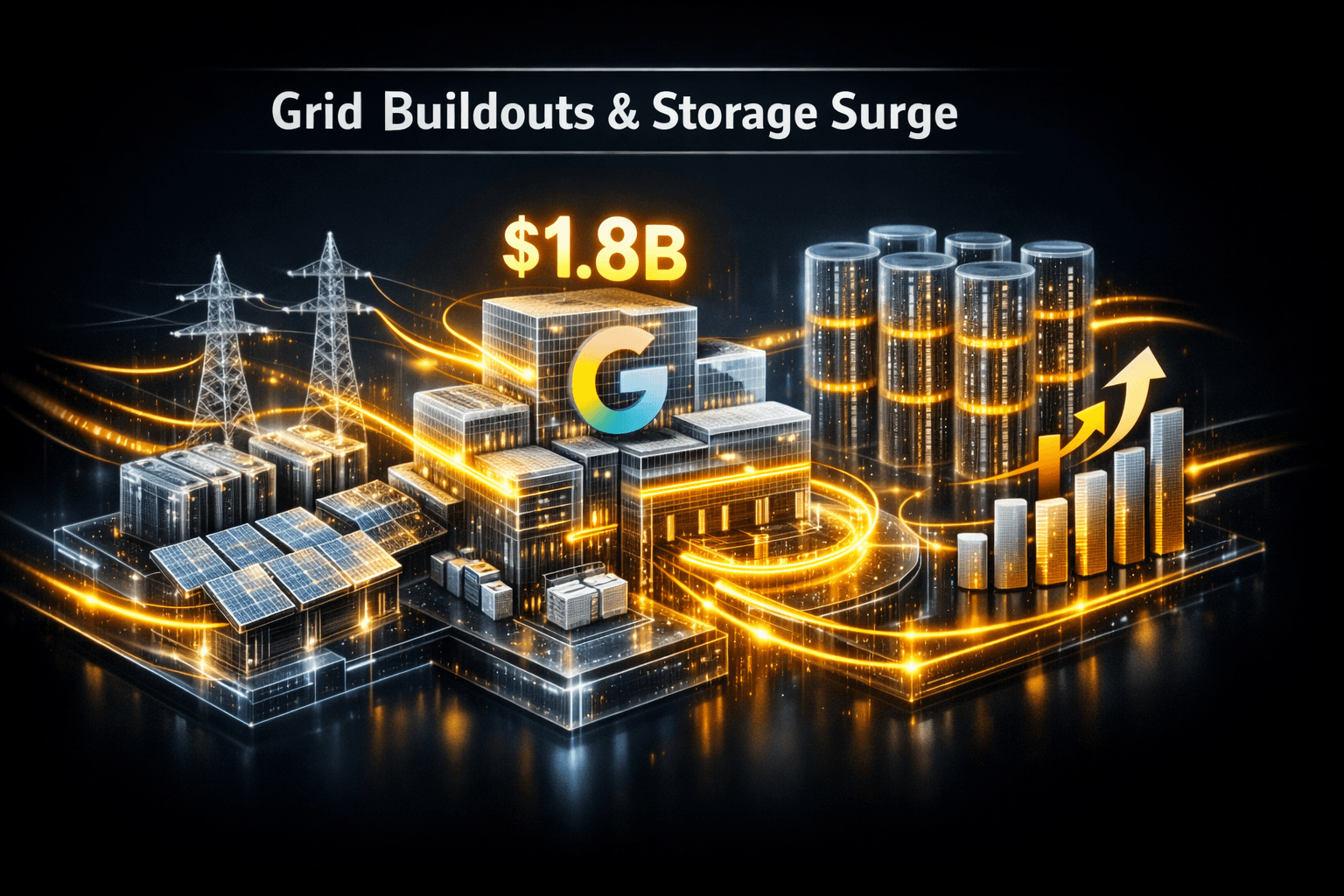
The Big Picture
Grid-scale capacity and customer-driven energy projects moved to the fore this week, with PJM fast-tracking more than 2.1 GW of new capacity and Black Hills Corp. signing a multibillion dollar build-and-manage assignment for a Google data center in Wyoming. Those developments show utility-scale project delivery and large corporate demand are shaping the sector heading into the long weekend.
At the same time, innovation in storage and distributed solar continued to make headlines, pointing to a diversified future for energy assets. What does that mean for your portfolio as markets reopen on Monday?
Market Highlights
Here are the quick facts and numbers you need to scan before the open on Monday.
- Black Hills Corp, $BKH: announced plans for $1.8 billion in natural gas generation and to operate a 2.1 GW microgrid to serve Google’s planned Cheyenne data center.
- PJM Interconnection: approved expedited interconnection for nearly 1.7 GW of Engie storage and a 455 MW gas-fired uprate from LS Power, with an expected online date around mid-2029.
- Rate requests: U.S. electric and gas utility rate requests jumped to $4.5 billion in Q3, more than double Q3 2025, signaling rising utility revenue asks and potential regulatory scrutiny.
- Storage and transit: coverage of battery-powered commuter rail in Boston and industry analysis on post-lithium storage options underscore growing demand for application-specific storage solutions.
- Distributed solar innovation: a Bucharest case study shows photovoltaic glass being used to heat domestic water in apartments, pointing to novel residential use cases.
Key Developments
Black Hills to build 564 MW gas and manage 2.1 GW microgrid for Google
Black Hills Corp. unveiled plans to invest roughly $1.8 billion in natural gas generation capacity and to manage a 2.1 GW microgrid for Google’s Cheyenne data center. For you that means large, contracted utility services tied to hyperscale demand are becoming a reliable revenue stream for regional utilities.
The deal combines traditional generation with microgrid operations, showing that hybrid approaches remain central to powering large customers where reliability and speed to market matter.
PJM fast-tracks 2.1 GW from Engie and LS Power
PJM’s approval for expedited interconnection covers nearly 1.7 GW of Engie storage projects plus a 455 MW uprate from LS Power. The operator expects these assets to be online by mid-2029, shortening development uncertainty for project owners and off-takers.
Faster interconnection can reduce financing risk and improve project bankability. That should make it easier for developers to secure funding and for utilities to add capacity when they need it.
Storage, transit electrification and apartment solar show diversification
Industry coverage asked whether lithium will remain dominant, then showcased battery commuter rail pilots in Boston and a Bucharest pilot using photovoltaic glass for water heating. These stories point to a future defined by multiple storage and distributed-generation solutions tailored to particular use cases.
Which technology will dominate for which application? Expect more pilots and targeted deployments rather than a one-size-fits-all winner. You’ll want to track where scale and regulatory support align.
What to Watch
Look to these catalysts and risks as you prepare for Monday and the weeks ahead.
- Regulatory response to rate requests. With Q3 rate filings up to $4.5 billion, regulators and consumer advocates will scrutinize filings. That could shape timelines and allowed returns for utilities.
- Interconnection timelines and financing. PJM’s fast-track is positive for Engie and LS Power projects. Watch whether other ISOs follow with similar acceleration, which would help project financing.
- Corporate offtake demand. Large customers like $GOOGL are pushing for bespoke solutions, including microgrids. That demand could accelerate project approvals and contracted revenue streams for utilities.
- Storage tech evolution. Reports on alternatives to lithium and battery-powered commuter rail pilots mean device-level improvements could change cost curves. Will innovation drive broader adoption rapidly, or will deployment remain incremental?
- Project execution and community response. Big builds mean permitting and local pushback may surface. Monitor local approvals, environmental reviews and labor issues that could affect schedules.
Bottom Line
- Major capacity wins and fast-tracked interconnections point to momentum in utility-scale projects and storage deployment.
- Corporate demand, exemplified by Google’s Wyoming data center, is creating large contracted opportunities for utilities and developers.
- Rate-request activity has spiked, signaling higher revenue targets and potential regulatory friction you should monitor.
- Storage innovation and distributed solar pilots suggest the sector’s technology mix will diversify, which creates both winners and losers over time.
- Stay selective and focus on execution risk, regulatory outcomes and corporate offtake trends as you reassess positions heading into next week.
FAQ Section
Q: How do PJM’s fast-track approvals affect project timelines? A: Fast-track interconnection reduces procedural delays and can speed up financing and construction, improving the likelihood projects meet mid-2029 online windows.
Q: Will rising rate requests mean higher utility profits? A: Rate requests increase potential revenue, but outcomes depend on regulator decisions and political pushback, so higher requests do not guarantee approved returns.
Q: Is battery power likely to replace diesel in commuter rail soon? A: Pilot projects show battery traction for short commuter routes, but wider adoption depends on range, charging infrastructure and cost reductions.