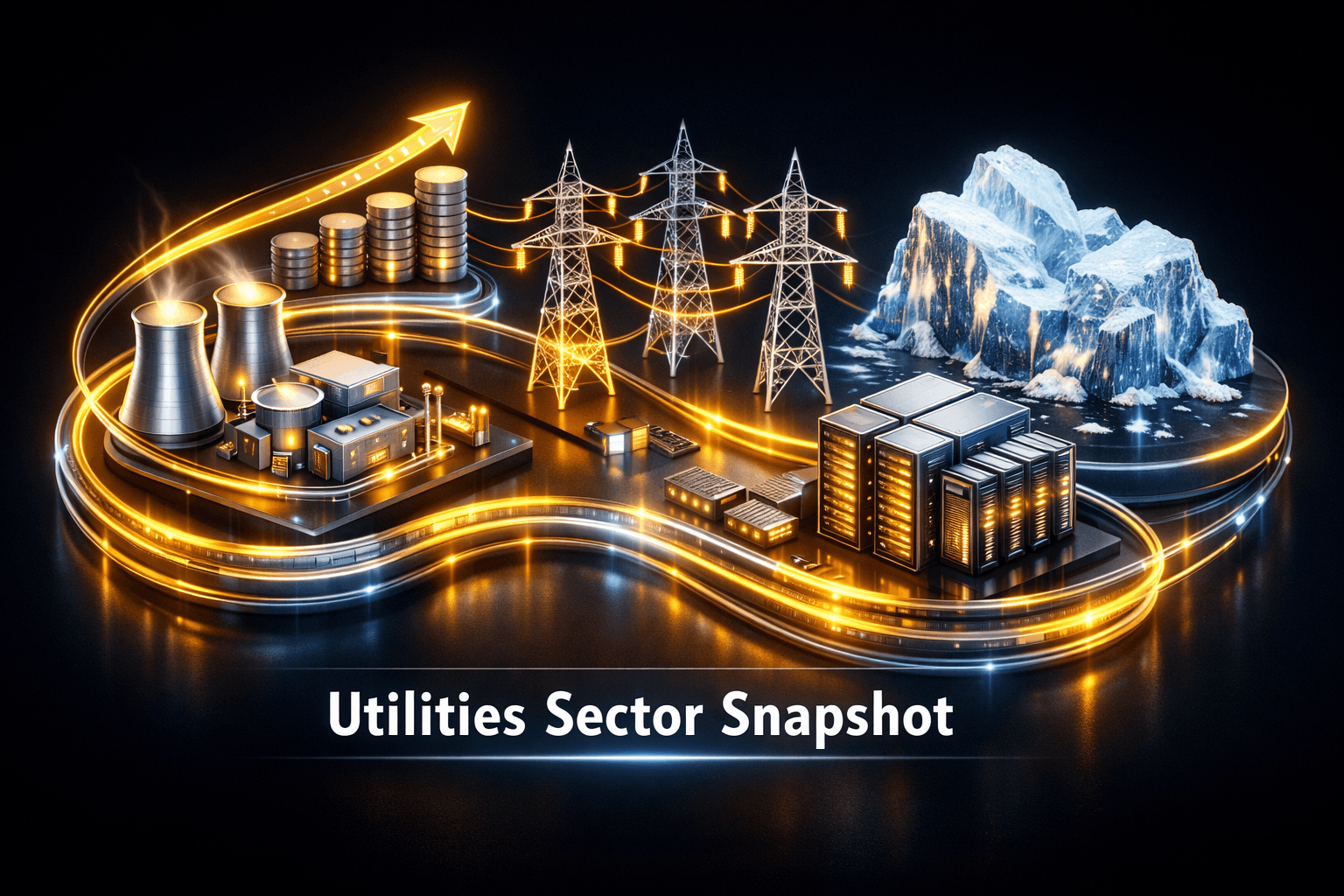
The Big Picture
Big-ticket financing and long-term contracts are backing cleaner, firm power, while climate impacts and fast-growing load centers are exposing strain on grid capacity. You should pay attention today because the mix of federal support, corporate procurement, and localized resilience moves will shape where utilities invest for the next decade.
The Department of Energy signaled serious federal backing for nuclear uprates, and corporate offtake continues to anchor large projects. At the same time you have operational stress from rising data center demand and climate-driven threats to hydro resources, so the sector faces both policy tailwinds and physical supply challenges.
Market Highlights
Overnight and pre-market developments set the tone for utility names tied to nuclear, grid modernization, and large corporate power purchasers. Here are the quick facts you need this morning.
- DOE conditional loan commitment, up to $4.2 billion, announced for Vistra Energy to fund uprates and modernization at Beaver Valley, Davis-Besse and Perry plants. Projects could add about 433 MW of capacity, according to reporting for Vistra. Company ticker: $VST.
- Amazon and Constellation signed a 20-year power purchase agreement to expand Calvert Cliffs, supporting upgrades at the 1,790 MW Maryland nuclear site. Expect near-term visibility for $CEG and counterparty $AMZN on load planning and offtake.
- Grid stress headlines overnight. Reports flag that America’s data center boom is outpacing transmission and construction timelines, pushing developers toward behind-the-meter generation to speed project energization.
- Environmental risk: Swiss glaciers lost about 5.5% of ice volume in 2026, a major hit for alpine hydropower resource outlooks and seasonal water availability for generation.
- Regulatory and permitting context shifted as Senate bipartisan permitting reform moved into view, while a Virginia hearing examiner ordered Dominion to release a memo tied to an FPL investigation, raising governance questions for $D and potential merger scrutiny with $NEE.
Key Developments
DOE conditional loan for Vistra, nuclear gets a boost
The DOE’s Office of Energy Dominance Financing put a conditional loan commitment of up to $4.2 billion on the table to fund uprates and modernization at Vistra’s nuclear fleet, which could yield roughly 433 MW of net added capacity. You should note this is federal facilitation of long-lived, firm generation, which analysts say helps underwrite merchant and contracted revenue streams for large generators.
For investors this suggests clearer longer-term capacity planning and potential for capital spending to shift from fossil maintenance toward uprates and reliability projects. Analysts note the funding could also set a template for future financing of plant life-extension and performance projects.
Data centers, grid limits, and behind-the-meter pivots
Multiple reports show America’s data center boom is colliding with transmission bottlenecks and long interconnection lead times. Developers are increasingly turning to on-site generation and behind-the-meter solutions to get projects powered faster, according to recent industry coverage. Have you wondered how utilities will capture the revenue from these load pockets once they bypass the queue?
This trend creates both challenges and opportunities for utilities. It raises near-term demand risk for traditional centralized delivery, while creating new markets for distributed energy resources, microgrids, and long-duration storage. For you that means watching which utilities or service providers offer turnkey behind-the-meter and interconnection services.
Policy moves, governance scrutiny, and corporate PPAs
Permitting reform landed in the headlines with the Bipartisan American Affordability and Jobs Act aiming to streamline energy infrastructure approvals. Faster permitting could accelerate transmission and generation projects if it survives legislative hurdles. Policy clarity often translates into lower execution risk for long-lead projects, which is why you might see selective optimism for regulated transmission developers.
At the same time a Virginia hearing examiner ordered Dominion to release a memo tied to an FPL investigation, raising governance questions for $D and the pending merger dialogue with $NEE. Corporate offtake remains strong though. The Amazon and Constellation 20-year PPA for Calvert Cliffs shows major buyers continuing to back nuclear as a clean firm source.
What to Watch
Focus on near-term catalysts and risk indicators that will drive sector headlines and earnings commentary. You can use these items to prioritize news flow and adjust your watchlist.
- DOE loan finalization and implementation details for $VST, including project timelines and credit terms. Analysts will parse whether conditional language becomes binding.
- Transmission and interconnection updates, especially in data center hubs. Watch state ISO queue timelines and filings for new behind-the-meter strategies by major developers.
- Progress on permitting reform in Congress and any implementing rulemaking. Faster permitting can materially shorten project timelines for renewables and transmission.
- Regulatory filings and discovery around the Dominion memo release and any merger-related proceedings involving $D and $NEE. Governance issues can delay approvals and create litigation risk.
- Operational signals: reservoir levels and hydropower inflows in Europe this winter and U.S. hydro basins. The Swiss glacier loss, about 5.5% this year, is a stark data point for seasonal supply risk.
- Electrification demand trends such as heat pump and electric water heater adoption rates. Continued uptake supports long-term load growth and grid investment needs.
Bottom Line
- Federal financing and long-term corporate PPAs are supporting firm, low-carbon capacity investments, offering clearer revenue profiles for projects and owners.
- Physical climate impacts and localized grid constraints are raising short-term supply risks, especially for hydropower and rapidly growing load centers like data hubs.
- Permitting reform could be a game changer if enacted, but governance and merger scrutiny remain near-term headwinds for some large utilities.
- You should monitor DOE loan progress, interconnection queue dynamics, and state regulatory developments for the clearest signs of momentum or delay.
- Data suggests mixed signals across the sector, so a selective approach focused on balance-sheet strength and contract visibility is prudent for following names.
FAQ Section
Q: How will the DOE conditional loan to Vistra affect utility financing? A: The loan commitment signals federal willingness to underwrite long-term nuclear uprates, which can lower financing costs for capital intensive reliability projects and create precedent for similar deals.
Q: Why are data centers turning to on-site power, and what does that mean for utilities? A: Long interconnection lead times and transmission constraints are delaying grid connections, so developers are using behind-the-meter generation to energize sites faster. This shifts some near-term revenue away from the grid but creates new service opportunities.
Q: Should I worry about hydropower after the Swiss glacier losses? A: Glacier retreat, including a reported 5.5% ice volume loss in Switzerland this year, highlights seasonal and long-term supply risk for alpine hydro. It suggests utilities and planners should factor changing water availability into resource adequacy assessments.