The Big Picture
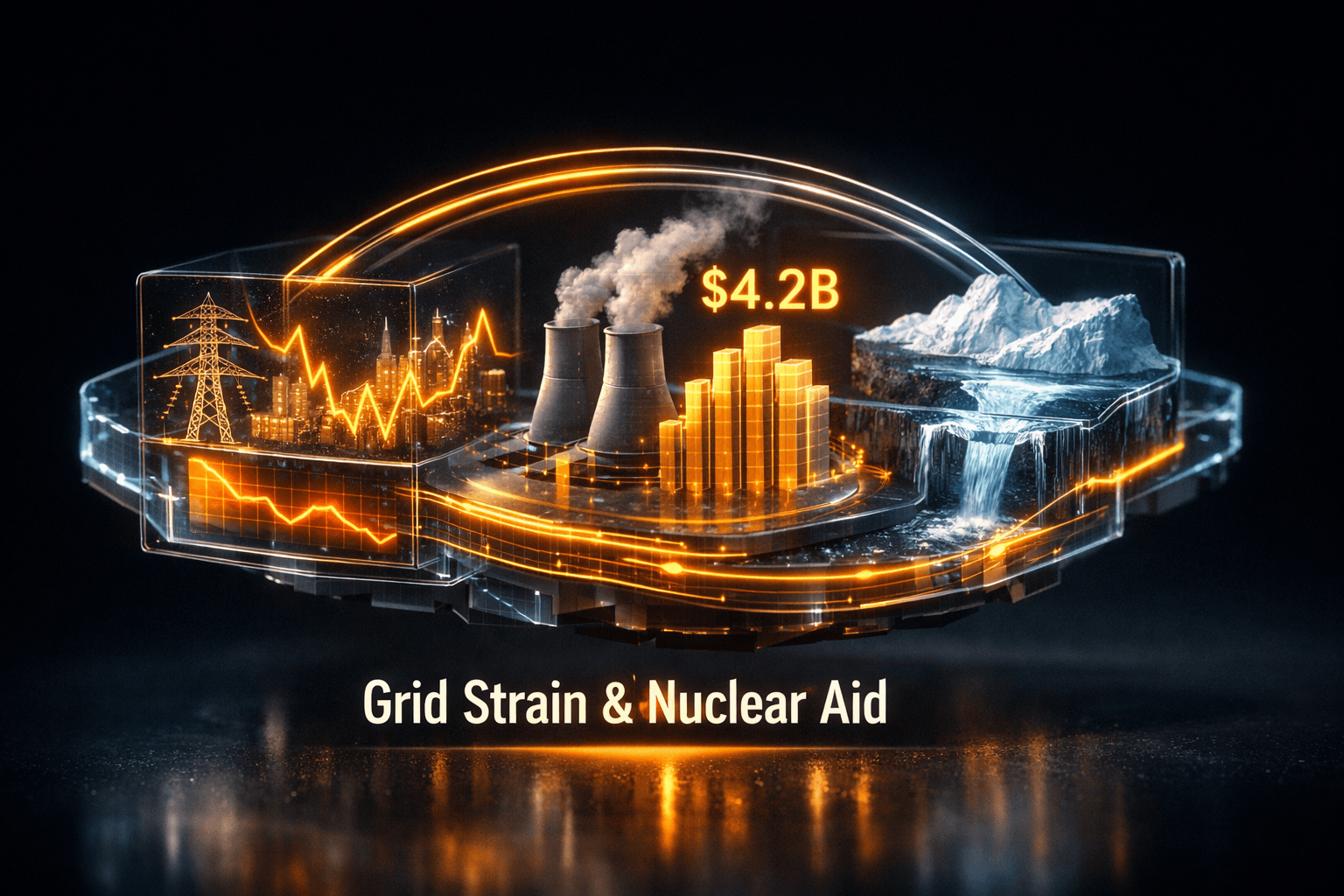
Today brought a split picture for the Utilities sector, with major financing and corporate offtake deals on one side and clear supply and grid constraints on the other. You saw the Department of Energy step in with a conditional $4.2 billion loan commitment that aims to boost nuclear capacity, while other stories highlighted accelerating demand pressures from data centers and climate risks to hydropower.
Why does this matter to you as a retail investor? Policy and long-term contracts are creating new revenue streams for generators, but operational and permitting bottlenecks mean timing and delivery risk remain topical. Which trend wins out will shape earnings and capital plans over the next few quarters.
Market Highlights
Quick facts and the day’s most direct impacts.
- DOE conditional loan: Vistra $VST is in line for up to $4.2 billion to uprate and modernize nuclear units, a package that could add about 433 MW of capacity across Ohio and Pennsylvania.
- Corporate PPA: $AMZN and Constellation $CEG signed a 20-year PPA to expand the 1,790-MW Calvert Cliffs nuclear plant in Maryland, locking in long-term demand from a major tech buyer.
- Hydropower risk: Swiss glaciers lost roughly 5.5% of ice volume in 2026, a steep decline that threatens seasonal hydropower output and local supply stability.
- Grid and demand: Reports highlighted America’s data center boom running into grid constraints, and many developers are shifting to behind-the-meter generation to avoid long queue times.
- Policy: A bipartisan permitting reform package aims to speed infrastructure builds and reduce costs, which could accelerate transmission and generation projects if enacted.
Key Developments
Nuclear financing and corporate offtake
The DOE’s conditional commitment of up to $4.2 billion for Vistra $VST is the most concrete capital story today. The package targets uprates and modernization at Beaver Valley, Davis-Besse and Perry, potentially adding about 433 MW of capacity and extending plant life and output.
Separately, $AMZN and $CEG signed a 20-year power purchase agreement to back expansion work at the 1,790-MW Calvert Cliffs Clean Energy Center. Together these items show both public finance and private contracts are converging to shore up nuclear supply, and analysts note this can stabilize revenue for plants undergoing long-term upgrades.
Grid capacity under strain as data centers race to energize
Multiple reports flagged that America’s data center boom is bumping into a slow-moving grid, with transmission buildouts, fuel constraints and permitting delays stretching project timelines. Developers are increasingly turning to on-site, behind-the-meter generation to avoid long interconnection queues.
That shift has two effects for utilities. You may see reduced incremental wholesale demand in some markets, and you may also face more complex distributed energy resource coordination on your system. Can the grid keep up with fast-moving load growth? Not without faster permitting and targeted investment.
Resilience, inspections, and climate impacts
Operational efficiency stories ran alongside technology discussion today. Industry leaders argued power plants need improved inspection history, not just more maintenance data, to reliably manage aging fleets. At the same time Switched Source’s CEO Charles Murray highlighted dynamic distribution as a resilience strategy that moves beyond simply buying heavier hardware.
Climate risk also made headlines as Swiss glaciers lost about 5.5% of their ice volume in 2026, exacerbating worries about seasonal hydropower. That’s a reminder that long-term resource availability affects supply mixes and capacity planning in hydro-reliant regions.
What to Watch
Key catalysts and risks you should track into tomorrow and the weeks ahead.
- Permitting reform progress: Watch congressional movement on the Bipartisan American Affordability and Jobs Act provisions. Faster permitting could cut project timelines and lower capex overruns.
- DOE loan finalization: Monitor formal loan documents and timing for $VST projects. Conditional commitments still need closing conditions and execution plans.
- Interconnection queues and data center builds: Keep an eye on local utility filings and ISO queue updates, particularly in high-growth markets. Queue backlogs can materially affect revenue timing for generators and grid service providers.
- Hydropower seasonality and weather forecasts: Near-term hydro production will hinge on snowfall and glacier melt patterns. If low snow continues, you could see price volatility in affected regions.
- Regulatory and merger oversight: The Virginia hearing examiner’s order for Dominion $D to release an internal memo tied to a NextEra $NEE-related investigation signals sustained regulatory scrutiny that could influence merger timelines and governance discussions.
Bottom Line
- Sector sentiment is mixed, with strong policy and finance moves balanced by grid and climate constraints.
- DOE and corporate PPAs are tangible positives for nuclear producers, providing capital access and long-term revenue visibility.
- Data center demand is real, but the grid is a bottleneck, pushing some developers to on-site generation and changing wholesale demand patterns.
- Climate-driven hydropower declines and operational data quality issues underscore the need for diversified and resilient planning.
- Stay selective and watch permitting, DOE loan closings, interconnection queue updates, and regional weather for near-term implications.
FAQ Section
Q: How will the DOE loan for Vistra affect utility earnings? A: Analysts note the conditional $4.2 billion commitment should support capital projects and extend plant output, but final earnings impact depends on loan closing timing and project execution.
Q: Should you expect higher electricity prices from hydropower shortfalls? A: Shortfalls in hydro-dependent regions can tighten supply seasonally and push prices up, so market prices and forward curves are worth monitoring for your exposure.
Q: Do data centers leaving the queue hurt utilities long term? A: Behind-the-meter solutions reduce near-term wholesale demand in some areas, but utilities may benefit from new grid services, interconnection upgrades, and commercial partnerships if policy and markets adapt.