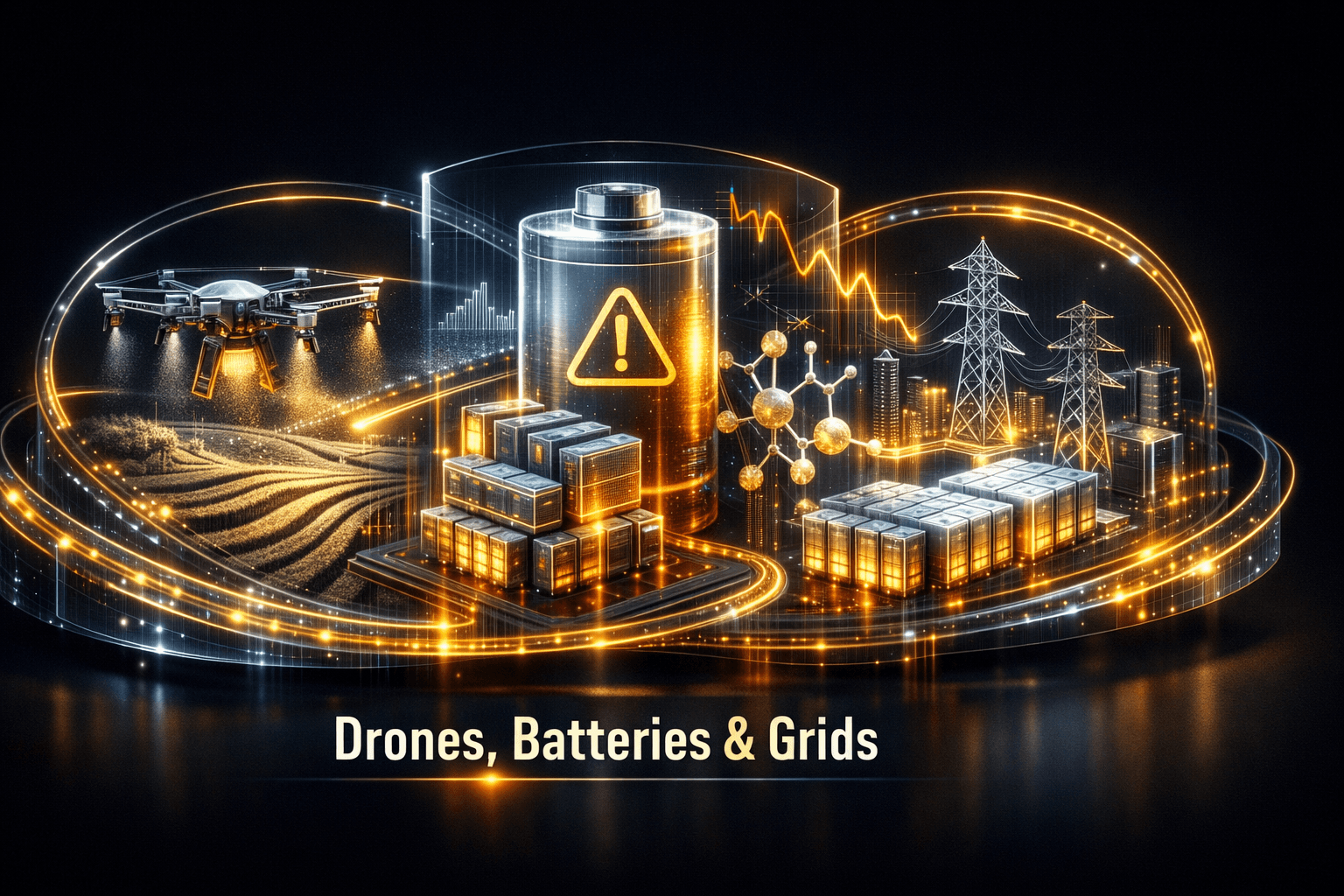
The Big Picture
China's dramatic rollout of agricultural drones is the standout item for utilities watchers this weekend because it signals industrial-scale electrification that could ripple into grid planning and storage demand. At the same time, a technical correction about a novel battery from Donut Lab pulls back on headline expectations for next-generation chemistries.
Markets were closed on Sunday, Sep 20. You'll want to note these developments heading into the next trading session on Monday, Sep 21, because they point to medium-term shifts in demand and technology adoption rather than immediate market moves.
Market Highlights
Here are the quick facts and numbers you should have at hand as you prepare for Monday.
- Scale of drone use: China entered 2026 with about 309,000 plant-protection drones, which performed roughly 203 million hectare-treatments during 2025, according to CleanTechnica reporting.
- Battery chemistry clarification: Donut Lab's battery has been confirmed not to be an NMC chemistry, correcting earlier claims and reducing uncertainty about the device's materials and risk profile.
- Publicity note: A new Elon Musk documentary is generating strong attention and debate, though its direct implications for regulated utilities are limited. Follow energy companies tied to storage and EV supply chains like $TSLA, $PLUG, and $BYD for indirect impacts.
- Market status: U.S. equity markets were closed Sunday. For price context use closing data as of Friday, September 18 when assessing positioning heading into Monday, September 21.
Key Developments
China's Agricultural Drone Boom and Grid Implications
The CleanTechnica report highlights that agricultural spray drones are now ordinary farm machinery in China at an extraordinary scale, with about 309,000 units operational and 203 million hectare-treatments performed in 2025. That kind of deployment suggests sustained demand for electric propulsion, battery replacements, and localized charging infrastructure.
What does this mean for utilities and grid planners? Widespread drone fleets increase distributed electricity consumption in rural areas and create new maintenance and charging service markets. You should expect higher load diversity and opportunities for off-grid or microgrid solutions near high-intensity agricultural zones.
Battery Chemistry Reality Check: Donut Lab Not Using NMC
CleanTechnica's correction on Donut Lab's battery chemistry is a reminder that headline claims about new battery breakthroughs often need verification. The disputed device was shown not to be NMC, which affects safety profiles, energy density expectations, and supply chain dynamics tied to nickel, manganese, and cobalt.
For utilities and companies working on grid storage, that clarification reduces immediate enthusiasm for a near-term game changer. It does, however, keep the spotlight on alternative chemistries and manufacturing pathways. Analysts note that incremental improvements across several chemistries can matter as much as a single breakthrough.
Publicity Wave Around an Elon Musk Documentary
The new documentary on Elon Musk has stirred a Streisand effect that’s pushing public discussion across sectors, including energy. While the film itself isn't a utilities story, Musk-linked companies and battery conversations often spill over into investor sentiment for energy storage and EV infrastructure companies.
Will the documentary change capital flows into energy-related names? Not directly in the regulated utilities space, but it can affect sentiment for storage innovators, EV charging networks, and vertically integrated suppliers, so it's worth watching for shifts in narrative and media-driven attention.
What to Watch
Focus on catalysts that could turn these informational stories into market-moving events. Are there regulatory updates, earnings or supply contracts due that reference these themes? Keep a close eye on a few specific items.
- Upcoming earnings: Watch battery and storage equipment makers' reports and guidance. Data suggests sentiment swings quickly when companies disclose procurement contracts or manufacturing scale plans.
- Policy and procurement: Monitor any announcements from Chinese provincial agricultural bureaus or rural electrification agencies. Large procurement tenders could signal multiyear demand.
- Supply chain risks: Track commodity prices for nickel, manganese, and cobalt, since changes there alter economics for different battery chemistries.
- Grid planning disclosures: Utilities filing long-term resource plans may start modeling higher distributed charging loads from drones and EV fleets. Those filings can affect local utility capex forecasts.
- Media-driven sentiment: Expect short-term attention spikes from high-profile coverage like the Musk documentary. That often raises awareness but not always fundamentals.
Bottom Line
- China's scale deployment of agricultural drones underscores accelerating electrification in nonurban sectors, which has clear implications for distributed charging and rural grid capacity.
- The Donut Lab battery correction reduces immediate hype about a single breakthrough, but it keeps attention on a diversity of storage chemistries that could slowly reshape utility-scale and behind-the-meter storage markets.
- Media events can shift sentiment for related names, but regulated utilities' fundamentals depend more on policy, planning filings, and long-term procurement trends than on short-term publicity.
- Markets were closed Sunday, Sep 20. Use closing data as of Friday, Sep 18 to position yourself heading into Monday, Sep 21 and monitor the catalysts listed above.
- Analysts note that these stories represent evolving themes rather than immediate opportunities, so a selective, data-driven approach is advisable.
FAQ Section
Q: How could agricultural drones affect utility demand? A: Widespread drone charging raises distributed electricity use in rural areas, creating new local load and potential demand for microgrids and fast-charging infrastructure.
Q: Does the Donut Lab correction mean battery innovation is stalled? A: No, it means one claim was clarified. Data suggests incremental advances and alternative chemistries remain active areas for storage improvements.
Q: Should news about a documentary change how you manage utility exposure? A: Media attention can alter sentiment for adjacent sectors, but regulated utilities are more influenced by policy, planning, and contracts than by publicity alone.