The Big Picture
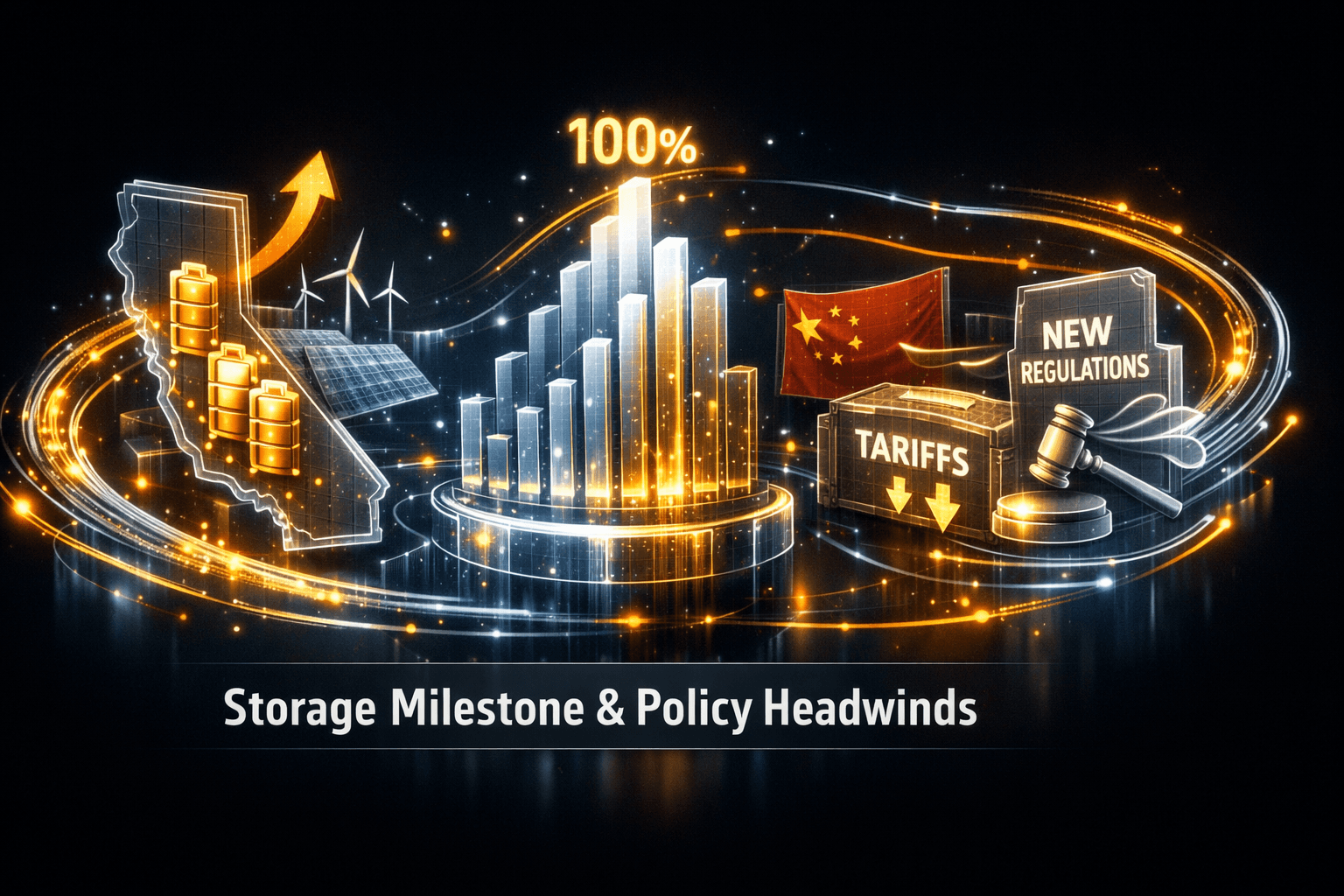
California crossing 21,112 MW of grid-connected energy storage is the standout development of the day, and it matters because it signals rapid scale-up of behind-the-meter and grid-scale batteries that are reshaping how utilities manage supply and demand.
At the same time you'll see fresh federal friction: new Sec. 232 tariffs on polysilicon and a proposed rollback of energy efficiency standards. Those policy moves create headwinds for parts of the solar supply chain even as grid resilience and new onsite power options keep demand steady.
Market Highlights
Here are the quick facts you need from today’s flow of stories. No single-stock market moves were reported in the items reviewed, but these developments are likely to influence utility and clean-energy equities over coming weeks.
- California energy storage: State now reports 21,112 MW of storage connected to the grid, up from under 700 MW in 2019, per the California Energy Commission.
- Federal policy: The administration announced new Sec. 232 tariffs and minimum import prices on polysilicon and related solar products, prompting an industry statement from SEIA about potential impacts on the U.S. solar rebuild.
- Regulatory and governance concerns: Reporting raised management and morale issues at the Interior Department, which could affect permitting and federal coordination on energy projects.
- Grid operations and corporate power: Constellation Energy, $CEG, emphasized that existing power plants remain the bedrock for supplying data centers and that Texas’ Batch Zero interconnection process should resume without meaningful delay.
- Technology and installers: Sol-Ark launched the MySolArk Installer App to streamline residential inverter commissioning and documentation for installers, boosting field efficiency.
Key Developments
California tops 21 GW of grid-connected storage
This is the biggest single infrastructure headline, with the California Energy Commission saying the state now has 21,112 MW of storage online. That growth, from under 700 MW seven years ago, shows rapid deployment of battery capacity to firm renewables and to support evening demand peaks.
For you that means grid operations are changing fast, and utilities will increasingly rely on storage for resource adequacy and volatility management. Expect more procurement and more project development in and around California as that market evolves.
Tariffs and a tug-of-war over efficiency standards
The administration’s Sec. 232 tariffs and minimum pricing on polysilicon, wafers, cells and modules landed today, and the solar and storage trade groups responded with concern. The measure targets supply chain security, but it raises near-term price and availability questions for module purchasers and project pipelines.
At the same time Senator Mike Lee introduced a bill that would limit future DOE efficiency standard updates. That proposal could increase consumer bills and add stress to demand-side management programs. Together these policy moves create a mixed regulatory backdrop for solar developers, equipment makers and utilities planning distributed resources.
Grid reliability, billing friction and onsite power demand
Several operational themes came through: utility billing systems are lagging, undermining rate and program innovation, while industry events are reframing reliability and resiliency strategies for utilities and customers. Data centers are evaluating onsite fuel cells as a fast path to power, and Constellation says existing plants remain central to serving large loads.
Those dynamics mean utilities and municipal power providers will be juggling legacy assets, new distributed resources and outdated billing systems that can slow customer-facing programs. How quickly you see modernization roll out will influence adoption of time-of-use rates and other demand programs.
What to Watch
You should track these catalysts and risks as they will shape near-term utility strategies and project economics.
- Tariff implementation and carve-outs, including details on minimum prices, exemptions and transition timelines, which could affect module pricing and project schedules.
- Legislative action on energy efficiency standards, and any legal or budgetary countermeasures that states or trade groups may pursue.
- DTECH Reliability & Resiliency, Aug 25-27, where utilities and vendors will clarify technical approaches to integrating storage and distributed assets.
- Texas interconnection updates, specifically Batch Zero resumption timing, since delays or accelerations will affect large data center hookups and the markets that serve them.
- Billing modernization programs and vendor rollouts, since billing limitations are already cited as a barrier to rate design and program innovation.
What questions should you ask next? How will tariffs change project timelines, and how fast can utilities convert the 21 GW of storage milestone into operational reliability gains for customers?
Bottom Line
- California’s 21,112 MW storage milestone is a structural bullish signal for grid flexibility and long-duration resource procurement, but it does not remove short-term market and policy uncertainty.
- New Sec. 232 solar tariffs and proposed rollbacks of efficiency standards introduce headwinds for the solar supply chain and for energy-saving programs, analysts note.
- Operational gaps, especially in billing systems, remain a practical constraint on program innovation and utility-customer interactions.
- Data center demand and onsite fuel cells underscore that corporate buyers still value firm, fast power solutions, which supports existing plant utilization alongside storage growth.
- Monitor tariff details, federal legislative moves, and state procurement plans, since they’ll determine implementation timelines and the financial outlook for developers, utilities and vendors.
FAQ
Q: How significant is California reaching 21 GW of storage? A: It’s a major milestone showing rapid scale-up of batteries that help firm renewable generation and reduce peak needs, and it will change procurement and operations for utilities.
Q: Will the new Sec. 232 tariffs stop solar deployment? A: The tariffs raise costs and add supply-chain uncertainty, but they do not automatically halt deployment; project timelines and procurement strategies will adapt depending on pricing and exemption rules.
Q: What should I watch to see if utilities are modernizing billing and rates? A: Track utility modernization budgets, vendor partnerships, pilot rate programs, and regulatory filings that propose meter, billing and customer information system upgrades.