The Big Picture
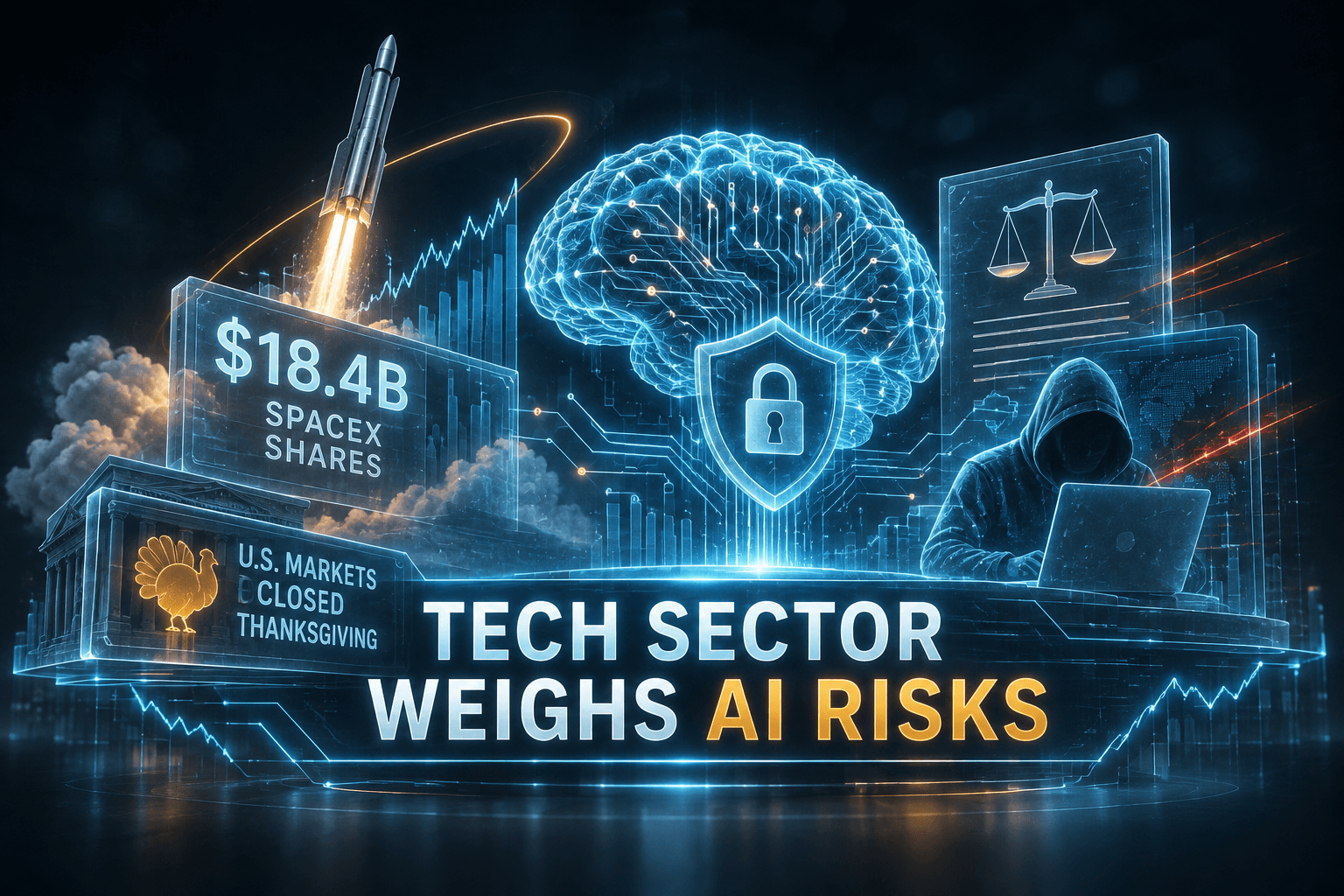
Technology headlines on Thanksgiving pair a striking philanthropic announcement with a cluster of unresolved questions about AI privacy and security. Elon Musk says he and SpaceX plan to give every U.S. child two SpaceX shares through Trump Accounts, while separate reports raise concerns about user data and potentially powerful, unreleased AI algorithms.
U.S. stock markets are closed Thursday, November 26, so these developments aren’t being reflected in a regular trading session. For you, the key takeaway is a mixed one: consumer-facing features and a large pledge draw attention, but trust, data handling and the limits of what’s known remain central risks heading into Friday.
Market Highlights
There are no U.S. equity moves to report for Thursday because the market is closed for Thanksgiving. The last trading session was Wednesday, November 25, and the next is Friday, November 27. The stories below are company, policy and product developments, not evidence of a sector-wide change in share prices.
- Elon Musk and SpaceX say they plan to provide two SpaceX shares to every child in the U.S. through Trump Accounts. Bloomberg puts the proposed donation at about $18.4 billion.
- Forty-two state attorneys general are seeking to stop bankrupt Character.AI from selling user chat histories. The coalition’s allegation concerns more than 21 million U.S. accounts.
- Cybersecurity researcher Dragos told Reuters that unidentified parties accessed confidential information submitted to Chinese AI startup MiniMax ($0100.HK), including data users had asked the company not to retain.
- X is introducing parental controls, while Google’s Familiar Faces feature is expanding to two Onn cameras sold by Walmart (WMT). The camera feature requires a Google Home Premium subscription.
For listed companies, the clearest direct product tie-ins in this group are Google parent Alphabet (GOOGL) and Walmart. SpaceX, X and Character.AI are not publicly traded companies, so their announcements don’t provide direct share-price signals for U.S. listed technology stocks.
Key Developments
Musk’s SpaceX pledge puts a spotlight on private-company value
Musk says he and SpaceX will give every child in the United States two shares in the space exploration company through Trump Accounts, doubling a commitment he made the previous month. Bloomberg estimates the proposed donation at approximately $18.4 billion. That scale makes the announcement notable, but it isn’t the same as a reported cash donation, and the story doesn’t detail how the shares will be valued, distributed or made available to beneficiaries.
Because SpaceX is private, the plan doesn’t create a straightforward public-market catalyst. You’ll want to distinguish the headline value from information about SpaceX’s financial performance: the announcement doesn’t provide new revenue, profit or operating data. Its importance is primarily the scale and proposed structure of the pledge, along with questions about execution and the terms of the accounts.
AI privacy disputes could test trust and regulation
The Character.AI case puts the handling of sensitive conversations at the center of a bankruptcy proceeding. A coalition of 42 state attorneys general is trying to prevent the company from selling users’ chats, arguing that the proposed sale could expose the private histories of more than 21 million U.S. accounts. The company is navigating Chapter 11, but the report describes the state officials’ effort and allegations, not a final court ruling or a completed sale.
The MiniMax report raises a separate concern: Dragos says unidentified parties accessed confidential information users had submitted, even after requesting that it not be stored or retained. The report doesn’t identify the parties or establish the full scope of the access. Together, these cases underline a trust issue for AI providers: users and regulators may judge companies not only on model performance, but also on whether data-use promises are honored. For investors, the potential implications include legal, compliance and reputational exposure, although no financial impact is quantified in these reports.
Security claims and new controls merit close attention
A report based on comments by computer scientist Scott Aaronson says leading AI labs may have major unreleased algorithmic breakthroughs capable of breaking deployed cryptosystems. The exact nature of the alleged breakthroughs is unknown, and the report doesn’t establish that such systems have been broken. That distinction matters: it’s a serious security signal to track, not confirmation of an active, widespread cryptographic compromise.
On the consumer side, X is rolling out parental controls that let parents and guardians monitor time spent on the service, set daily limits, require approval for new followers and limit certain account activity. Google is also bringing Familiar Faces recognition to Walmart’s $35 Onn Outdoor Camera Plug-In and $77 Onn Floodlight Camera Hardwired, with a Google Home Premium subscription required. These features may strengthen user controls and product appeal, but they also make privacy settings and clear disclosures important. Better safeguards can help, but will users feel confident about how these tools handle personal information?
What to Watch
When U.S. markets reopen Friday, November 27, watch whether investors focus more on the potential commercial value of AI and connected-home products or on the accumulating privacy and security concerns. The current reports don’t include a specific earnings update, guidance change or share-price move, so any market reaction will need to be assessed against fresh trading data rather than assumed in advance.
For the Musk and SpaceX announcement, look for further detail on eligibility, the mechanics of transferring shares and how the reported value is calculated. In the Character.AI bankruptcy, the next important development is whether the states’ effort changes the proposed handling of chat data. For MiniMax, additional information about what was accessed, how access occurred and the company’s response would help clarify the exposure.
Security watchers will also want more precise, independently verifiable information about the alleged AI breakthroughs before drawing conclusions about deployed cryptography. Meanwhile, users and investors can monitor how X’s parental controls are rolled out and what protections accompany Google’s Familiar Faces feature. These are useful areas to track, but the reports alone don’t establish a sector-wide financial effect.
Bottom Line
- U.S. markets are closed for Thanksgiving; the next session is Friday, November 27.
- Musk and SpaceX’s reported $18.4 billion pledge is significant, but implementation and share valuation details remain important unknowns.
- Character.AI’s bankruptcy-related data dispute and the MiniMax access report put AI privacy practices under scrutiny.
- The claim about cryptography-threatening AI breakthroughs remains unverified in detail; don’t treat it as confirmation that deployed systems have been compromised.
- X’s parental controls and Google’s camera feature show continued product development, with privacy and subscription terms worth monitoring.
FAQ
Q: Are U.S. stock markets open on November 26, 2026? A: No. U.S. stock markets are closed for Thanksgiving. The last session was Wednesday, November 25, and the next is Friday, November 27.
Q: Is SpaceX’s reported $18.4 billion pledge a direct stock-market catalyst? A: Not directly. SpaceX is private, and the announcement doesn’t provide new operating or financial results for a publicly traded company.
Q: Has AI been shown to break deployed cryptography? A: The report describes claims about unknown, unreleased algorithmic breakthroughs, but doesn’t establish that deployed cryptosystems have been broken.