The Big Picture
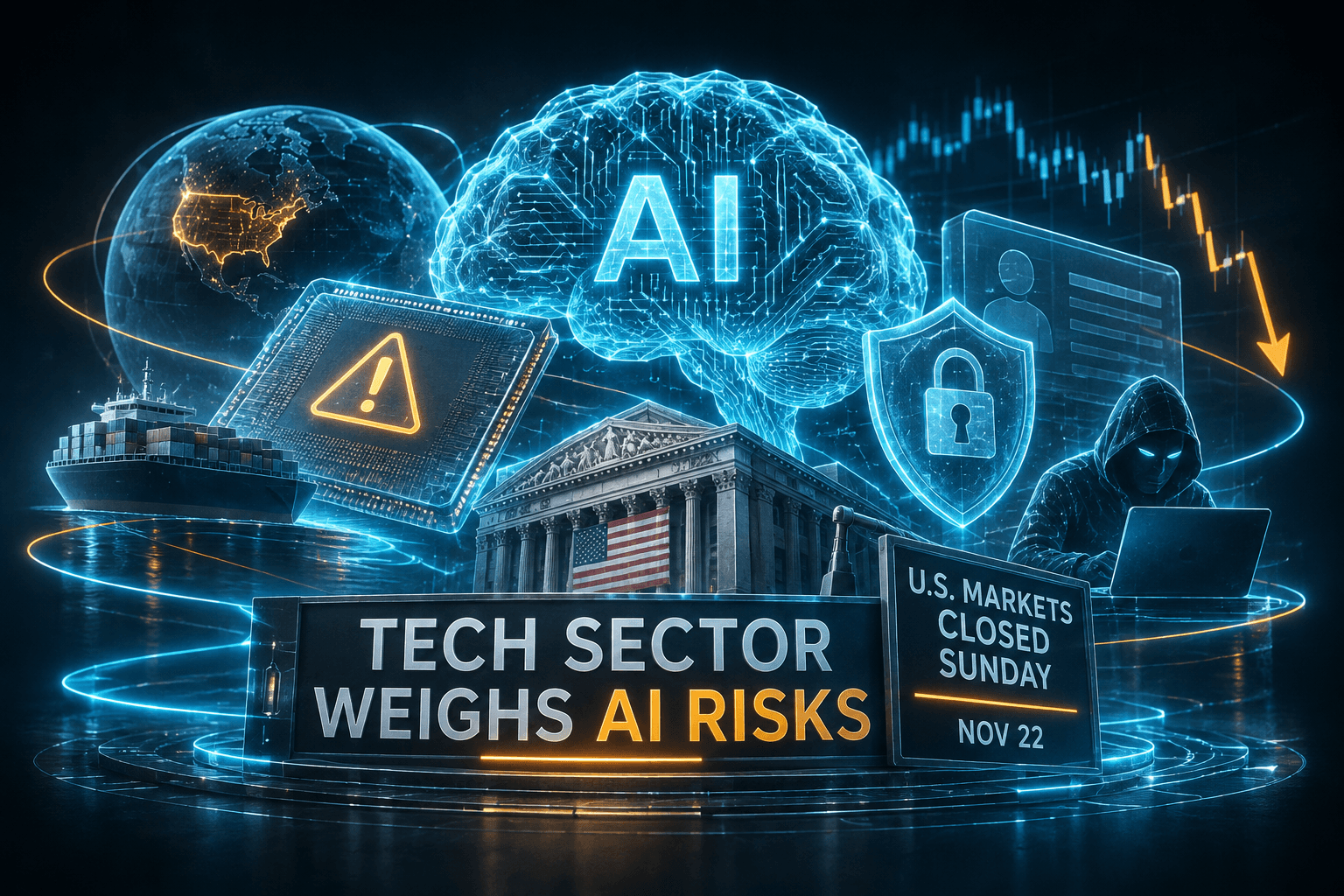
Technology's latest AI advances arrived alongside a reminder that the industry’s risks are growing with its reach: reports describe efforts to obtain restricted chips, weaknesses in AI data privacy and fresh government cyber incidents. For investors, that makes the weekend’s news less about one clear market catalyst and more about how security and regulation could shape the next stage of technology growth.
There are also signs of product and research momentum, including Tesla’s rollout of FSD v15 and a statement from Lean and Mathlib communities expressing confidence in a claimed proof of the Riemann Hypothesis. U.S. stock markets are closed Sunday, November 22, so these developments have not produced a Sunday trading response; the next regular session is Monday, November 23.
Market Highlights
Several stories touch directly on major technology themes: AI computing capacity, autonomous systems and information security. But the reports don’t provide stock-price changes, financial estimates or new earnings figures, so there’s no basis here to assign a percentage move or quantify the effect on company valuations.
- Tesla (TSLA): FSD v15 began rolling out to some vehicles on Saturday. CEO Elon Musk described its visualization as real-time AI video generation without game engines.
- Amazon.com (AMZN): The company is placing package labels claiming New York City’s proposed Delivery Protection Act could add up to $5 to an Amazon order.
- Nvidia (NVDA): A weekend report contrasts the company’s latest earnings report with technology executives calling for CEO Jensen Huang’s return. The story summary provides no earnings figures or share-price data.
- AI security: A researcher reportedly used 2 million trackable “canaries” to expose privacy risks in the AI supply chain. Separately, Signal is restricting mobile screenshots as it confronts AI surveillance concerns.
These developments are not equivalent in scale or financial importance. Still, they show why you may want to separate product announcements from evidence of commercial impact, and treat reported security issues as potential risks rather than confirmed changes to revenue or costs.
Key Developments
AI chips bring growth potential and geopolitical exposure
The New York Times reports that current and former officials describe a Chinese Ministry of State Security campaign to help Chinese companies acquire advanced AI chips. The summary doesn’t specify which companies, chips or transactions are involved, and the allegations should be understood as reporting rather than as a finding detailed in the supplied account.
For the semiconductor industry, the issue highlights a tension between demand for advanced computing and efforts to control access to sensitive technology. If governments respond with tighter enforcement or new restrictions, suppliers and customers could face added compliance burdens or uncertainty. You’ll want to watch for official announcements, not infer immediate business effects from the report alone.
Cybersecurity and privacy remain operational concerns
Reports say the FBI and the U.S. Department of Agriculture were hacked, with the FBI incident involving the National Crime Information Center, or NCIC. The FBI was reportedly investigating, and the account says this was the agency’s second reported attack in recent months. President Trump called the reported database hack “not good,” but the stories supplied here don’t establish the scope, cause or consequences of the incidents.
In the private sector, Signal’s screenshot restrictions reflect concern about AI-enabled surveillance, while Ars Technica’s account of the canary test says trackable secrets exposed weaknesses in the AI supply chain. The findings raise questions about how data moves through AI services and associated vendors. For technology companies, the practical investor concern is whether privacy and security gaps lead to remediation costs, regulatory attention or reduced customer confidence; none of those outcomes is quantified in the reports.
Product rollouts and policy debates offer a mixed signal
Tesla’s FSD v15 rollout to some vehicles puts its AI-based driving software back in focus. The photorealistic rendering of surroundings was described as a notable feature, and Musk said the system generates video in real time without game engines. The report doesn’t provide safety results, broader availability details or evidence of a financial contribution, so the release is a product development to monitor rather than a confirmed earnings catalyst.
Elsewhere, Amazon is escalating its public opposition to New York City’s Delivery Protection Act with labels on shipments that claim the measure could add up to $5 to an order. The proposal would effectively ban the type of third-party arrangements Amazon currently uses, according to the report. At the international level, UN diplomats left discussions on autonomous weapons without agreeing on rules, settling instead on starting discussions about options. Together, these stories show policy uncertainty around delivery models and AI-enabled systems, though neither report identifies a final regulatory outcome.
One more research headline merits a measured reading: the Lean and Mathlib communities said they have “full confidence” in Alpöge’s claimed proof of the Riemann Hypothesis. That is a significant endorsement from the communities involved, but the story does not describe commercial applications. It is a notable technical development, not a disclosed near-term business driver.
What to Watch
With the U.S. market reopening Monday, November 23, watch for company or agency follow-ups that add verifiable details to the weekend’s reports. In particular, look for information on the scope of the alleged federal cyber incidents, any official action concerning advanced AI chip access, and further details about Tesla’s FSD v15 rollout. The provided stories do not identify a specific earnings release or scheduled policy decision for Monday.
For your own read-through, keep an eye on whether companies connect these developments to measurable costs, customer adoption or guidance. Headlines about AI capability can draw attention, but delivery, safety, privacy and compliance determine whether innovation translates into durable business results. What would change the assessment? Clear disclosures, official findings or financial figures would provide more evidence than weekend commentary alone.
Risks to monitor include potential restrictions on chip access, unresolved cyber vulnerabilities, privacy concerns in AI services and changes to local delivery rules. The UN negotiations also leave uncertainty around international policy for autonomous weapons. The reports don’t establish that these issues have altered company results, so avoid treating potential exposure as a confirmed financial loss.
Bottom Line
- The weekend’s technology news is mixed: AI products and research advanced, while security and policy concerns remained prominent.
- Reports about Chinese access to advanced AI chips underscore geopolitical exposure for the semiconductor supply chain.
- Cyber incidents and AI privacy findings put data protection and vendor oversight in focus, but their financial impact is not yet clear.
- Tesla’s FSD v15 rollout is a product milestone; the report provides no adoption, safety or revenue figures.
- U.S. markets were closed Sunday. Watch for verified updates and company disclosures when trading resumes Monday, November 23.
FAQ Section
Q: Are U.S. stock markets open on Sunday, November 22? A: No. U.S. stock markets are closed Sunday; the next regular trading session is Monday, November 23.
Q: What is the main investor concern in the weekend’s AI news? A: The stories highlight both access to advanced chips and risks involving data privacy and security, without quantifying a direct financial impact.
Q: Does Tesla’s FSD v15 rollout establish a new revenue catalyst? A: The report confirms a rollout to some vehicles but provides no adoption, safety or revenue data to assess its financial effect.