The Big Picture
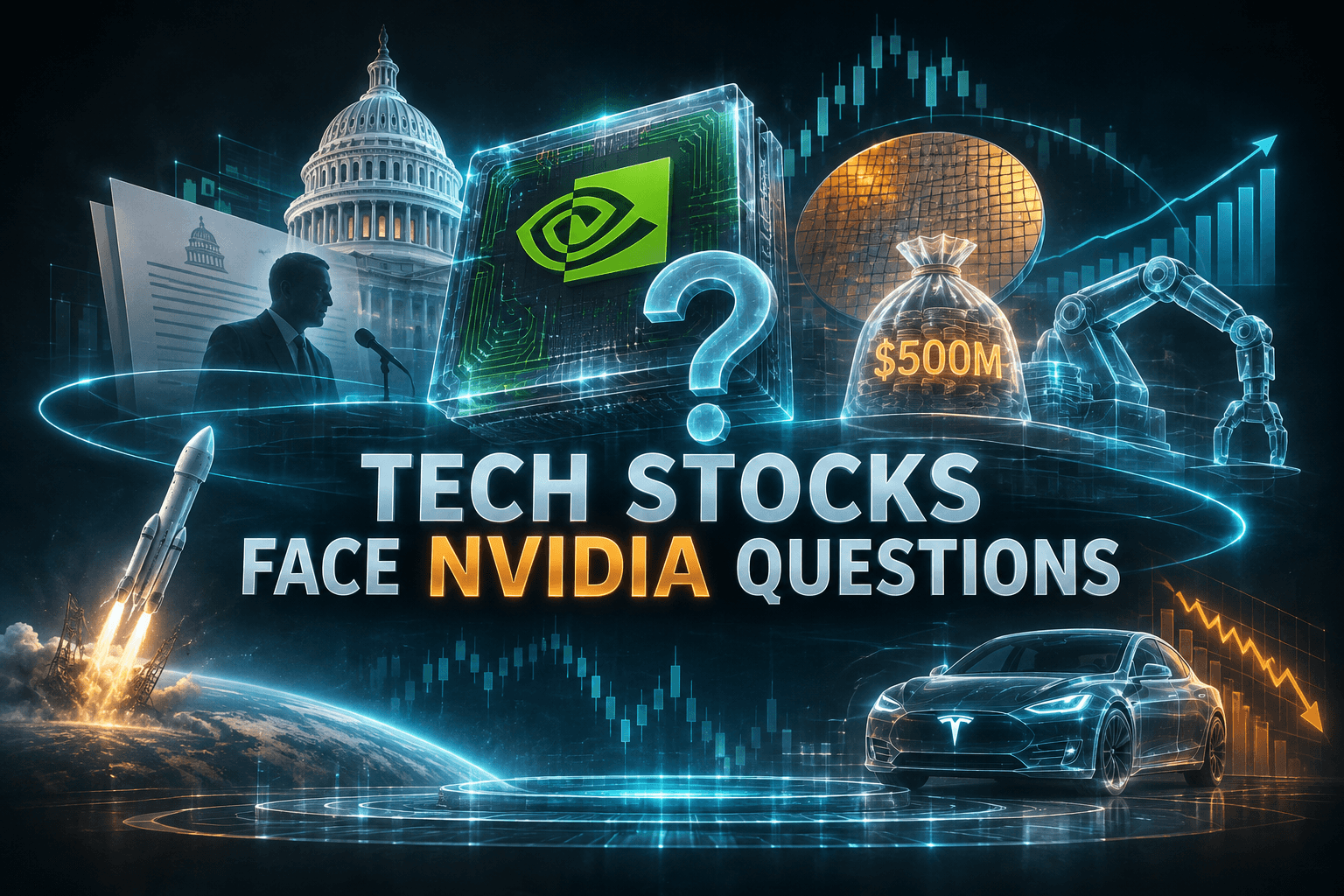
Nvidia’s reported leadership upheaval has become the weekend’s biggest technology-sector uncertainty, raising questions about governance, corporate security and the chipmaker’s relationship with Washington. With the U.S. market closed Sunday, investors have time to assess the reports before trading resumes Monday, November 16.
There are constructive signals elsewhere, including TSMC’s planned $500 million investment fund and a new defense-robotics startup’s early bookings. But what matters most for you is how these developments translate into execution, revenue and risk. The weekend’s headlines point to a selective, watchful market backdrop rather than a single sector-wide trend.
Market Highlights
U.S. stocks did not trade Sunday. The last trading session was Friday, November 13, and the supplied reports don’t include closing prices or percentage moves for the companies mentioned. As a result, there are no verified price changes to report; Monday’s session will be the first chance for equities to react to these weekend developments.
- Nvidia’s reported leadership departure and scrutiny of its Washington relationships put governance and policy exposure in focus for Nvidia (NVDA).
- TSMC plans a $500 million fund for chip startups and upstream partners, a potential long-term ecosystem investment for Taiwan Semiconductor Manufacturing (TSM).
- AI manufacturing startup Nidus raised $30 million across pre-seed and seed rounds and says it reached seven figures in bookings with defense industrial customers in four months.
- Tesla opened Cybercab pre-orders for personal use at $299 per month, subject to geographic restrictions. No Tesla (TSLA) price reaction was available in the reports.
Other notable headlines include SpaceX’s first successful “chopstick” catch of a Starship vehicle, a Netflix animated series based on Magic: The Gathering planned for 2027, and questions about the strain AI-generated bug reports are putting on Linux maintainers.
Key Developments
Nvidia faces a governance and policy test
Reports describe Jensen Huang’s exit from the company he co-founded, amid scrutiny of his relationships, including one with an executive at a company suspected of funneling chips to China. A separate TechCrunch report says Nvidia’s security chief quietly left in August and quotes a former intelligence officer questioning whether corporate security teams are equipped to catch risks embedded in everyday conversations.
The stories raise issues beyond leadership continuity. Nvidia sells strategically important chips in a politically sensitive area, so its ability to manage relationships, internal controls and government expectations matters to customers and policymakers as well as shareholders. A petition calling for Huang’s reinstatement had attracted more than 115,000 signatures by Saturday afternoon, according to TechCrunch. That response shows public attention, but it doesn’t settle the company’s leadership or policy questions.
A Financial Times commentary argues that Nvidia must reset its ties in Washington and recognize that corporate scale cannot dictate U.S. foreign policy. For investors, the practical questions are whether the company provides clarity on leadership and controls, and whether any policy developments affect its access to customers or markets. Those answers aren’t established by the weekend reports.
Chip investment and defense robotics offer growth signals
TSMC plans to establish a $500 million fund to support chip startups, suppliers and other upstream partners. The company says it wants to support the next generation of major chip businesses. The plan suggests TSMC is seeking to strengthen the ecosystem around semiconductor manufacturing, although the reports don’t specify investment timing, expected returns or individual recipients.
Nidus, which is developing AI-powered technology for manufacturing robots used by U.S. defense industrial companies, raised $30 million across pre-seed and seed rounds. The startup says it has reached seven figures in bookings with defense industrial customers in just four months. That is an early demand signal, not proof of sustained revenue or profitability. Still, the funding and reported bookings show how AI investment is extending into industrial and defense applications, beyond software services.
New products and infrastructure expose execution questions
SpaceX successfully used its Mechazilla tower to catch a Starship vehicle for the first time, after aborting a planned catch of the flight’s booster. The company had previously performed “chopstick” catches of boosters, making this a new milestone for the Starship vehicle itself. It is a technical achievement, but the report doesn’t establish a timetable for commercial operations or the program’s economics.
Tesla opened Cybercab pre-orders for personal use, with geographic restrictions and a $299 monthly fee. Even Elon Musk reportedly called the fee too high. The price and service limitations leave questions about customer demand and how the offering will be delivered; the announcement alone doesn’t show how many people will subscribe.
Two other stories highlight less direct business risks. The FAA said Friday’s nationwide ground stop was related to routine work replacing copper wire with fiber at a remote facility, bringing infrastructure reliability into focus. Meanwhile, some Linux maintainers say AI-generated bug reports are adding to their workload, even as others see potential benefits. AI can make it easier to identify possible issues, but getting them reviewed and fixed remains a human capacity challenge.
What to Watch
On Monday, watch for Nvidia’s response to the weekend’s leadership and security coverage, along with any company or government clarification. The reports provide no confirmed change to Nvidia’s financial outlook, but leadership continuity, internal controls and U.S. policy remain important questions for the chip sector.
For TSMC’s fund, details to monitor include when it launches, how it selects investments and whether the company reports concrete commitments. For Nidus, the next evidence point is whether its early bookings convert into recurring business. These are longer-term signals, not immediate proof of financial performance.
Tesla’s Cybercab pre-orders will offer an initial read on customer interest, while geographic restrictions and the monthly fee are key context for interpreting uptake. SpaceX’s catch is a technical milestone; subsequent test results and the pace of further development will matter more than the spectacle alone. You can also watch for updates on the FAA’s infrastructure work and on how Linux projects handle the influx of AI-related bug reports.
Bottom Line
- Nvidia is the central risk story, with leadership, security and U.S. policy questions unresolved in the reports.
- TSMC’s planned $500 million fund signals support for the semiconductor ecosystem, but its investment details and returns remain unknown.
- Nidus reported $30 million in funding and seven figures in early bookings, an encouraging but preliminary demand indicator.
- SpaceX’s Starship catch marks a technical milestone; Tesla’s Cybercab offer still faces questions about pricing, access and customer uptake.
- U.S. markets were closed Sunday. No share-price moves were provided, so Monday, November 16, is the next session for assessing market reaction.
FAQ
Q: Why is Nvidia the main focus for technology investors? A: Weekend reports raise questions about leadership, corporate security and the company’s relationships with Washington amid scrutiny involving a person linked to a company suspected of funneling chips to China.
Q: What is TSMC’s planned $500 million fund intended to do? A: TSMC says it plans to invest in chip startups, suppliers and other upstream partners, supporting the broader semiconductor ecosystem.
Q: Did U.S. technology stocks trade on Sunday, November 15? A: No. U.S. markets were closed Sunday; the last session was Friday, November 13, and the next is Monday, November 16.