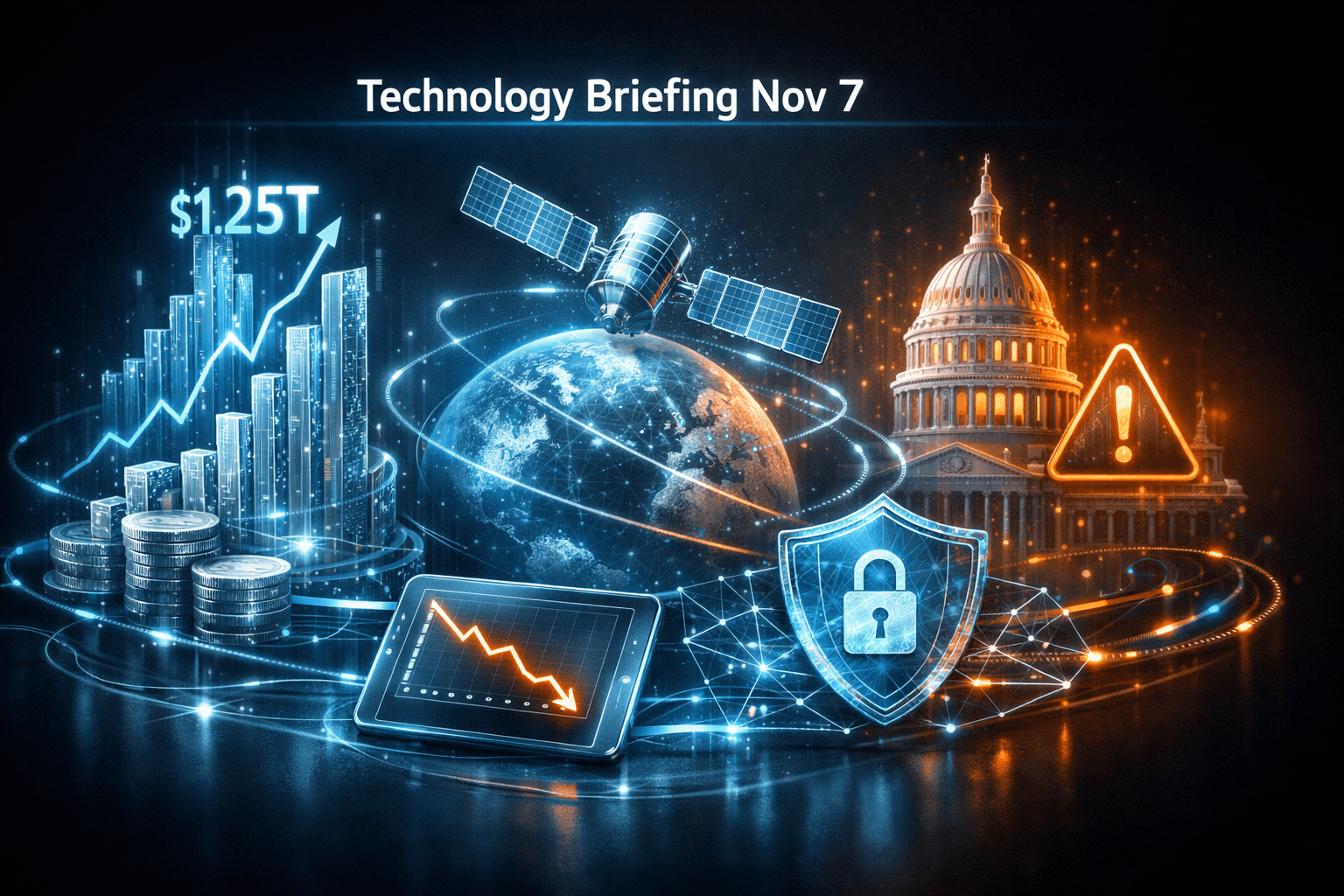
The Big Picture
Big, headline-grabbing funding and expansion in AI and connectivity are colliding with political pushback, security threats, and slipping device demand. OpenAI's new $1.25 trillion valuation underlines how much capital is chasing AI, while reports of Midterm-driven hostility toward Big Tech and exposed AI hacking tools show why investors can't treat the sector as a one-way bet.
These developments matter because they affect growth prospects, regulatory risk, and the cost of doing business in technology. As you read through the pieces below, think about how much momentum you believe is structural versus how much could be trimmed by policy, security, or cyclical demand shifts.
Market Highlights
Key facts and figures from overnight and pre-market reports, with context heading into the long weekend. Markets were closed on Saturday, so price reactions refer to available reports and data as of Friday, November 6.
- OpenAI valuation: Bloomberg reports a fresh round that values OpenAI at about $1.25 trillion after another roughly $11 billion was raised, following a March raise that Bloomberg says brought in about $122 billion at an $852 billion valuation.
- Tablet slump: Omdia says global tablet shipments fell 23% year-over-year to 32 million units in Q3 2026, the lowest in nearly three years. Apple's iPad shipments declined about 27.5% YoY to roughly 11.58 million units, spotlighting weakness in consumer hardware across the board (Apple (AAPL)).
- Cybersecurity warnings: Researchers at Censys found more than 800 publicly exposed copies of ARTEX, a Chinese-made, AI-powered open-source penetration testing tool linked to attacks since July. Separately, Alpine Linux and OpenSSH released a critical patch described as as bad as it can get, urging immediate remediation.
- VC and infrastructure moves: Sequoia is winding down its Scouts program, described as the end of an era for that sourcing model. Crusoe has sold a troubled Wyoming data-center project to Google, highlighting the difficulty of building massive AI facilities and the role of large incumbents (Alphabet (GOOGL)).
- Connectivity and competition: SpaceX is ramping up Starlink Mobile with ambitions to be a major mobile carrier, signaling new competition for incumbents such as T-Mobile US (TMUS), Verizon Communications (VZ), and $T.
- Geopolitics: The New York Times reports China recruited an AI executive to gather intelligence on Nvidia and its CEO, underscoring national-security tensions around advanced chips and AI hardware (Nvidia (NVDA)).
Key Developments
AI funding boom versus political unease
OpenAI's reported $1.25 trillion valuation and fresh capital inflows show enormous investor appetite for AI platforms and infrastructure. Anthropic is also moving toward an IPO, suggesting vibrant capital markets for leading AI players.
But Gillian Tett in the Financial Times and TechCrunch's midterms analysis note that voter hostility toward Big Tech shaped recent elections, and similar skepticism is spreading across Western markets. Can regulators slow AI's momentum, or will funding and product demand outpace policy changes? That's a central question for you to watch.
Security: AI tools aiding attackers and urgent patching
Censys's discovery of 800-plus exposed copies of ARTEX, an AI-powered penetration testing tool, raises practical security risks for enterprises and cloud providers. The open availability of powerful tools amplifies threats, and the Alpine/OpenSSH vulnerability is a reminder that foundational software still needs constant attention.
For companies and service providers, this increases operational risk and could raise costs for security teams. For investors, data suggests cybersecurity vendors may see sustained demand, but breaches remain a downside risk for exposed businesses.
Hardware demand softens, infrastructure gets complicated
Omdia's tablet numbers show a clear demand slowdown, with iPad shipments down sharply. That continues a pattern of consumers holding onto devices longer and spending more on AI services than on new hardware upgrades. Apple faces a tougher consumer backdrop even as it invests in services and AI features ($AAPL).
On the infrastructure side, Crusoe's sale of a troubled Wyoming data-center project to Google highlights two trends, one practical and one strategic. Building hyperscale AI-capable facilities is expensive and risky for smaller players, while big cloud incumbents keep consolidating capacity and control over the supply chain ($GOOGL).
What to Watch
You'll want to track a short list of catalysts as markets reopen on Monday, November 9. First, monitor regulatory and legislative headlines related to AI and Big Tech; policy moves can trigger broad sector re-rating in a hurry. Second, stay alert to security bulletins from major vendors and cloud providers because newly found vulnerabilities can affect service availability and costs.
Watch the financing and IPO calendar for Anthropic and other AI firms. Big private raises and IPO pricing will influence valuations across the sector. Keep an eye on device shipment reports and supply-chain updates for clues about consumer demand trends. Finally, follow SpaceX Starlink developments for potential disruption to wireless carriers.
Bottom Line
- AI remains the dominant narrative, with huge funding lifting sector valuations, but regulatory and geopolitical headwinds are intensifying.
- Security incidents and critical software patches are immediate operational risks, and exposed tools like ARTEX increase the odds of disruptive attacks.
- Hardware demand is softening, as shown by a sharp drop in tablet shipments, which could pressure revenue for device-heavy businesses.
- Infrastructure consolidation continues, with large cloud providers taking on more capacity and execution risk, as shown by Google acquiring Crusoe's project.
- Be selective and stay informed, since momentum and risks are both elevated; analysts note that market reactions will hinge on policy clarity and security trends.
FAQ
Q: How does OpenAI's valuation affect other AI companies? A: Large private raises tend to lift investor appetite and valuations across the AI ecosystem, but they also invite scrutiny from regulators and competitors, which can increase volatility.
Q: Should I be worried about the ARTEX exposures? A: Exposed offensive tools raise the immediate risk of attacks, so you should monitor vendor and cloud security advisories and apply patches promptly if you manage infrastructure.
Q: What does the tablet shipment decline mean for device makers? A: A sustained drop in shipments suggests weaker consumer upgrade cycles, pushing device makers to emphasize services, software, and higher-margin offerings.