The Big Picture
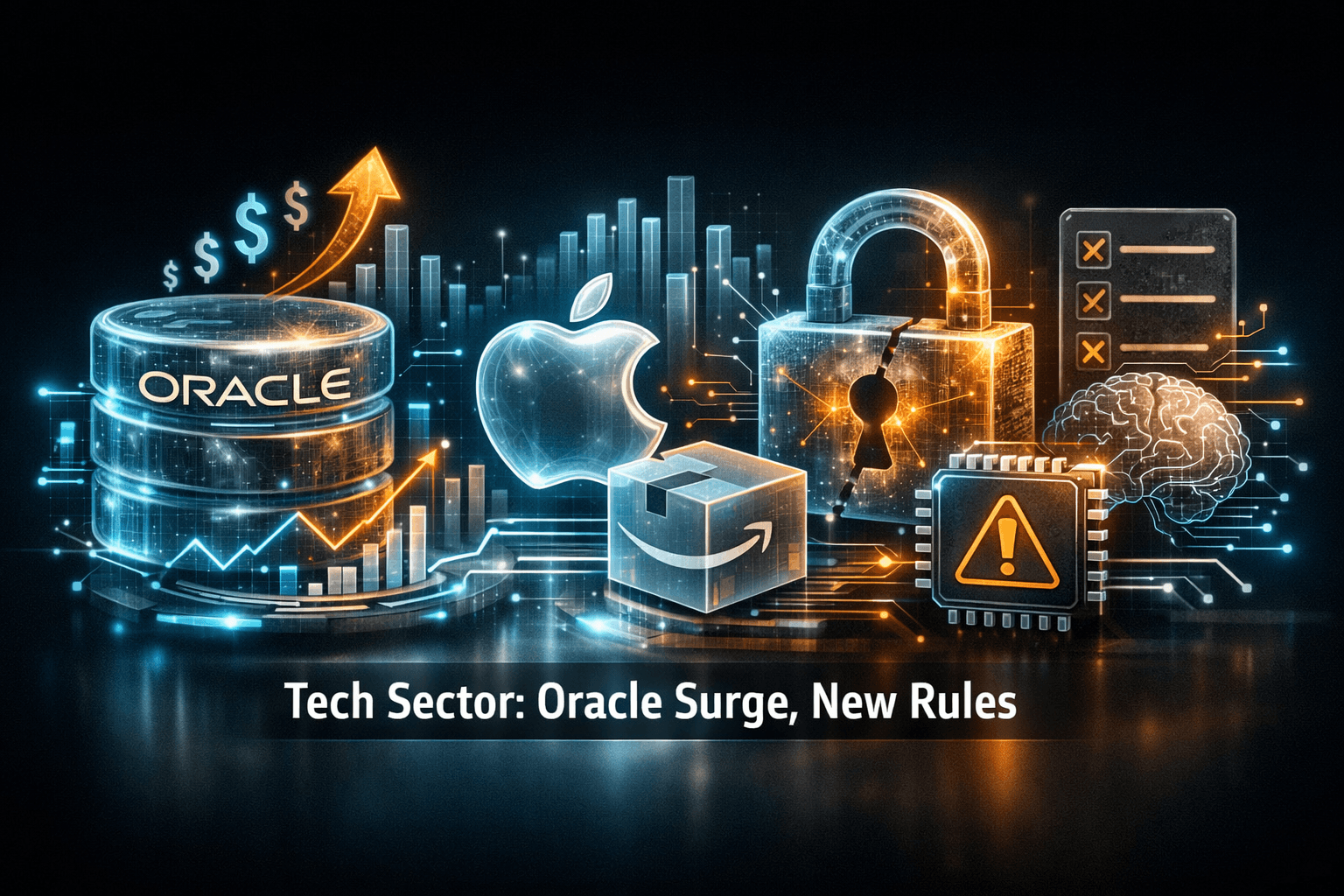
Oracle's dramatic guidance on capital and free cash flow was the single biggest market mover today, sending Oracle (ORCL) up more than 11 percent and refocusing attention on cloud infrastructure spending cycles. At the same time you'll want to weigh that optimism against a wave of policy moves and security scares that could reshape costs and demand across the sector.
For investors, the takeaway is mixed. Product momentum and clearer AI spend metrics are feeding bullish narratives, while tightened rules on foreign gadgets, new state-level AI limits, and persistent vulnerabilities mean you should be selective and stay alert to regulatory and operational risk.
Market Highlights
Key price moves and fast facts from today's session:
- Oracle $ORCL jumped more than 11 percent after saying it will limit new financing to $20 billion through fiscal 2030 and expects free cash flow to turn positive in H2 FY2028 and exceed $30 billion in FY2029.
- Apple Apple (AAPL) and Amazon Amazon.com (AMZN) dominated product coverage as hands-on and review pieces praised a new OLED iPad Mini, touchscreen MacBook Pros with M5 chips, and an Alexa Photo Frame product that adds casual device demand.
- Regulatory headlines pressured some supply chain and international-exposure names after the FCC moved to restrict certain Chinese consumer gadgets, while New York signed two AI-related bills tightening protections for minors and baby monitors.
Key Developments
Oracle's cashflow pledge reshapes cloud capex expectations
Oracle's plan to cap new financing at $20 billion through FY2030, and its guidance that free cash flow will turn positive in H2 FY2028 and top $30 billion in FY2029, recalibrated investor expectations for the cloud build-out timeline. The company said capital spending should peak this fiscal year and next as it completes capacity, which could ease investor concerns about indefinite heavy capex and support valuation revision for legacy cloud players.
What this implies for you is clearer visibility on when capital returns could resume and which peers may face similar capex narratives. Analysts note this could create relative winners and losers as capacity constraints ease.
Regulation front: FCC clampdown, state AI rules, and prison jamming debate
The FCC is moving to restrict a swath of Chinese-made consumer gadgets, from drones to routers and household robots, effectively erecting import barriers for certain devices. That policy could disrupt supply chains and hurt vendors reliant on overseas components or Chinese brands.
In New York, Gov. Kathy Hochul signed bills banning certain AI chatbot features for minors and requiring stronger security in internet-connected baby monitors. Meanwhile FCC Chair Brendan Carr plans a Nov. 19 vote on allowing prisons to jam cellphone signals, renewing debate over radiofrequency exemptions. These measures increase compliance and product-design costs for companies, and they raise questions about market access and timing for device rollouts.
Product and AI moves: Anthropic, Apple, Amazon, and platform changes
Anthropic released tools showing organizations what their AI spending buys, a move that increases transparency ahead of its planned IPO. That could help enterprise buyers control costs and improve procurement discipline, while giving Anthropic pitch material for institutional investors.
On the consumer side, hands-on reviews of Apple's OLED iPad Mini and touchscreen MacBook Pros were positive, and Amazon's new Alexa Photo Frame got favorable coverage for usability. Google search indexing of public Discord messages and an opt-out option drew attention to discoverability and privacy tradeoffs. Taken together, product momentum remains solid, but platform and privacy adjustments could affect user engagement metrics you watch.
What to Watch
Several near-term catalysts will shape positioning into next week. First, watch regulatory calendars closely, especially the FCC's Nov. 19 vote on prison signal jamming and any follow-ups to the gadget restrictions. How fast will enforcement roll out and who will be targeted first?
Second, Anthropic's IPO timeline and uptake of its cost-transparency tools matter for AI infrastructure demand and vendor comparability. Third, monitor how companies respond to New York's new AI rules and whether federal legislators adopt similar measures, as compliance could hit product roadmaps and timelines.
Security remains a top risk. The PHP vulnerabilities highlighted by Wiz affect a large portion of web infrastructure and could force outages or remediation costs. You should track patching rates and any disclosures from web-dependent firms you follow.
Bottom Line
- Oracle's financing cap and multiyear free cash flow targets reset expectations for cloud capex and unlocked buyer interest, but broader sector risk is mixed.
- Product momentum from $AAPL and $AMZN continues to support device demand, yet platform privacy moves and discoverability changes may influence engagement metrics.
- Regulatory actions at the FCC and state level are increasing compliance costs and creating uncertainty for supply chains and AI features.
- Cybersecurity vulnerabilities remain a significant operational risk and could prompt near-term remediation expenses or downtime for web-facing firms.
- Analysts note this is a period to separate the wheat from the chaff, focusing on companies with clear cashflow paths and robust compliance programs.
FAQ Section
Q: How will Oracle's cashflow guidance affect the broader cloud market? A: Oracle's guidance signals a potential end to escalating capex for cloud infrastructure, which could ease investor concerns about prolonged heavy spending across peers and shift focus toward profitability metrics.
Q: Should I be worried about the FCC's gadget restrictions? A: The restrictions may disrupt suppliers and product timing for companies relying on affected imports, but impact will vary by firm and by supply chain resilience; watch individual company disclosures for specifics.
Q: What immediate steps should companies take after the PHP vulnerabilities? A: Firms running PHP should prioritize patching and incident response, audit exposed endpoints, and disclose material impacts promptly; demand for managed security services is likely to rise.