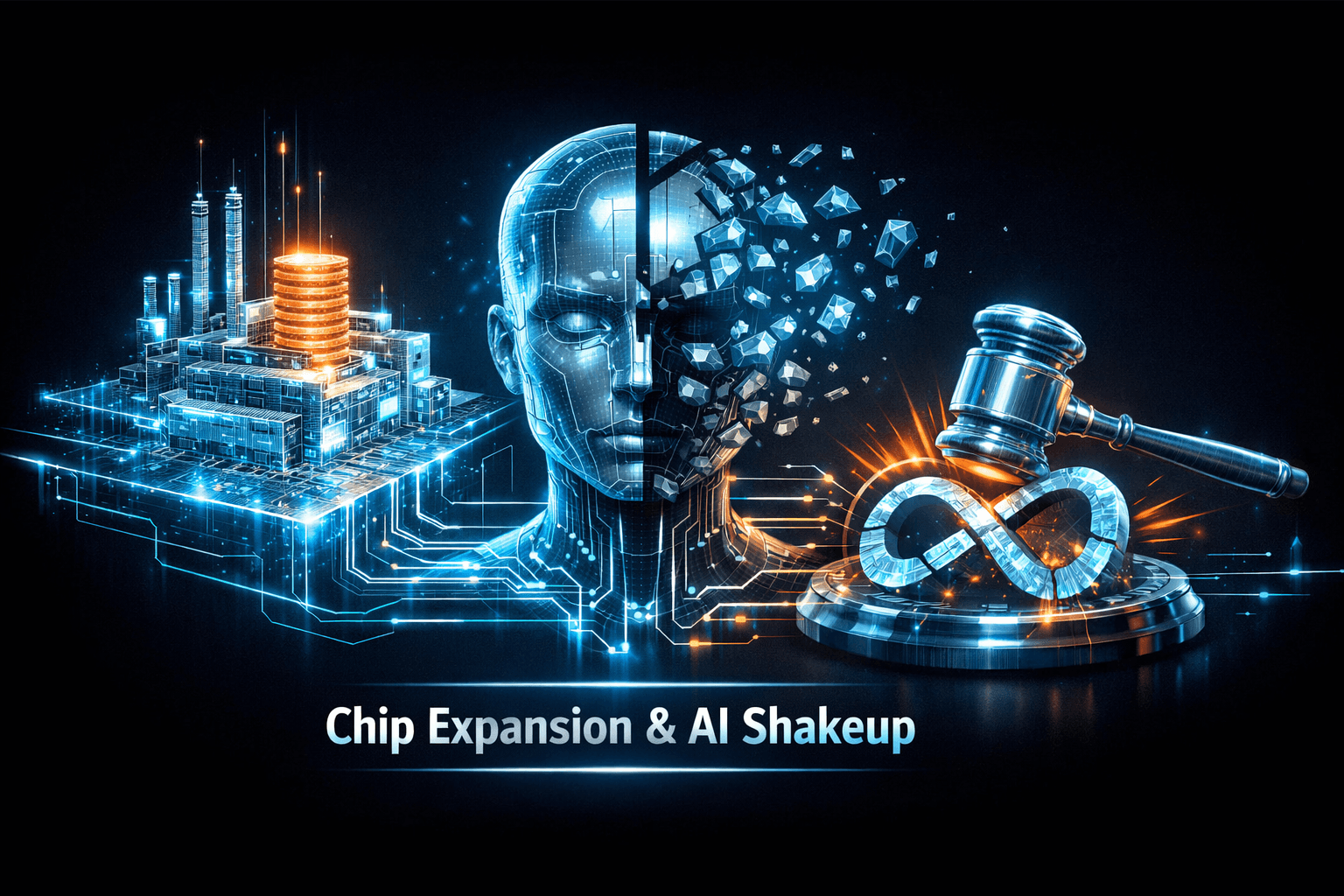
The Big Picture
SK Hynix's announcement of a roughly $38 billion expansion in South Korea is the day's headline and a clear vote of confidence in memory demand and supply-chain prioritization. That capital plan, split into an estimated $24.7 billion DRAM site in Yongin and about $13.3 billion in NAND capacity in Cheongju, will reverberate across suppliers and regional policy debates.
At the same time, big-name AI and platform stories are sending mixed signals about where tech earnings and regulatory risk may land. You're seeing both heavy investment and organizational turbulence, so today you'll want to separate long-term capacity moves from near-term execution and legal risks.
Market Highlights
Quick facts and figures to scan this morning.
- SK Hynix, $000660.KS, plans a 54 trillion won expansion, roughly $38 billion, with major DRAM and NAND fabs planned in Yongin and Cheongju.
- Meta, $META, was hit with an additional $567 million public nuisance award in New Mexico, bringing the case's second-phase damages to $567 million and total penalties near $1 billion.
- Alphabet, $GOOGL, is executing an AI leadership overhaul that shifts control back to Silicon Valley, while analysis notes Google Cloud revenue growth topping 100% year over year in recent reporting.
- OpenAI's reported AI smart speaker pricing came in between $300 and $400, signaling premium positioning for AI consumer devices.
Key Developments
SK Hynix's $38B Capacity Push
SK Hynix's plan to invest about $38 billion in domestic chipmaking capacity is one of the largest single expansions in memory in recent years. For you that means a likely multi-year acceleration in capex-led demand for equipment, construction, and local services, and a potential easing of memory tightness if demand growth slows later.
Policy implications are immediate. The scale of the projects will draw government attention on incentives, talent, and power infrastructure, and suppliers to Hynix will be in the driver's seat for order flow over coming quarters.
Google AI Shakeup and DeepMind Momentum Loss
Reports that Google is re-centralizing AI control in Silicon Valley and that DeepMind has lost some frontier-model momentum after leadership and reinforcement learning departures are notable. Analysts and industry watchers say Google Cloud is benefiting from added compute and commercial traction, with year over year growth above 100% noted in recent commentary.
What does this mean for you as an investor in cloud and AI ecosystems? Expect an emphasis on commercialized models, cloud revenue capture, and cost of talent as the company retools strategy and leadership. Execution risk is higher while internal transitions are underway.
Meta Legal Ruling and OpenAI Device Pricing
The New Mexico ruling that adds $567 million in damages against Meta feeds regulatory and litigation risk narratives for social platforms. The court found the platforms contributed materially to teen harm in a public nuisance case, which raises the specter of further state-level actions and compliance costs.
On the product front, OpenAI's reported pricing for a smart speaker between $300 and $400 signals a premium hardware play for generative AI assistants. You're likely to see other firms react on pricing and feature sets, which could shape adoption curves for AI-enabled devices this holiday season.
What to Watch
Here are the catalysts and risks that could move tech names in the coming days and months.
- SK Hynix project milestones and government approvals, including site permits, local incentives, and timelines for production. Capex deployment will affect equipment vendors and regional suppliers.
- Google's leadership announcements and product roadmap shifts, plus any follow-up on DeepMind departures. Monitor Google Cloud monthly trends for continued revenue acceleration.
- Legal and regulatory fallout from the Meta ruling, including potential appeals, settlement activity, and related state actions. Watch disclosures for increased compliance costs.
- OpenAI product launch details and distribution partners, along with pricing confirmation. Consumer device pricing will inform margins and market penetration assumptions for AI hardware.
- Macro demand for memory and semiconductors. Even large capacity additions can be masked by cyclical demand swings, so track inventory and spot pricing in DRAM and NAND markets.
Bottom Line
- SK Hynix's $38 billion expansion is a major structural bet on memory, and it will drive supplier order books and regional capital spending for years.
- Google's AI reorganization and DeepMind talent changes create near-term execution risk, even as Google Cloud captures more compute-driven revenue.
- The Meta ruling increases legal and regulatory risk for platforms and could raise compliance costs across the industry.
- OpenAI's reported device pricing positions it in the premium smart-speaker market and could accelerate AI device competition this fall.
- Ultimately, you're seeing mixed signals: heavy capital investment and product launches versus leadership churn and legal pressure, so a selective approach remains warranted.
FAQ Section
Q: How will SK Hynix's expansion affect chip suppliers and equipment makers? A: The plan should boost demand for semiconductor equipment, materials, and construction services over multiple years and will likely benefit suppliers tied to DRAM and NAND fabs.
Q: Should I be worried about Google Cloud's growth if DeepMind is losing talent? A: Google Cloud's commercial momentum can offset research disruptions in the near term, but you should watch execution and product integration as leadership changes play out.
Q: Does the Meta ruling signal more state-level legal risk for social platforms? A: Yes, the New Mexico decision could encourage additional state actions and increase compliance costs, so platform operators may disclose higher legal reserves or policy changes.