The Big Picture
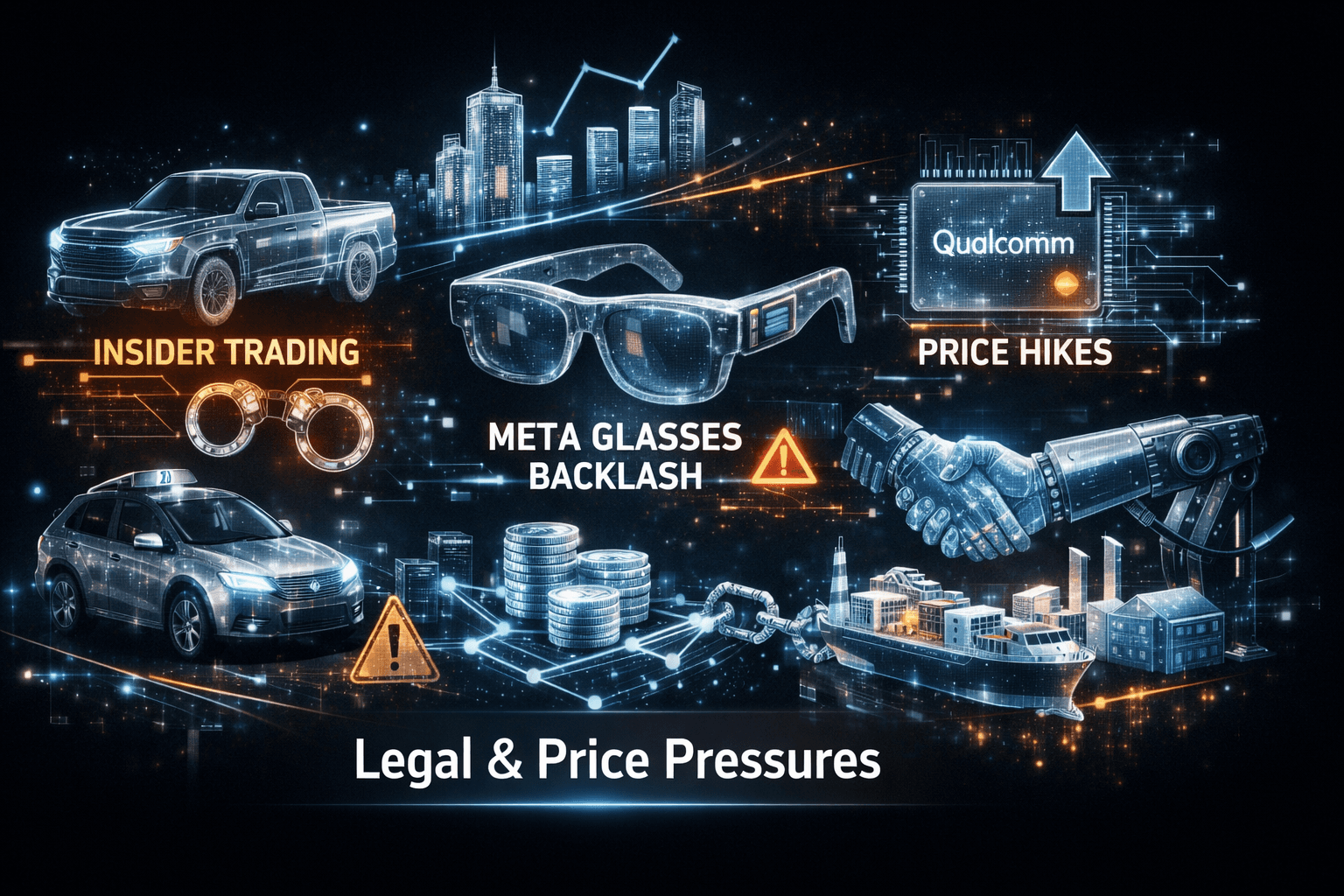
Regulatory and legal risks took center stage in the technology sector today, with an insider-trading indictment tied to a Rivian joint venture and fresh privacy prosecutions making headlines. You should note that those stories, coupled with $QCOM's announced price increases and growing friction in the robotaxi ecosystem, raise near-term uncertainty for hardware makers and mobility plays.
There was still momentum in AI funding and dealmaking, so today's news feels like the tip of the iceberg, not the whole picture. How you position yourself may depend on whether you focus on near-term risk or longer-term AI-driven opportunities.
Market Highlights
Quick facts and moves to keep on your radar:
- Volkswagen engineers were indicted in an insider-trading case tied to stock purchases in $RIVN, a story unsealed on Jul 24 and reported by TechCrunch.
- Waymo's relationship with $UBER appears strained, with reports that Waymo is exploring an exit from the Uber partnership amid lobbying battles over robotaxi rules.
- $QCOM warned customers of planned price increases in the double digits for products shipped after Sept 1, a move Bloomberg and The Verge say will ripple through device makers.
- AI deal activity continued: Paper raised $34 million in Series A funding led by Accel and ICONIQ, and Cognition acquired Poke in a deal valuing the target in the low nine figures, signaling investor appetite for AI UX and assistant tech.
- Meta's smart glasses faced intense public backlash over privacy and harassment concerns, amplifying moderation and product-risk questions for $META.
- Midjourney acquired the astrology app Co-Star, and Amazon offered a $350 gift card promotion on new Samsung phones, highlighting consumer demand incentives.
Key Developments
Insider-trading indictment tied to Rivian joint venture
Prosecutors unsealed an indictment alleging that Volkswagen engineers used confidential information to buy $RIVN shares ahead of a joint-venture announcement. That raises reputational and compliance questions for $VWAGY and could prompt closer scrutiny of governance in strategic partnerships.
For investors the immediate implication is elevated event risk around any collaborative announcements in the EV space, and potential legal tail risks that could affect partner valuations. Are you watching partner disclosures and compliance programs more closely now?
Waymo and Uber partnership strains amid robotaxi lobbying
Sources tell the Financial Times that Waymo is exploring an exit from its partnership with $UBER as lobbying over robotaxi rules intensifies. The move underscores how regulation can reshape commercial partnerships and rollout timelines for autonomous services.
If the partnership weakens, that could slow deployments and shift the competitive landscape toward companies with clearer regulatory strategies. You should track policy developments and any partner replacement plans closely.
Price shock from Qualcomm, privacy and moderation headaches
$QCOM told customers to expect double-digit price hikes on product shipments after Sept 1, citing higher supplier costs. Device makers and retailers will face margin and pricing pressure if those increases are passed on to consumers.
At the same time, $META's smart glasses are drawing a public backlash over privacy and harassment, while U.S. prosecutions related to phone-wiping and duress passcodes highlight growing legal risk around device encryption and border search policies. These stories together raise the regulatory stakes for consumer hardware.
What to Watch
Near-term catalysts and risks to monitor tomorrow and in the coming weeks:
- Regulatory filings and press releases from $VWAGY and $RIVN for updates on the insider-trading case and any corporate responses.
- Statements from Waymo and $UBER, plus regulatory lobbying updates that could change the timeline for robotaxi rollouts.
- Details from $QCOM on which product lines and customers will be affected by the double-digit price increases and whether those costs will be passed to consumers or absorbed by partners.
- Any policy or enforcement moves tied to privacy and device security after the DOJ and related prosecutions, which could influence hardware makers and OS vendors.
- AI M&A and funding activity, including integration plans from Cognition and Midjourney, which could point to where customer-facing AI experiences are headed.
Remember, you should check company filings and official statements before drawing conclusions. Which of these risks matters most may depend on whether you own stocks sensitive to hardware margins or to regulatory timelines.
Bottom Line
- Legal and regulatory stories dominated the day, creating short-term downside risk across device makers and mobility partnerships.
- $QCOM's announced double-digit price hikes increase supply-chain pressure and could squeeze OEM margins if costs are passed on.
- Waymo and $UBER friction raises uncertainty for autonomous mobility rollouts and partner-dependent business models.
- AI funding and M&A, including Paper's $34 million Series A and Cognition's Poke acquisition, show continued investor interest in AI UX and agent design.
- Keep a selective approach, watch official filings and policy updates, and be mindful of execution risk in hardware and regulation-exposed businesses.
FAQ Section
Q: What does the Volkswagen-Rivian indictment mean for $RIVN? A: The indictment raises governance and event-risk concerns around partnership announcements. It does not change company fundamentals directly but could increase volatility in the near term.
Q: How will $QCOM's price increases affect you as a technology investor? A: Double-digit price hikes can squeeze OEM margins or drive higher consumer prices, so watch company-level commentary from affected suppliers and device makers for margin impact.
Q: Are the AI deals a sign the sector is still healthy? A: Yes, funding and acquisitions like Paper's Series A and Cognition's buy of Poke indicate strong interest in AI tooling and UX, though that momentum coexists with regulatory and hardware risks.