The Big Picture
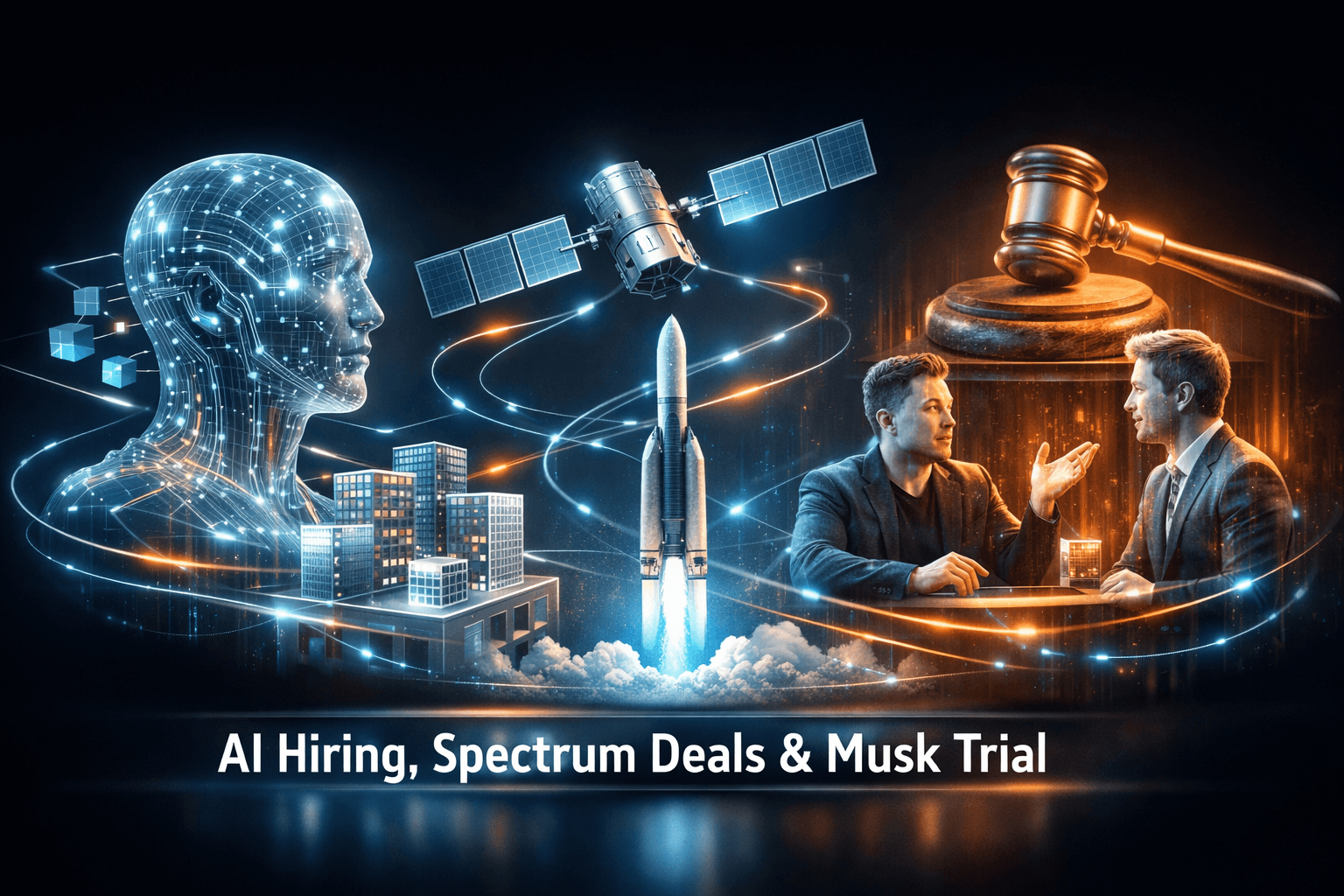
Google's announcement that it will hire hundreds of forward deployed engineers to accelerate enterprise AI adoption set the tone in tech today, pointing to fresh revenue focus for cloud and AI products. At the same time, the FCC approved EchoStar's sale of spectrum slices to SpaceX and $T, a move that expands capacity for satellite and wireless networks and has practical infrastructure implications.
But it's not all growth headlines. High-profile courtroom exchanges between Elon Musk and Sam Altman, and testimony about internal decisions at OpenAI, reminded the market of governance and reputational risks tied to AI leadership. What does this mean for you as an investor? The mix of business execution and legal scrutiny leaves the sector in balanced territory today.
Market Highlights
Here are the quick facts and movers from today's headlines and company actions.
- $GOOGL, Google, said it will hire forward deployed engineers in the hundreds to help customers deploy business-focused AI products, signaling stronger enterprise adoption interest.
- $T, AT&T, benefited from the FCC approval to buy 50 megahertz of spectrum from EchoStar, a regulatory green light for network capacity expansion.
- SpaceX received approval for roughly 65 megahertz of spectrum from EchoStar, a practical win for satellite internet capacity, though SpaceX is private and has no public ticker.
- $META is rolling out new Teen Account features that notify parents when teens add new interests to Instagram, reflecting product changes tied to regulation and public concern.
- VC activity continued as A* Capital closed a $450 million Fund III, reinforcing early-stage funding momentum for tech startups.
Key Developments
Google ramps front-line AI support
$GOOGL told reporters it plans to hire hundreds of forward deployed engineers to work directly with customers on business AI products. That suggests Google is moving to shorten the time from proof of concept to commercial deployment, which could support cloud revenue over time.
If you're watching enterprise AI adoption, this is a concrete sign Google wants to monetize deployments more aggressively. It also raises demand for skilled engineers and could accelerate competitive dynamics with other cloud providers.
FCC approves EchoStar spectrum sales to SpaceX and $T
The FCC approved EchoStar's sale of about 65 megahertz of spectrum to SpaceX and 50 megahertz to $T. Practically, that expands capacity for satellite broadband and wireless carriers, which matters for congestion and new service rollouts.
For you, the immediate takeaway is infrastructure buildup, not a quick revenue leap. Spectrum gives operators more headroom to scale services, but monetization will depend on rollout speed and consumer uptake.
Musk v. Altman courtroom drama highlights governance risks
Testimony today included tense cross-examination of Sam Altman and accounts that Elon Musk suggested extreme internal measures at OpenAI. Altman said certain conversations were "hair-raising," and he testified that Musk's behavior caused friction inside the company.
These exchanges aren’t just tabloid fodder, they underline governance and personnel risks around high-profile AI ventures. You should expect investor attention on board oversight and leadership stability in AI companies going forward.
Funding and startup activity: A* and new founders
Kevin Hartz's A* Capital closed Fund III at $450 million, signaling ongoing VC interest in early-stage tech. Separately, former Tesla exec Drew Baglino launched Sadi Thermal Machines, a heat pump startup, showing continued founder-driven innovation in climate tech.
These items show capital is still flowing into new ideas, and you're likely to see more specialized hardware and climate-tech plays emerge as funded startups.
What to Watch
Look ahead to catalysts and risks that could move the sector in the coming days.
- Regulatory and legal timetable around the Musk v. Altman case. Court developments could influence sentiment for AI-related stocks and partnerships.
- How quickly $GOOGL translates its hiring into customer deployments and measurable cloud revenue. Watch cloud and AI services guidance in upcoming earnings reports.
- Operator rollout plans using the newly approved spectrum. $T will likely outline deployment priorities, and you should track any mentions in carrier investor presentations.
- VC activity and fundraises, including portfolio disclosures from A* Capital, which may indicate hot subsectors for early-stage investments.
- Policy moves on teen safety and algorithm transparency after $META's change, which could spur similar product shifts across social platforms.
How will regulators react to increased AI deployment and governance headlines? Will enterprise AI hiring translate into faster monetization? Those are central questions for tomorrow's tape.
Bottom Line
- Google's hiring push signals a practical step toward enterprise AI monetization, but revenue impact will take time to show in results.
- The FCC spectrum approvals are infrastructure positive, supporting future capacity for satellite and wireless services rather than immediate earnings boosts.
- High-profile courtroom testimony about AI leadership keeps governance risk front and center, a wake-up call for boards and investors.
- Venture funding and new startups show continued appetite for innovation, especially in climate tech and early-stage AI applications.
- Stay selective and watch upcoming earnings and regulatory announcements to see which companies convert operational moves into measurable growth.
FAQ Section
Q: How will Google's hiring affect its cloud and AI revenue? A: Hiring forward deployed engineers aims to speed customer deployments, which can improve sales conversion over quarters, but direct revenue effects will show up only after deployments scale.
Q: Does the FCC approval immediately change the competitive landscape for satellite internet? A: The approval increases spectrum capacity, which helps operators plan expansion, but competitive effects depend on deployment timelines and consumer adoption.
Q: Should I be worried about the Musk-Altman trial if I own AI-related stocks? A: Courtroom developments heighten governance and reputation risk, and you should monitor company disclosures and any regulatory fallout, but legal news alone does not equal broad sector impairment.