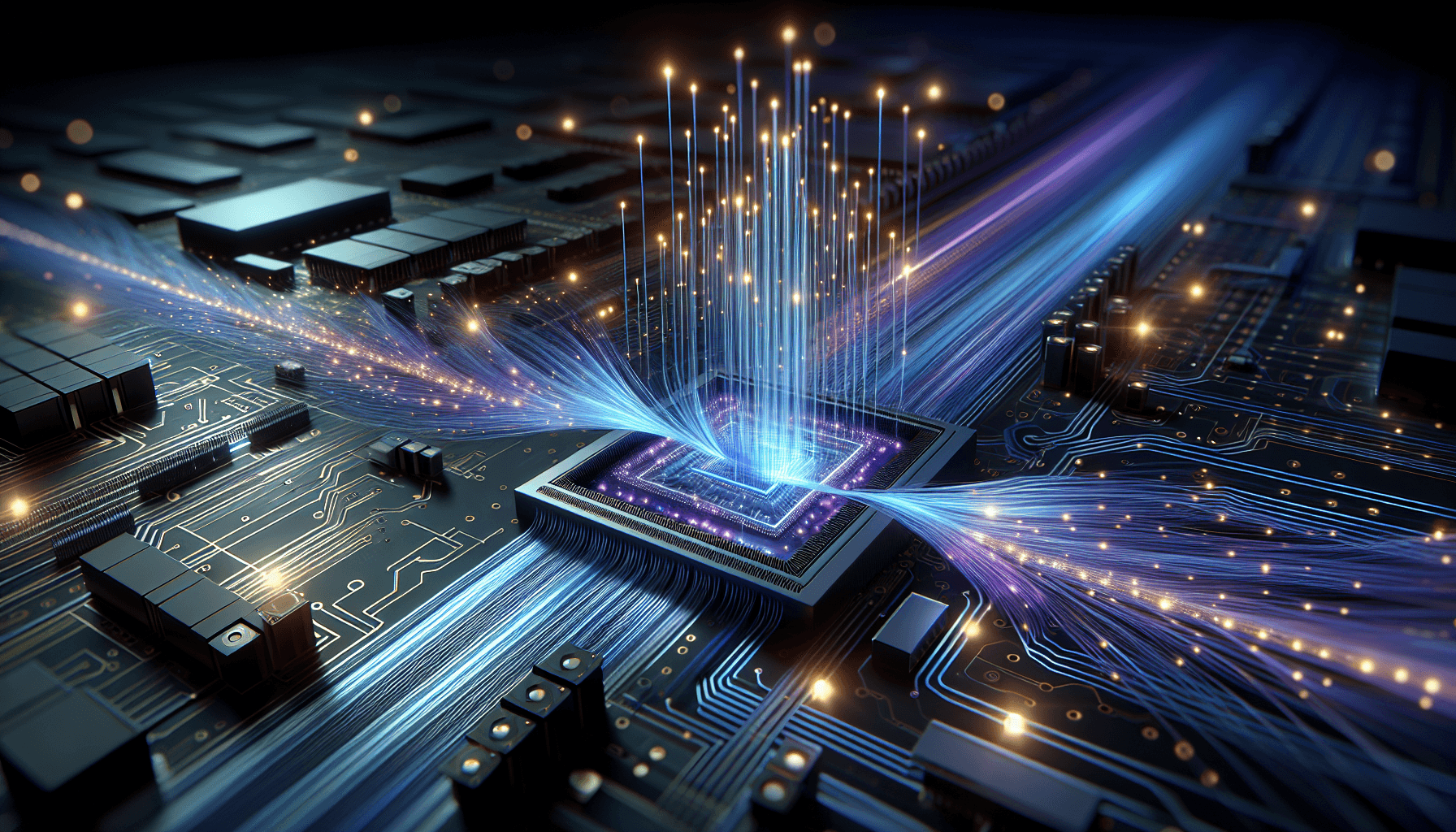
Looking Beyond GPUs: The Hidden Layer of AI Infrastructure
The artificial intelligence investment narrative has largely revolved around graphics processing units, accelerators, and high-performance CPUs. These chips are essential, but they are only one piece of the system. As AI models grow larger and workloads become more distributed, the challenge is no longer just computation, it is moving data efficiently between processors, memory, racks, and entire data centers.
This shift is forcing investors and infrastructure designers to look deeper into the stack. Data movement, not compute, is emerging as a fundamental constraint. Electrical connections struggle as speeds increase, running into power consumption, heat dissipation, and signal integrity limits. Optical connectivity has become the practical solution.
POET Technologies operates squarely in this hidden layer. It is not a consumer-facing AI company and does not design GPUs or models. Instead, it focuses on the photonics and microchip infrastructure that allows AI systems to scale.
What Does POET Technologies Do?
POET Technologies is a photonics and microchip company specializing in optical engines and advanced photonics packaging. Optical engines are the core building blocks used inside high-speed transceivers that enable data to move rapidly across AI clusters, hyperscale data centers, and cloud networks.
At the center of POET's strategy is its Optical Interposer platform. The Optical Interposer is designed to integrate lasers, modulators, photodetectors, and electronic components at wafer scale. This approach borrows concepts from traditional semiconductor manufacturing, applying them to photonics.
Rather than assembling optical components individually using labor-intensive active alignment, POET's platform emphasizes passive alignment and repeatable processes. The goal is not just higher performance, but manufacturability at scale.
Why Optical Connectivity Is Critical for AI
Modern AI systems are distributed systems. Training and inference workloads depend on fast, low-latency communication between thousands of processors working in parallel. As data rates move from 400G toward 800G, 1.6T, and eventually multi-terabit links, electrical interconnects face unavoidable physical limitations.
Optical interconnects overcome many of these barriers. They allow data to travel longer distances with lower power consumption and reduced signal degradation. This makes optics indispensable for hyperscale data centers, AI training clusters, and next-generation networking architectures.
However, as optical speeds increase, manufacturing complexity grows as well. Yield, cost, and scalability become just as important as raw bandwidth. POET's technology is aimed directly at this manufacturing challenge.
POET Technologies Addressable Market
POET operates within the global optical interconnect and photonics market, which spans data centers, AI infrastructure, telecom networking, and high-performance computing. This market already measures in the tens of billions of dollars and continues to grow as AI adoption accelerates.
Rather than targeting the entire market at once, POET's near-term focus is on optical engines and integrated photonics modules used in next-generation data links. These components sit inside transceivers and co-packaged optics architectures.
This focused strategy is important for investors. POET does not need to dominate the entire optical market to succeed. Even modest adoption within large data center ecosystems can represent meaningful revenue if its platform becomes embedded in customer designs.
Competitive Landscape: How POET Stacks Up
POET does not compete directly with AI chip designers or hyperscalers. Its competitive landscape can be divided into three primary groups:
- Vertically integrated silicon photonics companies: Large semiconductor firms develop photonics tightly coupled to their own chips and ecosystems. These solutions can be powerful but often lock customers into a single vendor roadmap.
- Optical I/O and co-packaged optics startups: These companies focus on redefining how optics interface with compute, bringing optical connections closer to processors. While innovative, these architectures still face manufacturing and integration challenges.
- Traditional optical component vendors: These companies have scale and customer relationships but often rely on assembly-heavy processes that become increasingly complex and costly at higher speeds.
POET differentiates itself by focusing on manufacturing architecture rather than end-system control. Its platform is designed to be vendor-agnostic, integrating components from multiple suppliers while emphasizing scalability and repeatability.
Why POET Technologies Flies Under the Radar
Despite operating in a fast-growing segment, POET remains relatively unknown to many investors. One reason is that it is not a compute story. Connectivity issues are invisible until systems fail or costs rise dramatically.
Another reason is its position in the supply chain. POET sells into module manufacturers and system integrators rather than directly to end users or hyperscalers. This makes progress less visible in quarterly headlines.
Finally, optical hardware adoption involves long design and qualification cycles. Progress is measured in years, not months. Manufacturing platforms rarely generate hype, but they often determine which technologies scale.
Why Investors Are Starting to Pay Attention
As AI infrastructure matures, investor focus is expanding beyond raw compute into power efficiency, thermal limits, and interconnect scalability. These factors increasingly influence total cost of ownership for data centers.
POET's strategy aligns with this shift. By targeting the manufacturing bottleneck in optical connectivity, it positions itself as an enabler rather than a headline performer. Its platform approach allows participation across multiple product generations rather than dependence on a single design win.
For investors looking for AI exposure beyond well-known chip names, POET represents a different angle, one tied to infrastructure, packaging, and long-term system needs.
Final Takeaway
POET Technologies is a microchip and photonics company operating quietly beneath the AI boom. It focuses on a structural challenge that AI cannot avoid: moving massive amounts of data efficiently and economically.
Rather than competing on compute performance, POET competes on manufacturability and scalability. This positioning keeps it under the radar, but also places it at a critical intersection as AI systems continue to grow in size and complexity.
For long-term investors willing to look beyond headline AI stocks, POET Technologies represents an underappreciated piece of the AI infrastructure puzzle.
Frequently Asked Questions (FAQ)
Is POET Technologies an AI stock?
POET Technologies is not an AI software or model company, and it does not design GPUs or AI accelerators. Instead, POET is best described as an AI infrastructure and optical connectivity company. Its technology supports the high-speed data movement required by AI data centers, hyperscale cloud networks, and distributed computing systems. Investors often view POET as an indirect or enabling AI play rather than a pure AI stock.
What does POET Technologies do?
POET Technologies develops optical engines and photonics packaging platforms used in high-speed optical interconnects. Its core technology, the Optical Interposer, integrates lasers, modulators, detectors, and electronic components at wafer scale, aiming to improve manufacturability, scalability, and cost efficiency for next-generation optical connectivity.
How does POET make money?
POET generates revenue through the sale of optical engines, non-recurring engineering (NRE) work with customers, and manufacturing partnerships tied to optical module production. As customer designs move into production, revenue potential increases through volume shipments of optical engines.
Who are POET Technologies' customers?
POET primarily sells into the semiconductor and photonics supply chain. Its customers include optical module manufacturers, system integrators, and technology partners rather than end consumers or hyperscale cloud providers directly.
What market does POET Technologies operate in?
POET operates in the global optical interconnect and photonics market, which supports data centers, AI infrastructure, cloud networking, telecom, and high-performance computing. This market is measured in the tens of billions of dollars and continues to grow as AI workloads increase bandwidth demands.
Why is POET considered under the radar?
POET focuses on manufacturing processes and infrastructure rather than headline AI compute products. Its long design cycles, supply-chain positioning, and focus on optical packaging keep it less visible than GPU or AI software companies, even though its technology addresses a critical scaling bottleneck.